

The last time Su Chien-yi’s (蘇建益) pregnant wife saw her newlywed husband was on the morning of Aug. 9 last year. Despite a typhoon warning, heavy rains and washed out roads, he had been called in to the office for overtime work.
He never made it home. Su was one of 10 victims on Shuangyuan Bridge (雙園大橋) when it collapsed into the Gaoping River (高屏溪) that afternoon after raging waters washed away its support columns.
There was no warning about the bridge’s imminent collapse, nor was any attempt made to seal off the bridge that connected Kaohsiung and Pingtung counties, despite the record rainfall upstream brought by Typhoon Morakot.
One year later, Su Lee Yu-mei (蘇李玉美) is demanding answers from the government on whether her son’s family is entitled to national compensation. Despite months of consultations, the government has yet to make a decision.
Under the State Compensation Act (國家賠償法), the government is liable for any damage caused by a defect in public facilities, including roads and bridges, or public officials’ negligence.
Chou Chun-mi (周春米), a lawyer representing the victims’ families, said both these factors were evident when the 2.9km bridge collapsed.
“It’s a fact that the bridge washed away and because the victims were found to have died as a result, the government should be liable for compensation,” she said.
However, the Ministry of Transportation and Communications (MOTC) has given conflicting signals on the issue over the past six months. First, it rejected the claim in February, saying the act did not apply in the case of a natural disaster. In May, it asked the families to reopen the case.
A senior Directorate-General of Highways official said there was a policy change after the government decided to compensate the families of four people killed when a landslide buried a section of National Freeway No. 3 in Taipei County in April.
“What we realized was that the motorists are innocent when incidents like this occur,” said Mile Chen (陳茂南), chief secretary at the directorate. “We decided to take another look at their claims as a result.”
Nevertheless, claimants like Su Lee say they are getting tired of waiting while the government decides what should have been apparent from the start: That people drowned because the government was unprepared.
“If President Ma Ying-jeou (馬英九) or Minister of Transportation and Communications Mao Chi-kuo’s (毛治國) children had died that day, would the government still be adopting this attitude?” she asked at a press conference held by Democratic Progressive Party Legislator Pan Men-an (潘孟安) yesterday.
Pan said it was incomprehensible that it took the ministry less than a month to decide to compensate the landslide victims’ families, but the Shuangyuan families have been waiting for almost a year.
Representatives of the 22 other people who lost family members in the incident said they were angry with the lack of communication on the progress of the case since May.
“Don’t they feel disgraced or ashamed that we have to hold two press conferences [to ask for information]?” said Lin Liang-lin (林良璘), who lost his brother. “It’s been three months [without] a word.”
The directorate promised to give a decision by Aug. 20, but in the meantime, it said it would hold talks with Chou.
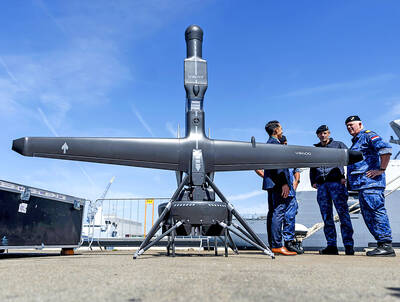
DEFENSE PROCUREMENT: Taiwan could become the largest operator of V-BAT drones outside the US once they are delivered, the Ministry of National Defense said The navy and the coast guard are acquiring 292 units of MQ-35A V-BAT vertical takeoff and landing (VTOL) surveillance drones manufactured by US-based defense technology company Shield AI, making Taiwan one of the largest buyers of the drone. The Coast Guard Administration budgeted NT$1.2 billion (US$37.1 million) to buy 12 drones, which have been delivered, Shield AI said in a report on Oct 13. The navy is planning to spend NT$36 billion under a four-year program code-named Project Yuan Xiao (遠鴞) to acquire 280 V-BAT drones, the Ministry of National Defense’s fiscal 2027 report showed. The combined procurement is expected
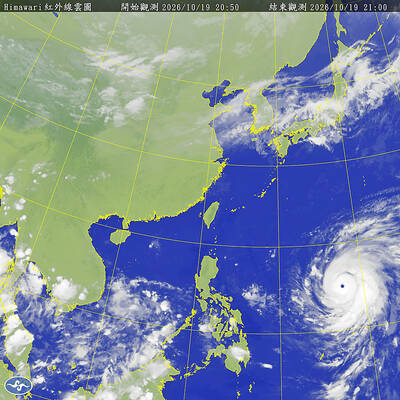
Typhoon Champi will turn northward earlier than previously forecast, sparing Taiwan a direct hit but still bringing heavy rain to the north of the country on Friday and Saturday, according to the Central Weather Administration (CWA). CWA forecaster Cheng Chieh-jen (鄭傑仁) said Typhoon Champi had strengthened and increased in size over the past 12 hours, and as of yesterday afternoon was packing sustained winds of 198 kilometers per hour near its center. Due to the weakening of a Pacific high-pressure system, however, the storm is now expected to turn northward earlier than initially

MAYORAL RACE: Su Chiao-hui made gains by persuading undecided voters and winning over voters in KMT-leaning districts, a pollster said Legislator Su Chiao-hui (蘇巧慧), the Democratic Progressive Party’s (DPP) candidate for New Taipei City mayor, has a 13.1 percentage point lead over her Chinese Nationalist Party (KMT) rival Lee Shu-chuan (李四川), a poll released yesterday showed. The poll, commissioned by the Taipei Trust in Democracy Association, showed that 43.1 percent of respondents said they would vote for Su, up 7.9 percentage points from a poll conducted in late August, while support for Lee was at 30 percent, down 4.7 percentage points. It showed that 48.6 percent of respondents thought Su would make a suitable mayor, compared with 35.9 percent for Lee. Independent candidate
A Chinese People's Liberation Army (PLA) Navy aircraft carrier group was being monitored after entering the western Pacific, the Ministry of National Defense said today, after Beijing yesterday criticized Taiwan for using a water cannon against a Chinese fishing boat near the Pratas Islands (Dongsha Islands, 東沙群島). A Chinese naval task group led by the aircraft carrier Liaoning (遼寧) yesterday sailed to the western Pacific for training, Chinese state-run Xinhua news agency quoted the PLA Navy as saying. “The drill is part of the annual routine training plan aimed at testing and improving the troops’ combat readiness and enhancing their ability to


 RSS
RSS