


The grand opening of the Taipei City Hall Bus Station will be delayed until next month, the Taipei City Government said, acknowledging that traffic would pose a challenges in the area after the station opens.
The bus station, located at the intersection of Zhongxiao E Road and Keelung Road, was initially scheduled to begin operating last month, a plan that was pushed back to this month before being delayed again.
Taipei City Department of Transportation Commissioner Lo Shiaw-shyan (羅孝賢) said the department and the operator, Uni-president Development Corp, were finalizing the details of the building and the bus routes, seeking to minimize the impact on area traffic when the bus station opens.
The intersection is one of the busiest in Taipei City.
The bus station is now scheduled to begin operations on Aug. 5. It will serve as a transportation hub for 14 bus companies, with services to Taoyuan, Hsinchu and Yilan.
The planning of the bus station dates back to when President Ma Ying-jeou (馬英九) was Taipei mayor 12 years ago. The city planned to build four major bus terminals in the city. The Taipei Bus Station on Chengde Road and Huayin Street was launched last year.
Two more bus terminals will be situated in the Muzha and Yuanshan areas.
While the city government said it was confident it would open the station on schedule, it said it was facing problems similar to those encountered when the Taipei Bus Station was opened, including heavy congestion in the area and concerns about operators making excess profits.
Chinese Nationalist Party (KMT) Taipei City Councilor Chen Yu-mei (陳玉梅) said the new bus station in Xinyi District also has a small terminal and waiting area. The station takes up about 2,400 ping (7,934m²) of the 43,000 ping building. The 31-story building also features a shopping mall, restaurants and a hotel, which are scheduled to open in October.
“The bus station occupies only 5.7 percent of the entire building, making it just a facility of the hotel and shopping mall. Controlling traffic and crowds in the area will be a great challenge for the station operators,” she said.
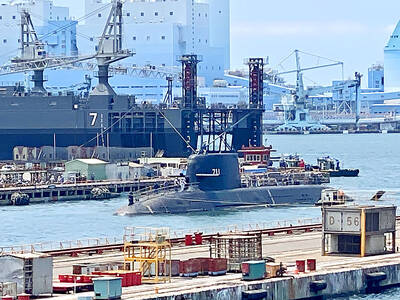
AGING: While Japan has 22 submarines, Taiwan only operates four, two of which were commissioned by the US in 1945 and 1946, and transferred to Taiwan in 1973 Taiwan would need at least 12 submarines to reach modern fleet capabilities, CSBC Corp, Taiwan chairman Chen Cheng-hung (陳政宏) said in an interview broadcast on Friday, citing a US assessment. CSBC is testing the nation’s first indigenous defense submarine, the Hai Kun (海鯤, Narwhal), which is scheduled to be delivered to the navy next month or in July. The Hai Kun has completed torpedo-firing tests and is scheduled to undergo overnight sea trials, Chen said on an SET TV military affairs program. Taiwan would require at least 12 submarines to establish a modern submarine force after assessing the nation’s operational environment and defense
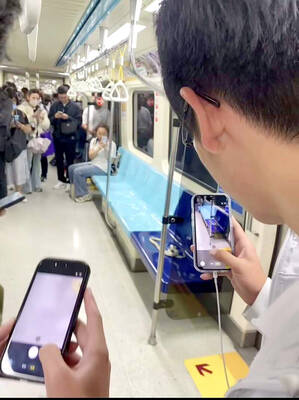
A white king snake that frightened passengers and caused a stir on a Taipei MRT train on Friday evening has been claimed by its owner, who would be fined, Taipei Rapid Transit Corp (TRTC) said yesterday. A person on Threads posted that he thought he was lucky to find an empty row of seats on Friday after boarding a train on the Bannan (Blue) Line, only to spot a white snake with black stripes after sitting down. Startled, he jumped up, he wrote, describing the encounter as “terrifying.” “Taipei’s rat control plan: Release snakes on the metro,” one person wrote in reply, referring
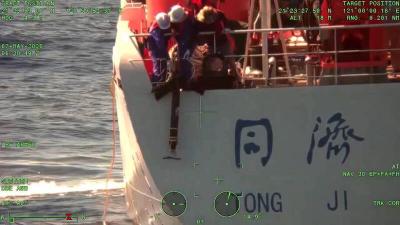
The coast guard today said that it had disrupted "illegal" operations by a Chinese research ship in waters close to the nation and driven it away, part of what Taipei sees a provocative pattern of China's stepped up maritime activities. The coast guard said that it on Thursday last week detected the Chinese ship Tongji (同濟號), which was commissioned only last year, 29 nautical miles (54km) southeast of the southern tip of Taiwan, although just outside restricted waters. The ship was observed lowering ropes into the water, suspected to be the deployment of scientific instruments for "illegal" survey operations, and the coast
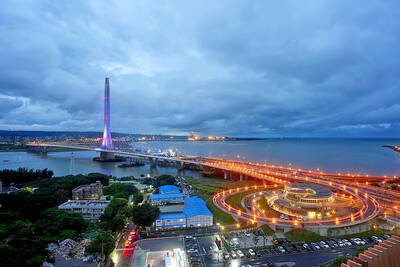
An inauguration ceremony was held yesterday for the Danjiang Bridge, the world’s longest single-mast asymmetric cable-stayed bridge, ahead of its official opening to traffic on Tuesday, marking a major milestone after nearly three decades of planning and construction. At the ceremony in New Taipei City attended by President William Lai (賴清德), Premier Cho Jung-tai (卓榮泰), Minister of Transportation and Communications Chen Shih-kai (陳世凱) and New Taipei City Mayor Hou Yu-ih (侯友宜), the bridge was hailed as both an engineering landmark and a long-awaited regional transport link connecting Tamsui (淡水) and Bali (八里)


 RSS
RSS