


Laughter and tears marked the first official reunion yesterday of former residents of Losheng Sanatorium and activists who rallied for its preservation, nearly two years after most of the buildings were demolished.
Losheng Sanatorium, located in Sinjhuang City (新莊), Taipei County, was built in the 1930s by the Japanese colonial government to isolate people with Hansen’s disease — also known as leprosy — because it was believed to be highly contagious and incurable.
A plan to demolish the sanatorium complex to make room for a mass rapid transit line met with opposition from groups who protested against the forced eviction of aged residents, many of whom had lived in the sanatorium for most of their lives.
Others considered the site an important relic of the nation’s public health history.
After about four years of campaigning to save Losheng, the government came up with a compromise plan that preserved about 41 percent of the buildings.
Despite continued opposition, demolition work went ahead in December 2008.
SAD
“I feel sad deep inside my heart seeing all we went through and how hard it was for us and for the student [activists] who were with us all the way,” Losheng resident Chou Fu-tzu (周富子) said, in tears, after watching a documentary on the long struggle to save the sanatorium.
“Many people misunderstood and criticized us. They should all watch this film, then they will know how things really were,” she said.
The film documented demonstrations and marches, as well as how police officers removed protesters and residents trying to prevent the razing of the buildings.
Many in the audience — residents and conservationists alike — shed tears during the showing.
Lan Tsai-yun (藍彩雲) was one of the last residents to be evicted on Dec. 3, 2008, and the dormitory where she had lived for most of her life was torn down the same day.
She said she was happy to see everyone again, but was saddened by the documentary.
“I’m very happy to see everyone coming back again. I always welcome you, because you’re like my children and grandchildren,” Lan said. “I’m not a good-looking person and I have a bad temper, but I’m grateful that so many people have given me so much love and support along the way.”
“We can’t do anything about what’s already gone, but what we should do now is insist the government maintain the remaining buildings properly — as it promised — so that whoever wants to come back to stay or visit can do so,” she said.
ENCOURAGEMENT
Many activists who were college students when they campaigned for Losheng returned yesterday, some with spouses or even children, to revisit the place and meet friends.
“I was one of the earliest members of the Youth Alliance for Losheng, but now I’m a middle-aged woman,” Chang Hsing-wen (張馨文) said. “I consider everyone family, so I would like to ask encourage you to share the major changes in their lives — whether you’re getting married, having a child, or are sick — with all of us.”
“Whatever becomes of you, remember what we fought for, and never give up what you believe in,” she said.

UPGRADE: The Kang Ding-class frigate is replacing its Chaparall missiles with Tien Chien II and Hua Yang VLS, which would provide it with long-range, 360° air defense Taiwan plans to produce 1,200 to 1,376 Hai Chien II missiles (海劍二, Sea Sword II) — also known as TC-2N — to serve as the standard air defense system of the navy’s surface combatant fleet, a source said yesterday. Last week, the Hai Chien II, the naval version of the Tien Kung II missile (天劍二, Sky Sword II), completed a live-fire test in waters off the National Chungshan Institute of Science and Technology’s Jiupeng facility (九鵬) in Pingtung County’s Manjhou Township (滿州). The MIM72 Chaparral and other dated air defense missiles that currently arm Taiwanese ships have inadequate range to combat Chinese

REASONS FOR TRAVEL: An assistant professor said that proposed amendments to penalize drivers if they used drugs overseas would not deter people from traveling People who operate a motor vehicle under the influence of marijuana would have their driver’s license revoked, even if they used the substance while overseas, the Ministry of Transportation and Communications said yesterday, citing proposed amendments to the Road Traffic Management and Penalty Act (道路交通管理處罰條例). The amendments would also authorize the government to revoke the licenses of people determined to have used Category 1 or Category 2 narcotics, even if they were not operating a vehicle while under the influence of drugs, as well as ban them from taking the license test for three years, the ministry said. People aged 18 or

HEAVY WEATHER: Typhoon Jangmi is due to crash straight into the Ryukyus as airlines look to shift flights to larger aircraft or cancel flights to Okinawa entirely Taiwan’s international air carriers announced flight adjustments over the weekend as Typhoon Jangmi is forecast to hit the Ryukyu Islands today and tomorrow. The Central Weather Administration (CWA) upgraded Jangmi from a tropical storm to a typhoon at 8am yesterday, with the eye located 580km south of Naha city. It was moving north at 19kph. Today, China Airlines’ CI-120, CI-121, CI-122 and CI-123 flights between Taoyuan and Naha, Okinawa, have been canceled as well as CI-132 and CI-133 between Kaohsiung and Naha. EVA Air’s BR-112, BR-113, BR-186 and BR-185 flights between Taoyuan and Naha are also canceled. Low-cost carrier Tigerair Taiwan canceled IT-230,
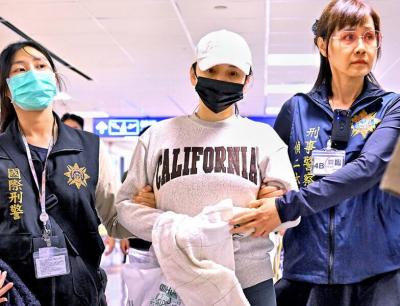
Johanne Liou (劉喬安), a Taiwanese woman who shot to unwanted fame during the Sunflower movement protests in 2014, returned to Taiwan last night after being deported from the US. She is to stand trial in Taiwan for charges involving embezzlement, fraud and drug crimes. The Criminal Investigation Bureau (CIB) said it took her into custody at Taiwan Taoyuan International Airport and would first question her before transferring her to the New Taipei District Prosecutors’ Office. She was arrested upon disembarking a flight from San Francisco that landed shortly before 7pm. Liou absconded to the US in 2019 after jumping bail


 RSS
RSS