


The debate over a controversial trade pact Taipei intends to sign with China entered the classroom yesterday, as students from nine universities met to debate whether the government should move to sign the agreement.
The event, held at National Taiwan University (NTU) by the pro-independence Northern Taiwan Society, saw students raise concerns that an economic cooperation framework agreement (ECFA) with China could have a negative impact on their future career prospects and more fragile Taiwanese industries.
A debate team led by Lin Yu-lun (林于倫), a student of Chinese literature at NTU, said the issue was polarized because the Chinese Nationalist Party (KMT) government had yet to fully reveal the details on an ECFA and how it would affect Taiwan’s economy.
Other students — the vast majority of whom opposed an ECFA — called on more people to rally in support of a referendum on the agreement, saying the public deserved a say on what they said was an important instrument of national policy.
A student from the Minghsin University of Science and Technology said that as “[an ECFA] will not benefit the public and instead could harm Taiwanese [interests], people should take to the streets in support of a referendum.”
DELEGATIONS
The more than a dozen university delegates included representatives from as far away as Kaohsiung, with students from the Kaohsiung Medical University and I-Shou University.
A number of high school students and university alumni associations were also in the audience.
This was the second student debate organized by the Taiwan Society North on an ECFA, which it opposes on the grounds that an influx of cheaper competing goods from China would have an adverse effect on Taiwanese jobs and salaries.
The organization has also raised concerns that the agreement could increase Taiwan’s economic dependence on China, which it maintains could have dangerous political side effects.
President Ma Ying-jeou (馬英九) and Premier Wu Den-yih (吳敦義) have called the agreement “essential,” saying it would boost Taiwan’s economic growth, create jobs and increase the likelihood of Taiwan signing free-trade agreements with other trade partners.
FOREIGN VIEWS
The topic of whether Taiwan should sign an ECFA with China also attracted the interest of foreign students studying in Taiwan, who took part in a separate event that began on Saturday.
A team made up of four students from NTU’s International Chinese Language Program has signed up for a three-day debate among political science majors from universities nationwide.
The inter-school debate is usually held annually.
National Chengchi University (NCCU) is the organizer of this year’s debate, in which teams will argue on whether Taiwan should sign a trade pact with China.
Asked why he signed up for the activity, Jeffrey Hartsough of the US said in Mandarin he did so because an ECFA is “a very significant issue that concerns the future of a country.”
Hartsough said that while having ordinary conversations in Mandarin is easy, debating in Mandarin can be challenging. As a result, he has been practicing with his classmates for several weeks.
The debate, which concludes today, attracted students from NTU, NCCU, Soochow University and Tamkang University, as well as the Republic of China Military Academy, which is participating for the first time and sent three teams.
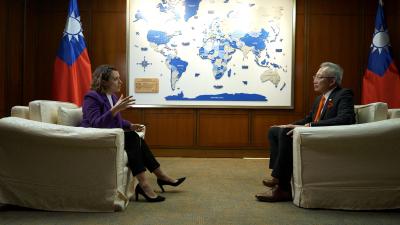
“China is preparing to invade Taiwan,” Deputy Minister of Foreign Affairs Francois Wu (吳志中) said in an exclusive interview with British media channel Sky News for a special report titled, “Is Taiwan ready for a Chinese invasion?” the Ministry of Foreign Affairs said today in a statement. The 25-minute-long special report by Helen Ann-Smith released yesterday saw Sky News travel to Penghu, Taoyuan and Taipei to discuss the possibility of a Chinese invasion and how Taiwan is preparing for an attack. The film observed emergency response drills, interviewed baseball fans at the Taipei Dome on their views of US President
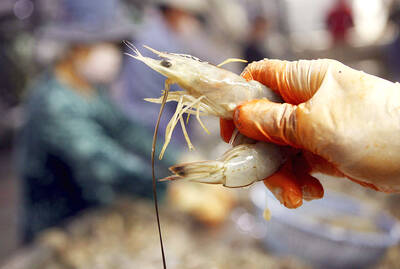
ECONOMIC BENEFITS: The imports from Belize would replace those from Honduras, whose shrimp exports have dropped 67 percent since cutting ties in 2023 Maintaining ties with Taiwan has economic benefits, Ministry of Foreign Affairs officials said yesterday, citing the approval of frozen whiteleg shrimp imports from Belize by the Food and Drug Administration (FDA) as an example. The FDA on Wednesday approved the tariff-free imports from Belize after the whiteleg shrimp passed the Systematic Inspection of Imported Food, which would continue to boost mutual trade, the ministry said. Taiwan’s annual consumption of whiteleg shrimps stands at 30,000 tonnes, far exceeding domestic production, the ministry said. Taiwan used to fill the gap by importing shrimps from Honduras, but purchases slumped after Tegucigalpa severed diplomatic ties with Taiwan
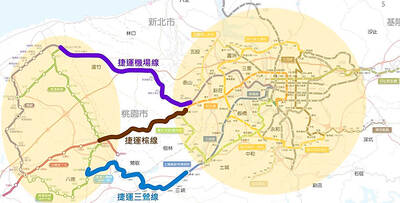
The Executive Yuan yesterday approved a southwestern extension of the Sanying MRT Line from New Taipei to Bade District (八德) in Taoyuan, with a goal of starting construction by late 2026. The 4.03-kilometer extension, featuring three new stations, will run from the current terminus at Yingtao Fude Station (LB12) in New Taipei City to Dannan Station (LB14), where it will connect with Taoyuan’s Green Line, New Taipei City Metro Corp said in a statement. This extension will follow the completion of core Sanying Line, a 14.29-kilometer medium-capacity system linking Tucheng (土城), Sansia (三峽)
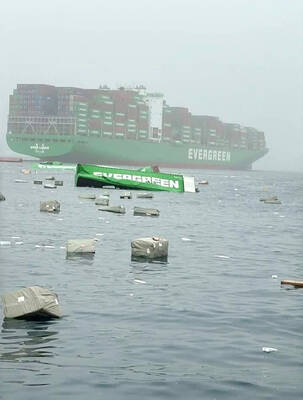
CARGO LOSS: About 50 containers at the stern of the ‘Ever Lunar’ cargo ship went overboard, prompting the temporary closure of the port and disrupting operations Evergreen Marine Corp, Taiwan’s largest container shipper, yesterday said that all crew members aboard the Ever Lunar (長月) were safe after dozens of containers fell overboard off the coast of Peru the previous day. The incident occurred at 9:40am on Friday as the Ever Lunar was anchored and waiting to enter the Port of Callao when it suddenly experienced severe rolling, Evergreen said in a statement. The rolling, which caused the containers to fall, might have been caused by factors including a tsunami triggered by an earthquake in Russia, poor winter sea conditions in South America or a sudden influx of waves,


 RSS
RSS