


Growing up in Taipei’s Beitou (北投), once famous for its lion dancing, Hong Lai-wang (洪來旺) was introduced to lion dancing and lion head making at the age of nine, and grew up to become a renowned lion head maker whose work can be found in almost all lion dance shows in northern Taiwan.
Having made more than 8,000 lion heads in his life, Hong, now 96 years old, is still not considering retirement after passing on his skills to his son. The lion head he is working on now will be used in a lion head performance at the Republic of China centennial celebrations.
“A lion head takes at least one month to make, and the procedure is extremely complicated. We want him to get more rest, but my father just forgets to eat once he sits down and starts molding a lion head,” Hong’s son Wen-ding (洪文定) said.
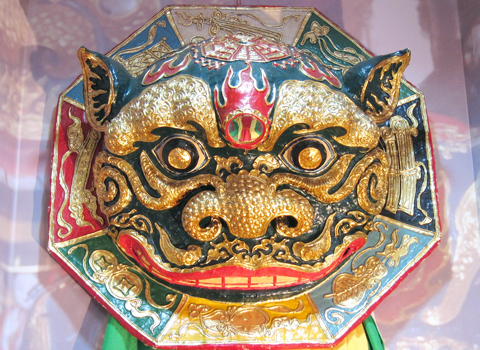
PHOTO: MO YAN-CHIH, TAIPEI TIMES
Recognizing his dedication and persistence in preserving the disappearing craft, the Taipei City Government presented him with a Taipei City Master of Traditional Arts Award last week.
Hong Lai-wang mastered the making of the so-called “Taiwan lion heads,” which differ in style from the Guangdong-style lion heads. Taiwan lion heads are very colorful, and have large eyes, a mirror on their forehead and horns, while Guangdong-style lion heads are decorated with fur around the eyes and the forehead.
Over objections from his family, Hong Lai-wang insisted on learning the craft from an old master in Beitou. He made a living by making molds of teeth after leaving school at 18, but continued to practice making lion heads.
He has also played a significant role in promoting the heritage of the lion dance, and was influential in its development in northern Taiwan. He established a reputation in the folk arts community as the “father of Taiwanese lion dancing” for incorporating martial arts in lion dancing performances.
He never gave up his passion for the lion dance and lion head making despite repression of traditional folk arts during the White Terror era under the former Chinese Nationalist Party (KMT) regime, and established a lion dance troupe in 1955 to perform lion dances at temple fairs and celebrations.
As one of the few masters who still handcrafts lion heads in Taiwan, Hong Lai-wang said the most important part of making a lion head was shaping the mold by hand, which determines the appearance of the work.
The remaining steps, from pasting small pieces of white cloth on the mold to create layers, covering it with gold foil and painting it, required patience, skill and attention to detail, he said.
The works of Hong Lai-wang incorporate religious elements, including clouds, fire and the eight trigrams, which represent peace, power and harmony. The lion heads he has made are popular not only among lion dance troupes. Many people display his works in their offices and homes to bring good fortune and guard against evil spirits.
When asked what distinguishes his father’s works from others, Hong Wen-ding said his father’s works keep to the traditional form.
The master, however, gave a different answer.
“People like the lion heads I made because they are just more beautiful,” he said.
In 2006, he and his son established the Taiwan Lion Folkways Art Development Association to promote folk art, giving lessons in lion dance and lion head making at schools and communities.
Influenced by their father, Hong Lai-wang’s two daughters also perform and teach lion dance. His grandson is interested in the “family business,” and wants to become a third-generation lion dance master.
“Lion dance and lion head manufacture are my father’s passions and life-long profession. It is his wish and our obligation to pass on the heritage and preserve the folk art,” Hong Wen-ding said.

Considering that most countries issue more than five denominations of banknotes, the central bank has decided to redesign all five denominations, the bank said as it prepares for the first major overhaul of the banknotes in more than 24 years. Central bank Governor Yang Chin-lung (楊金龍) is expected to report to the Legislative Yuan today on the bank’s operations and the redesign’s progress. The bank in a report sent to the legislature ahead of today’s meeting said it had commissioned a survey on the public’s preferences. Survey results showed that NT$100 and NT$1,000 banknotes are the most commonly used, while NT$200 and NT$2,000

The Centers for Disease Control (CDC) yesterday reported the first case of a new COVID-19 subvariant — BA.3.2 — in a 10-year-old Singaporean girl who had a fever upon arrival in Taiwan and tested positive for the disease. The girl left Taiwan on March 20 and the case did not have a direct impact on the local community, it said. The WHO added the BA.3.2 strain to its list of Variants Under Monitoring in December last year, but this was the first imported case of the COVID-19 variant in Taiwan, CDC Deputy Director-General Lin Ming-cheng (林明誠) said. The girl arrived in Taiwan on

South Korea is planning to revise its controversial electronic arrival card, a step Taiwanese officials said prompted them to hold off on planned retaliatory measures, a South Korean media report said yesterday. A Yonhap News Agency report said that the South Korean Ministry of Foreign Affairs is planning to remove the “previous departure place” and “next destination” fields from its e-arrival card system. The plan, reached after interagency consultations, is under review and aims to simplify entry procedures and align the electronic form with the paper version, a South Korean ministry official said. The fields — which appeared only on the electronic form

The Ministry of Foreign Affairs (MOFA) is suspending retaliation measures against South Korea that were set to take effect tomorrow, after Seoul said it is updating its e-arrival system, MOFA said today. The measures were to be a new round of retaliation after Taiwan on March 1 changed South Korea's designation on government-issued alien resident certificates held by South Korean nationals to "South Korea” from the "Republic of Korea," the country’s official name. The move came after months of protests to Seoul over its listing of Taiwan as "China (Taiwan)" in dropdown menus on its new online immigration entry system. MOFA last week


 RSS
RSS