


Anti-dam protesters from central and southern Taiwan yesterday urged the government to stop all work on new reservoirs in their hometowns, saying construction would cause irreversible damage to the local ecosystem.
“What we are asking from the government is the chance to survive. All we want to do is protect our homeland and families from flooding and other catastrophes,” said Lai Mei-ching (賴美清), a longtime resident of Jianshih Township (尖石) in Hsinchu County and a member of the Atayal tribe.
Lai said the government's plan to build Bilin Reservoir (比麟水庫) and Kaotai Reservoir (高台水庫) means that more than 5,000 villagers, including her family, would be forcibly relocated.
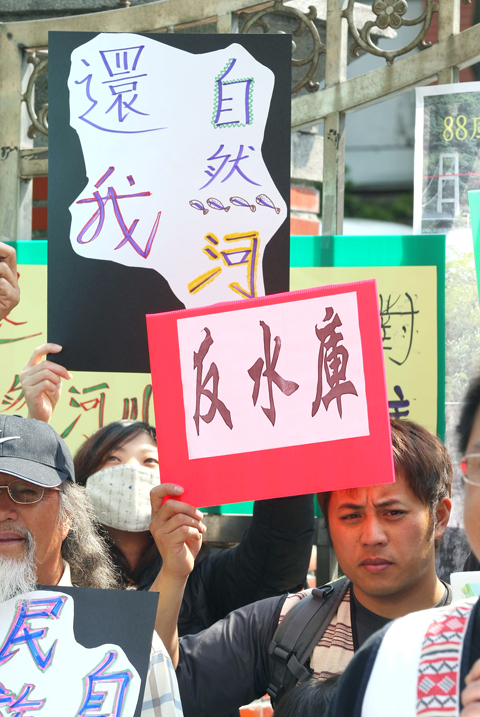
PHOTO: CNA
She said construction would also have a negative impact on the local landscape.
In addition, she said, local residents would not reap any benefit from the two reservoirs because they would cater only to the water needs of the Hsinchu Science Park.
Anti-Pingsi Dam Alliance president Lin Seng-jen (林森仁) said the government would not need to spend billions of dollars building dams if it fixed other problems, such as leakage.
Lin said the global average of water loss between reservoirs and household taps was 18 percent. However, in Taiwan, this was significantly higher at 22 percent. Keelung City, in particular, suffers a loss of about 37 percent.
If the water company spent a fraction of the money intended for these projects fixing the leakage problem, it would not have to construct a dam that will put local residents at risk of flooding and mudslides if another storm like Typhoon Morakot — which killed more than 500 people in the south Taiwan last August — hits the nation, he said.

Three passengers and the assailant were reportedly injured in a knife attack on the Taichung MRT on Tuesday. The Rapid Transit Brigade of the Taichung Police Department is still investigating the incident, with no motive immediately apparent. Taichung Police Commissioner Lee Wen-chang (李文章) said that at least four people were injured in the attack, and the suspect has been taken into custody. The incident occurred at about 11:15am on a train car near Taichung City Hall Station. Witnesses reported seeing a man attacking others with a knife, while other passengers tried to grab his hair or fend him off with umbrellas. Three people were reportedly

‘OBNOXIOUS MAN’: The KMT’s Chen Ching-hui moved into Chung Chia-pin’s path atop the podium and reached for him before he grabbed at her legs with both hands Democratic Progressive Party Legislator Chung Chia-pin (鍾佳濱) yesterday said he slipped and lost his balance, and did not know who was around him, after jumping onto the speaker’s podium at the legislature in Taipei. He apologized after a collision with Chinese Nationalist Party (KMT) Legislator Chen Ching-hui (陳菁徽), who moved to intercept him as he mounted the podium. There was pushing and shoving when the session started in the morning as KMT lawmakers attempted to block access to the podium to shield Legislative Speaker Han Kuo-yu (韓國瑜) so he could preside over the session. Video footage showed Chung step on a chair and

While it is common to see bumper stickers informing other drivers about important information, such as “baby on board” or “rookie driver,” some motorist in Taiwan are using creative statements to warn other drivers to keep a safe distance to avoid a collision. A photograph recently circulating on the Internet showed a van in Changhua City with a bumper sticker saying that the driver received their license after taking the test three times, so it is dangerous to drive close to the vehicle. The person who took the photograph said all vehicles behind the van appeared to “subconsciously” maintaining a safe distance. Some

Taipei police on Saturday arrested 24 female Thai tourists on suspicion of working as hostesses and engaging in illegal activities at an underground bar in Zhongshan District (中山), the distict’s police precinct said in a statement yesterday. The police also arrested five other people involved in the operation, including the 29-year-old bar owner surnamed Chiang (蔣), and 17 customers, the statement said. The 24 Thai women were fined an undisclosed amount in accordance with the Social Order Maintenance Act (社會秩序維護法) by the police and transferred to a National Immigration Agency (NIA) special brigade in Taipei for repatriation to Thailand. The cases of


 RSS
RSS