


Three Atayal men accused of theft in the landmark Zelkova tree case were acquitted yesterday after a legal battle lasting more than four years.
In October 2005, police arrested the three men from the Atayal village of Smangus (司馬庫斯) in Hsinchu County and charged them with theft for transporting part of a Zelkova tree felled by a typhoon that was blocking the road connecting their community to the outside.
The decision to remove the tree and bring it back to the village to be carved into a piece of artwork was made communally by the village's council.
The three men pleaded not guilty to the charges, saying they were only executing the village council's decision to remove the tree and bring it back to the village to be carved into a work of art.
They said they also believed that the community had the right to decide what to do with the tree as it had fallen within its traditional domain, in accordance with the Aboriginal Basic Act (原住民族基本法).
“I was very upset about being charged, and think it's very unfair,” Amin Yosow, one of the three men, told the Taipei Times outside the Taiwan High Court after the verdict.
“I kept telling the judge that I didn't agree it was theft because I was following a council decision, especially when I wasn't even taking the tree home for myself,” he said.
However, while the Aboriginal law allows Aborigines to gather items from nature for daily non-commercial use within their traditional domain, the law does not define the boundaries of “Aboriginal traditional domains.”
To help the three men, the Council of Indigenous Peoples quickly declared areas surrounding Smangus a traditional Atayal domain.
But this failed to work, and they were each sentenced to six months in prison and a fine of NT$160,000 in 2007.
The three appealed for help from Aboriginal rights activists and other Smangus villagers. Finally, the High Court ordered a re-examination of the case last year based on the reasoning that Aboriginal culture should be respected.
It was on the same grounds that the Taiwan High Court declared the three defendants not guilty.
“We thank all our friends for helping us in our hard-fought legal battle over the past four years, and we are happy that justice has finally been done,” Smangus chief Icyeh Sulong said in Atayal at a brief press conference outside the courthouse.
“We're also happy to see that the [judicial] authorities are able to respect the tradition, culture and autonomy of Aborigines — which has been passed down from generation to generation over thousands of years,” he said.
Thomas Chan (詹順貴), defense attorney and a member of the Legal Aid Foundation, called the verdict a “belated victory” and urged the prosecutor not to file an appeal.
Although he felt relieved at the verdict, Amin said he was worried that not all Aborigines would be so fortunate as to have their cases reviewed by judges who respect Aboriginal culture.
“Although we have the Aboriginal Basic Act, which establishes the framework for protecting Aboriginal rights, we don't have related subordinate laws that lay out the details,” he said. “Only when the subordinate laws are all adopted can we be fully relieved.”


UPGRADE: The Kang Ding-class frigate is replacing its Chaparall missiles with Tien Chien II and Hua Yang VLS, which would provide it with long-range, 360° air defense Taiwan plans to produce 1,200 to 1,376 Hai Chien II missiles (海劍二, Sea Sword II) — also known as TC-2N — to serve as the standard air defense system of the navy’s surface combatant fleet, a source said yesterday. Last week, the Hai Chien II, the naval version of the Tien Kung II missile (天劍二, Sky Sword II), completed a live-fire test in waters off the National Chungshan Institute of Science and Technology’s Jiupeng facility (九鵬) in Pingtung County’s Manjhou Township (滿州). The MIM72 Chaparral and other dated air defense missiles that currently arm Taiwanese ships have inadequate range to combat Chinese

REASONS FOR TRAVEL: An assistant professor said that proposed amendments to penalize drivers if they used drugs overseas would not deter people from traveling People who operate a motor vehicle under the influence of marijuana would have their driver’s license revoked, even if they used the substance while overseas, the Ministry of Transportation and Communications said yesterday, citing proposed amendments to the Road Traffic Management and Penalty Act (道路交通管理處罰條例). The amendments would also authorize the government to revoke the licenses of people determined to have used Category 1 or Category 2 narcotics, even if they were not operating a vehicle while under the influence of drugs, as well as ban them from taking the license test for three years, the ministry said. People aged 18 or
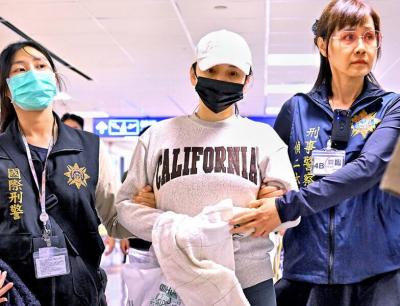
Johanne Liou (劉喬安), a Taiwanese woman who shot to unwanted fame during the Sunflower movement protests in 2014, returned to Taiwan last night after being deported from the US. She is to stand trial in Taiwan for charges involving embezzlement, fraud and drug crimes. The Criminal Investigation Bureau (CIB) said it took her into custody at Taiwan Taoyuan International Airport and would first question her before transferring her to the New Taipei District Prosecutors’ Office. She was arrested upon disembarking a flight from San Francisco that landed shortly before 7pm. Liou absconded to the US in 2019 after jumping bail

Shih Hsin University President Chen Ching-he (陳清河) yesterday issued a public apology for comments made in his commencement speech last week, stating that he has asked the school to suspend his duties and halt his wages for two months as a show of contrition. At the commencement ceremony on May 30, Chen said, “If you don’t manage your time well, or your own emotions, or your health, then I am telling every one of you — put a quick end to ‘you,’ because the world has no need for ‘you.’” The comments have sparked significant controversy online, and Chen through an open


 RSS
RSS