


Two companies are under investigation by Kaohsiung City prosecutors for allegedly selling large amounts of activated carbon — a compound used to absorb dioxin emissions in waste incineration — that was of an inferior quality.
Prosecutors said Pingtung-based Li Jing Viscarb Co and Wel Han Environmental Industrial Co supplied material to incinerators that did not fulfill legal requirements and which led to dangerous fumes containing heavy chemical and metal compounds being released into the atmosphere.
The two companies appear to be run by the same owner and share an office together in Neipu Industrial Zone, Pingtung County.
Activated carbon, derived from charcoal, is processed to give it absorption qualities that allow it to trap dangerous compounds.
Prosecutors allege that the companies have been supplying inferior material which only contains iodine levels of 300 milligrams per gram, while packaging it as more expensive activated carbon that can contain up to 900 milligrams per gram and which fulfills legal requirements.
Kaohsiung City prosecutor Chou Chang-you (周昶佑) said yesterday that the company had deceived spot checks conducted by municipal authorities by creating a false compartment in the storage areas of its delivery trucks.
“If you open [the compartment] to take a sample, all the material inside fulfills regulations, but the material delivered to the incinerators does not,” Chou said.
According to documents filed with prosecutors, the company has been supplying 20 publicly and privately-owned garbage incinerators for more than six years. Because of the inferior quality of the material supplied, prosecutors fear that large amounts of dangerous chemicals, including dioxins, have been pumped unchecked into the air.
Dioxins have been blamed for causing a wide range of illnesses, including liver problems in the short-term, as well as the impairment of immune, neurological and reproductive systems over longer periods, a WHO report showed.
Last August, more than 9,000 dioxin-contaminated ducks were culled at a Kaohsiung County farm situated on the site of a former landfill. The land was found to be tainted with dioxins from dumped steel-mill slag.
Speaking to reporters yesterday, however, company representative Chen Jun-ming (陳俊明) showed reports of tests conducted by the non-profit Industrial Technology Research Institute which state the material tested met the regulations.
Chen said his company had never sold inferior activated carbon or attempted to deceive investigators.
In response to reports of secret compartments found in the company’s delivery trucks, Chen said the material was transported directly from the manufacturer to the end-users in sealed containers, making allegations of tampering baseless.
Operators of garbage incinerators involved said yesterday that repeated tests on discharged fumes showed that dioxin levels were below regulations.
Chiang Chun-hsiang (江俊卿), operator of a plant in Taipei County, said the company had always supplied activated carbon that was within regulations.
Prosecutors said three company officials were detained yesterday and had been charged with fraud, making false statements and violating the Waste Disposal Act (廢棄物清理法).
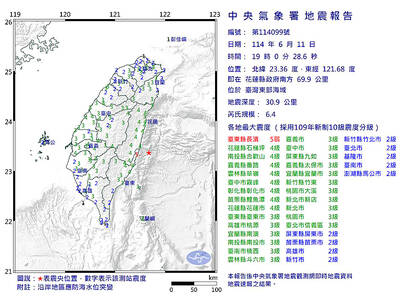
A magnitude 6.4 earthquake struck off the coast of Hualien County in eastern Taiwan at 7pm yesterday, the Central Weather Administration (CWA) said. The epicenter of the temblor was at sea, about 69.9km south of Hualien County Hall, at a depth of 30.9km, it said. There were no immediate reports of damage resulting from the quake. The earthquake’s intensity, which gauges the actual effect of a temblor, was highest in Taitung County’s Changbin Township (長濱), where it measured 5 on Taiwan’s seven-tier intensity scale. The quake also measured an intensity of 4 in Hualien, Nantou, Chiayi, Yunlin, Changhua and Miaoli counties, as well as

Credit departments of farmers’ and fishers’ associations blocked a total of more than NT$180 million (US$6.01 million) from being lost to scams last year, National Police Agency (NPA) data showed. The Agricultural Finance Agency (AFA) said last week that staff of farmers’ and fishers’ associations’ credit departments are required to implement fraud prevention measures when they serve clients at the counter. They would ask clients about personal financial management activities whenever they suspect there might be a fraud situation, and would immediately report the incident to local authorities, which would send police officers to the site to help, it said. NPA data showed
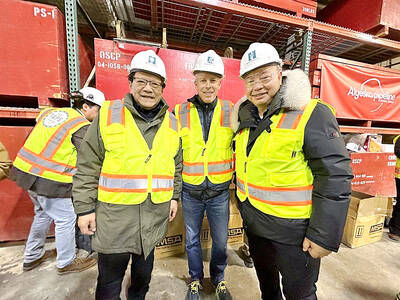
ENERGY RESILIENCE: Although Alaska is open for investments, Taiwan is sourcing its gas from the Middle East, and the sea routes carry risks, Ho Cheng-hui said US government officials’ high-profile reception of a Taiwanese representative at the Alaska Sustainable Energy Conference indicated the emergence of an Indo-Pacific energy resilience alliance, an academic said. Presidential Office Secretary-General Pan Men-an (潘孟安) attended the conference in Alaska on Thursday last week at the invitation of the US government. Pan visited oil and gas facilities with senior US officials, including US Secretary of the Interior Doug Burgum, US Secretary of Energy Chris Wright, Alaska Governor Mike Dunleavy and US Senator Daniel Sullivan. Pan attending the conference on behalf of President William Lai (賴清德) shows a significant elevation in diplomatic representation,

The Taipei City Reserve Command yesterday initiated its first-ever 14-day recall of some of the city’s civilian service reservists, who are to undergo additional training on top of refresher courses. The command said that it rented sites in Neihu District (內湖), including the Taipei Tennis Center, for the duration of the camp to optimize tactical positioning and accommodate the size of the battalion of reservists. A battalion is made up of four companies of more than 200 reservists each, it said. Aside from shooting drills at a range in New Taipei City’s Linkou District (林口), the remainder of the training would be at


 RSS
RSS