


Bureaucratic red tape has been known to cause annoyance for many people, but for 51-year-old Lai Ming-teh (賴明德) it has meant being stuck in a non-marriage for more than a decade.
A former fisherman from Pingtung County, Lai married a South African woman 10 years ago on a fishing trip to the country. The couple got married in Cape Town in April 1996 and registered their marriage in South Africa.
Lai said because of his lack of legal knowledge, when he brought his bride back to Taiwan he only registered her as his legal spouse with his local household registration office. He did not apply for permanent residency or start his wife on the naturalization process.
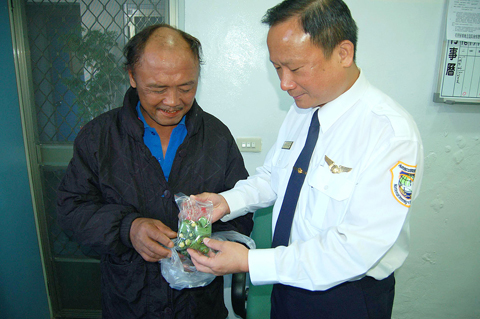
PHOTO: LEE LI-FA, TAIPEI TIMES
Seven months after they returned to Taiwan, Lai’s wife went back to South Africa and he has since lost contact with her.
In the last 10 years, Lai has sought various ways to file for a divorce, but because of a lack of paperwork and without the consent of the wife, the courts have been reluctant to grant it to him.
Lai’s married status, to a woman still of a legally recognized working age, has disqualified him from receiving low-income subsidies despite his being unemployed for a long period of time.
The illiterate Lai said he thought about going to South Africa to look for his wife, but when he called his wife’s home, the number had been disconnected.
Many people have encouraged Lai to remarry, but that is also impossible as according to government records he is still legally married.
The court has not been able to serve his wife legal papers because Lai was not able to provide a current address.
An immigration officer helped him by seeking assistance from the Bureau of Consular Affairs (BOCA) to retrieve the documents his wife used when she entered the country in 1996, but after six months of waiting, BOCA said it was not able to help because Lai’s case was not a consular affair.
As the household registration office requires little information from foreign nationals married to Taiwanese, this often presents difficulties for people wanting to file for divorce.
The Pingtung office said although the law requires foreign nationals who want to marry a Taiwanese citizen to present a wedding certificate notarized by a Republic of China embassy or representative office of the country in which they were married, many neglected to do so.
Many people only fill in the name, age and nationality of their spouse, but neglect to provide other information.
Even if the paperwork has been filled out completely, it was still difficult to verify the information, the office said.
Liao Wen-chung (賴文忠) of the Pingtung Family Court said there have been cases where a husband has successfully divorced his wife while she was living abroad because the court failed to verify her address overseas, which resulted in her not receiving a summons.
Liao said in Lai’s case, the judge was not able to grant a divorce, but if the related government agencies exhausted all means of finding his wife, the judge could “compassionately” end his marriage.

Considering that most countries issue more than five denominations of banknotes, the central bank has decided to redesign all five denominations, the bank said as it prepares for the first major overhaul of the banknotes in more than 24 years. Central bank Governor Yang Chin-lung (楊金龍) is expected to report to the Legislative Yuan today on the bank’s operations and the redesign’s progress. The bank in a report sent to the legislature ahead of today’s meeting said it had commissioned a survey on the public’s preferences. Survey results showed that NT$100 and NT$1,000 banknotes are the most commonly used, while NT$200 and NT$2,000

The Centers for Disease Control (CDC) yesterday reported the first case of a new COVID-19 subvariant — BA.3.2 — in a 10-year-old Singaporean girl who had a fever upon arrival in Taiwan and tested positive for the disease. The girl left Taiwan on March 20 and the case did not have a direct impact on the local community, it said. The WHO added the BA.3.2 strain to its list of Variants Under Monitoring in December last year, but this was the first imported case of the COVID-19 variant in Taiwan, CDC Deputy Director-General Lin Ming-cheng (林明誠) said. The girl arrived in Taiwan on

South Korea is planning to revise its controversial electronic arrival card, a step Taiwanese officials said prompted them to hold off on planned retaliatory measures, a South Korean media report said yesterday. A Yonhap News Agency report said that the South Korean Ministry of Foreign Affairs is planning to remove the “previous departure place” and “next destination” fields from its e-arrival card system. The plan, reached after interagency consultations, is under review and aims to simplify entry procedures and align the electronic form with the paper version, a South Korean ministry official said. The fields — which appeared only on the electronic form

The Ministry of Foreign Affairs (MOFA) is suspending retaliation measures against South Korea that were set to take effect tomorrow, after Seoul said it is updating its e-arrival system, MOFA said today. The measures were to be a new round of retaliation after Taiwan on March 1 changed South Korea's designation on government-issued alien resident certificates held by South Korean nationals to "South Korea” from the "Republic of Korea," the country’s official name. The move came after months of protests to Seoul over its listing of Taiwan as "China (Taiwan)" in dropdown menus on its new online immigration entry system. MOFA last week


 RSS
RSS