


Chinese Nationalist Party (KMT) Chairman Ma Ying-jeou’s (馬英九) absence from the KMT’s latest campaign commercial for the mayor and county commissioner elections next month reflects Ma’s plummeting popularity with party candidates and the central government’s poor performance, analysts said.
The KMT unveiled its first campaign commercial on Friday to promote its candidates. However, Ma, who in the past had appeared in almost all KMT campaign commercials, was not featured.
KMT spokesman Lee Chien-jung (李建榮) dismissed concerns about Ma’s absence, adding that the party’s 18 candidates were the protagonists in the upcoming elections.
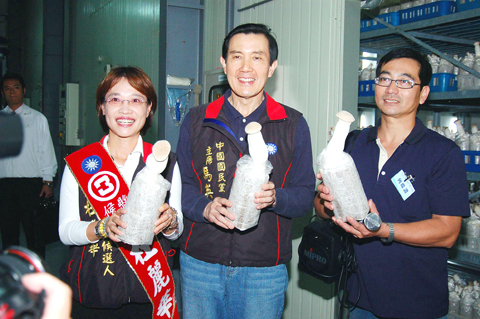
PHOTO: HUA MENG-CHING, TAIPEI TIMES
Premier Wu Den-yih (吳敦義) joined Lee in brushing off speculation that Ma’s low support rate as president made the party hesitate to use him in the ads, adding that the election of local government heads should not reflect the public’s view of Ma’s national policies.
Political commentators, however, said Ma’s absence from the commercial highlighted the KMT’s attempts to separate Ma from party candidates and to prevent the government’s performance from affecting the elections.
“The upcoming elections are the first major elections Ma will be facing as president and KMT chairman, and of course this is an important test for him,” said Wang Yeh-lih (王業立), a political science professor at National Taiwan University.
The KMT’s decision not to include Ma in the first campaign commercial for the Dec. 5 elections indicated a decline in Ma’s popularity amid the government’s poor handling of a number of items, including Typhoon Morakot and the relaxation of restrictions on imports of US beef, he said.
Ma’s popularity dropped to a record-low of 16 percent in August after the government was severely criticized for its slow response in the aftermath of Morakot.
A survey released on Friday by the Global Views monthly magazine showed that a majority of Taiwanese have more trust in US President Barack Obama than in Ma, with only 38.6 percent of respondents giving their trust to Ma, while Obama enjoyed a 46.1 percent trust rate.
Ma’s plummeting support rate as president has also cost him popularity within the party, as many local candidates took down posters or billboards featuring them with Ma.
Wang Kun-yi (王崑義), a professor at National Taiwan Ocean University, said former health minister Yeh Ching-chuan’s (葉金川) defeat in the party’s Hualien County commissioner primary in October and the KMT’s crushing defeat in the Yunlin legislative by-election were both warnings to the KMT that it should not count on Ma alone in the election campaigns, although he had led the party to win elections in the past.
He said it was no surprise that the KMT tried to downplay Ma’s role in the elections this time around, but separating Ma from local candidates would have limited effect because many voters viewed the elections as a chance to cast a vote of confidence on Ma and his Cabinet.
Dismissing Wu’s comments that local factions had a great impact on local elections and that they were not a midterm exam for Ma and his Cabinet, Yang Tai-shun (楊泰順), a political science professor at Chinese Culture University, said Ma was behind the party’s nomination of candidates in several cities and counties including Hualien, Hsinchu and Taitung, and his leadership in the party will be challenged if the KMT lost in those places.

Considering that most countries issue more than five denominations of banknotes, the central bank has decided to redesign all five denominations, the bank said as it prepares for the first major overhaul of the banknotes in more than 24 years. Central bank Governor Yang Chin-lung (楊金龍) is expected to report to the Legislative Yuan today on the bank’s operations and the redesign’s progress. The bank in a report sent to the legislature ahead of today’s meeting said it had commissioned a survey on the public’s preferences. Survey results showed that NT$100 and NT$1,000 banknotes are the most commonly used, while NT$200 and NT$2,000

The Centers for Disease Control (CDC) yesterday reported the first case of a new COVID-19 subvariant — BA.3.2 — in a 10-year-old Singaporean girl who had a fever upon arrival in Taiwan and tested positive for the disease. The girl left Taiwan on March 20 and the case did not have a direct impact on the local community, it said. The WHO added the BA.3.2 strain to its list of Variants Under Monitoring in December last year, but this was the first imported case of the COVID-19 variant in Taiwan, CDC Deputy Director-General Lin Ming-cheng (林明誠) said. The girl arrived in Taiwan on

South Korea is planning to revise its controversial electronic arrival card, a step Taiwanese officials said prompted them to hold off on planned retaliatory measures, a South Korean media report said yesterday. A Yonhap News Agency report said that the South Korean Ministry of Foreign Affairs is planning to remove the “previous departure place” and “next destination” fields from its e-arrival card system. The plan, reached after interagency consultations, is under review and aims to simplify entry procedures and align the electronic form with the paper version, a South Korean ministry official said. The fields — which appeared only on the electronic form

The Ministry of Foreign Affairs (MOFA) is suspending retaliation measures against South Korea that were set to take effect tomorrow, after Seoul said it is updating its e-arrival system, MOFA said today. The measures were to be a new round of retaliation after Taiwan on March 1 changed South Korea's designation on government-issued alien resident certificates held by South Korean nationals to "South Korea” from the "Republic of Korea," the country’s official name. The move came after months of protests to Seoul over its listing of Taiwan as "China (Taiwan)" in dropdown menus on its new online immigration entry system. MOFA last week


 RSS
RSS