


Donghe Village (東河) in Dongshan Township (東山), Tainan County, looks almost the same as any other rural village in Taiwan. Walk into one of its temples, however, and they may seem surprisingly empty.
Six village temples stand empty apart from ceramic jars and vases filled with water and branches. The water-filled vases indicate that this is a Siraya village.
Temples in a village of the Siraya Aboriginal tribe are not just places of worship, but also meeting places. The temples are known as kuwa in Siraya, or konkai (公界 or 公廨) in Hoklo (also known as Taiwanese).
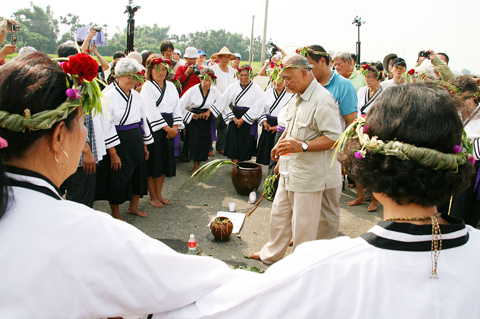
PHOTO: LOA IOK-SIN, TAIPEI TIMES
The Siraya are one of the pingpu (平埔), or “plains,” Aboriginal tribes that once inhabited large swathes of Taiwan’s coastal regions.
Over the past few centuries, the pingpu tribes gradually disappeared as they assimilated with the dominant Han culture and adopted the Hoklo language.
The Siraya in Tainan, as well as Siaolin Village (小林) in Kaohsiung County’s Jiasian Township (甲仙), are among the few communities that keep some Siraya traditions alive.
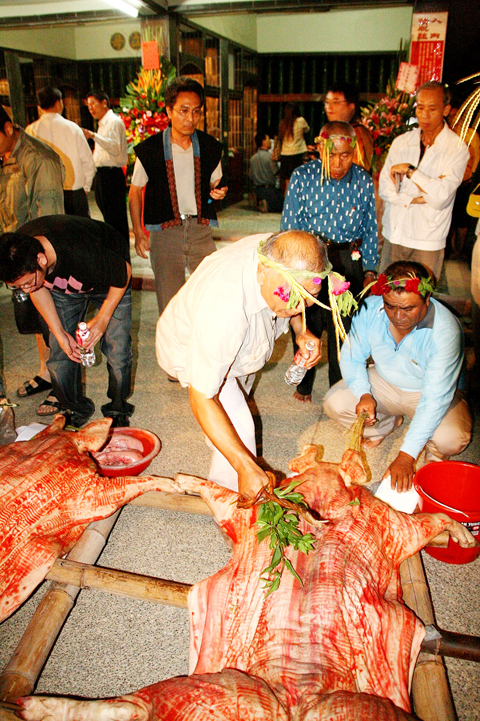
PHOTO: LOA IOK-SIN, TAIPEI TIMES
“We believe that we can communicate with the arit — ancestral spirits — through water, and that the forces of the arit are contained in water,” said Tuan Hung-kun (段洪坤), a researcher on Siraya culture and history and the convener of the Alliance of Siraya Communities.
“Some people say that we worship the jars, but that’s not correct. We only use the jars to hold water,” he said.
There are six konkai in Donghe: the Grand Konkai is dedicated to Anzu (案祖), the supreme spirit in Siraya culture, and two arit, while the other five konkai are spread out along the outer rim of the village, each dedicated to an arit that protects the village from evil spirits.
On the night of Oct. 21, villagers poured into the Grand Konkai to take part in the village’s biggest annual event, the Arit Ritual.
“The annual Arit Ritual is held to express our appreciation for the arit’s blessing for the year, and to ask the arit to bless us for the coming year,” Tuan said. “In the past, there were festivities all day and then religious activities after nightfall. Today only the religious part has been retained.”
Long before the ritual began at 11pm, villagers began arriving at the Grand Konkai to pray to the arit.
They brought offerings of pork, chicken, fish, small cakes made of rice called ban (粄), rice wine, betel nuts and the “five gifts” in red envelopes.
“The [five] gifts are iron from a plough, mung beans, rice grains, nails and coins. We put them in red envelopes and present them [to the arit] to ask for a good harvest, newborn children and prosperity in the coming year,” Lee Chu-lung (李朱龍), a village elder, told visitors outside the Grand Konkai.
“When you present sacrifices to the arit, the head of the chicken and the thicker part of a portion of pork must face the arit, but with the fish, it’s the tail that must face the arit,” Lee said.
No one knows why this is, he said, adding that it was a tradition handed down over thousands of years.
After arranging their offerings, villagers placed betel nuts on a small table in front of the arit jar, prayed, took a sip of rice wine and spit it over the jar.
Each villager then threw the two halves of a betel nut to the ground. If one half lands facing up and the other facing down, it means the spirit is happy; if not, the villagers may repeat the rite or consult the priest about why the spirit is not pleased.
“Our arit ritual is less influenced by Han culture, so we don’t burn incense or ghost money — there are other Siraya villages that have adopted such practices,” Lee said.
Those who prayed for something specific at the previous year’s Arit Ritual were back this year with whole pigs and other sacrifices as well as the five gifts to show their appreciation.
During the ritual, the priest chanted a spell to summon the ancestral spirit. Under his guidance, villagers who brought pigs arranged them in front of the Grand Konkai and covered them with white cloth.
“We do that because the arit likes everything neat and clean. It’s also a signal to other spirits who may be around that the pigs have already been dedicated to the arit and they may not touch them,” Siraya priest Chang Ming-hai (張明海) said.
Those who brought pigs then dripped rice wine into five goblets arranged in front of each pig, and repeated the action five times, with 20 minute intervals.
“Five” is an auspicious number in the Siraya culture, Tuan said.
It was well past 1:30am when the wine ritual ended, but there was more to come.
After seeking the arit’s approval, the pigs were removed to make way for qianqu (牽曲), the singing of ancient Siraya songs.
Around 20 women held hands in a circle as the priest placed jars with water at the center.
He invited ancestral spirits into the circle and the women began slowly to dance and sing.
“They’re singing two things: One is a song taught [to the tribe] by the arit to pray for rain after the Siraya suffered a severe drought a long, long time ago, so they sing it to remember that,” Tuan said. “They also sing another song to thank the arit for blessings over the past year.”
There’s no rule for how long the dance should last; that depends on when the ancestral spirit is satisfied.
“We ask the ancestral spirit whether it is pleased by throwing down a halved betel nut,” Tuan said. “One year the dance continued until 5am and we were all exhausted by the time it finished.”
This year the dancing lasted until 3am and the villagers were able to go home relatively early — but not to rest.
“Don’t think that’s the end of it. Those who brought whole pigs must cook the pig’s organs and head when they get home and bring the cooked pork back after dawn and before noon to finish their ritual of thanksgiving,” he said.
While the annual Arit Ritual ends with qianqu in most Siraya communities, in this village, a ritual called haohai (哮海) follows the next afternoon.
Like qianqu, haohai involves dancing in a circle and singing, but the priest performs another ritual, which lasts about an hour.
Haohai is Hoklo and could mean either remembering an incident at sea or remembering a person named A-hai.
“There are two legends on the origin of the ritual and we’re not sure which is true,” Tuan said.
One has it that the first of the Siraya ran into a storm while traveling at sea. When they finally reached shore on Taiwan, seven people were missing, and the haohai is a rite to remember them.
Another legend has it that when the Siraya arrived in the region, a man named A-hai helped them settle down, and the haohai is a ritual of thanks.
“Some say the Siraya have died out,” Tuan said. “They say we are an extinct tribe and have lost our culture.”
“Well, the fact that we still hold our nighttime Arit Ritual each year proves we are flourishing,” he said.
The Siraya hope the Arit Ritual and other traditions will never die, Tuan said. As for traditions and language already lost, Tuan said he hopes research can help the tribe explore its roots.

NATIONAL SECURITY: Authorities are working to confirm the identities of the military personnel involved and investigating possible illegal conduct and regulatory violations Authorities are probing possible national security implications after Kinmen police and immigration officers on Sunday found a Chinese woman allegedly posing as a tourist while engaging in prostitution involving more than 10 military personnel. The woman, surnamed Chen (陳), has since been deported, authorities said, adding that investigators are still working to confirm the identities of those implicated, as the records only listed code names and aliases. The case stemmed from a report received by the Kinmen District Prosecutors’ Office on Friday last week from the Jinhu Precinct of the Kinmen County Police Bureau. On Sunday, police, along with the National Immigration

GLOBALGIVING: ‘ Caving to external pressure is not acceptable for an organization that has cultivated justice reform and human rights for 30 years,’ one NGO said A slew of non-government organizations (NGOs) have withdrawn from the GlobalGiving fundraising platform after it announced it would use “Chinese Taipei” instead of “Taiwan” from next month. The Taiwan Good Rice Association wrote on Facebook on Friday that it was informed on April 28 via a teleconference call of the change, which was made because the platform wanted to operate in China. Taiwan Good Rice is to terminate all cooperative relationships with GlobalGiving in response to the platform’s “unilateral and non-negotiable” decision to remove references to Taiwan, the NGO said. “Taiwan is in the official name of Taiwan Good Rice Association and the

HEAVY WEATHER: Typhoon Jangmi is due to crash straight into the Ryukyus as airlines look to shift flights to larger aircraft or cancel flights to Okinawa entirely Taiwan’s international air carriers announced flight adjustments over the weekend as Typhoon Jangmi is forecast to hit the Ryukyu Islands today and tomorrow. The Central Weather Administration (CWA) upgraded Jangmi from a tropical storm to a typhoon at 8am yesterday, with the eye located 580km south of Naha city. It was moving north at 19kph. Today, China Airlines’ CI-120, CI-121, CI-122 and CI-123 flights between Taoyuan and Naha, Okinawa, have been canceled as well as CI-132 and CI-133 between Kaohsiung and Naha. EVA Air’s BR-112, BR-113, BR-186 and BR-185 flights between Taoyuan and Naha are also canceled. Low-cost carrier Tigerair Taiwan canceled IT-230,
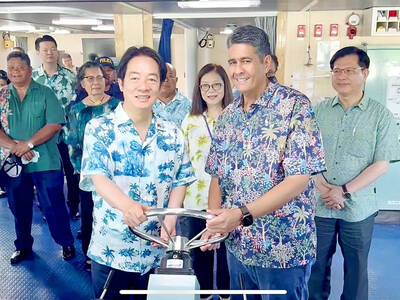
MULTIPRONGED APPROACH: China has sought to pressure Palau across a number of fronts, but the island nation has staunchly resisted overtures to ditch Taiwan Palau has been firm in backing Taiwan despite Chinese pressure that uses tourism economics, cyberattacks and criminal infiltration as tools to threaten the Pacific ally into renouncing its recognition of Taiwan as a sovereign state. The Presidential Office yesterday announced that Vice President Hsiao Bi-khim (蕭美琴) would visit Palau from Saturday to Wednesday next week at the invitation of Palauan President Surangel Whipps Jr. Whipps in April said in an interview that China had outspokenly asked Palau to “denounce Taiwan.” “And we have said: ‘We have no enemies, but nobody tells us who our friends are,’” he said. Whipps has told reporters multiple times


 RSS
RSS