


The Presidential Office yesterday dismissed speculation that President Ma Ying-jeou (馬英九) had denigrated the dignity of Confucius by sending an unorthodox plaque to a Confucius temple in Tainan.
Presidential Office press relations director Tsai Chung-li (蔡仲禮) said the office did not mean to depreciate the nobility of Confucius or the temple, adding that the plaques conferred by the Presidential Office conformed to certain standards.
The plaque may not be in line with regional practices, he said, adding that the office had collected opinions from Tainan City and would present an assessment to the president for final reference.
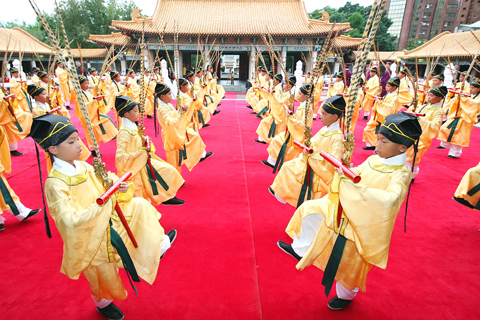
PHOTO: CNA
Feng shui masters have complained about the plaque, which Ma gave to the temple last year, saying it was too small and that the writing should stand out from its surface, rather than being carved into it. They say only writing on gravestones is carved into the surface.
Hsu Keng-hsiu (??, director of the Tainan City Government’s Department of Culture and Tourism, said the city informed the Presidential Office of the complaints last year, but that it had yet to receive any response.
Attending an early-morning ceremony to celebrate the 2,559th birthday of the Chinese philosopher at the temple yesterday morning, Ma burned incense sticks and paid his respects as a “special guest” of the event.
No president had ever attended the annual ceremony in Tainan, instead sending the minister of the interior to perform the honor.
Ma attended the ceremony in Taipei last year and said he would attend the event in a different place every year.
At a different setting on Yangmingshan yesterday morning, Ma said he attended the event to show his respect for Confucianism and support for Confucius’ educational concept of “providing education for all people without discrimination” and “teaching students in accordance with their aptitude.”
Ma encouraged local governments to store the ashes of outstanding local educators at local Confucius temples.
The president said he did so three years ago with the ashes of an academic and educator of the Qing Dynasty who taught in northern Taiwan for many years.
Ma said he would fulfill his campaign promise by increasing the educational budget by 0.2 percent of GDP each year. During his stint as Taipei mayor, Ma said that while the city government’s budget had shown negative growth five years in a row, the educational budget never contracted.
“My theory is that even if we are poor, education cannot be poor, and even if we suffer, we cannot let our children suffer,” he said.
He also vowed to narrow the salary gap between public school teachers and their counterparts at private schools.

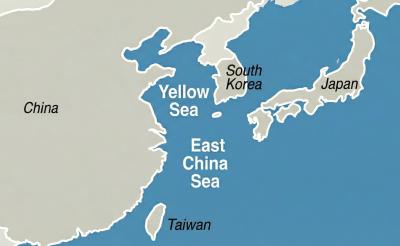
China has reserved offshore airspace in the Yellow Sea and East China Sea from March 27 to May 6, issuing alerts usually used to warn of military exercises, although no such exercises have been announced, the Wall Street Journal (WSJ) reported yesterday. Reserving such a large area for 40 days without explanation is an “unusual step,” as military exercises normally only last a few days, the paper said. These alerts, known as Notice to Air Missions (Notams), “are intended to inform pilots and aviation authorities of temporary airspace hazards or restrictions,” the article said. The airspace reserved in the alert is
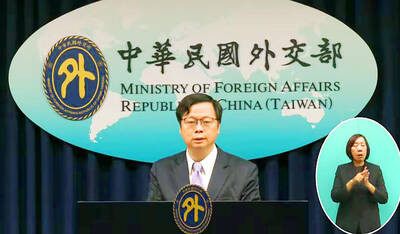
NAMING SPAT: The foreign ministry called on Denmark to propose an acceptable solution to the erroneous nationality used for Taiwanese on residence permits Taiwan has revoked some privileges for Danish diplomatic staff over a Danish permit that lists “Taiwan” as “China,” Eric Huang (黃鈞耀), head of the Ministry of Foreign Affairs’ Department of European Affairs, told a news conference in Taipei yesterday. Reporters asked Huang whether the Danish government had responded to the ministry’s request that it correct the nationality on Danish residence permits of Taiwanese, which has been listed as “China” since 2024. Taiwan’s representative office in Denmark continues to communicate with the Danish government, and the ministry has revoked some privileges previously granted to Danish representatives in Taiwan and would continue to review
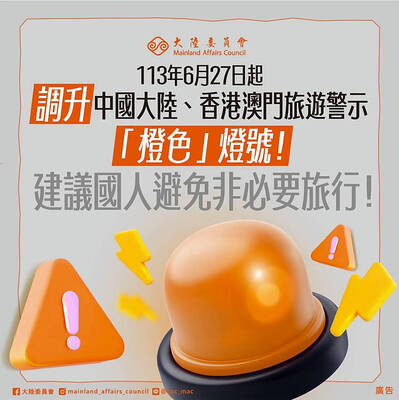
More than 6,000 Taiwanese students have participated in exchange programs in China over the past two years, despite the Mainland Affairs Council’s (MAC) “orange light” travel advisory, government records showed. The MAC’s publicly available registry showed that Taiwanese college and university students who went on exchange programs across the Strait numbered 3,592 and 2,966 people respectively. The National Immigration Agency data revealed that 2,296 and 2,551 Chinese students visited Taiwan for study in the same two years. A review of the Web sites of publicly-run universities and colleges showed that Taiwanese higher education institutions continued to recruit students for Chinese educational programs without

A bipartisan group of US senators has introduced a bill to enhance cooperation with Taiwan on drone development and to reduce reliance on supply chains linked to China. The proposed Blue Skies for Taiwan Act of 2026 was introduced by Republican US senators Ted Cruz and John Curtis, and Democratic US senators Jeff Merkley and Andy Kim. The legislation seeks to ease constraints on Taiwan-US cooperation in uncrewed aerial systems (UAS), including dependence on China-sourced components, limited access to capital and regulatory barriers under US export controls, a news release issued by Cruz on Wednesday said. The bill would establish a "Blue UAS


 RSS
RSS