


Among the many recollections of heroism and sacrifice in the wake of the killer earthquake that struck the nation 10 years ago, one of the most significant is the account of the swift response and hard work of the country’s military.
Huang Jung-tsun (黃榮村), president of China Medical University who served as executive director of the 921 Earthquake Post-Disaster Recovery Commission, recalled that 13 minutes after the magnitude 7.3 temblor struck, the military responded to calls for assistance and was able to report to government agencies about the situation on the ground.
“That response time was faster than in any other country,” Huang said.
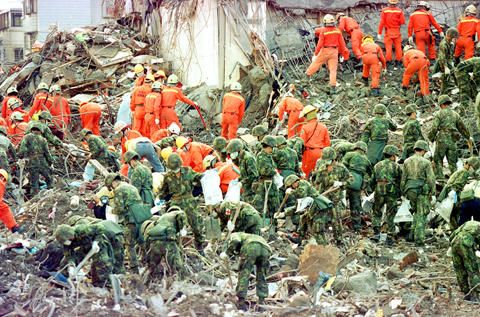
PHOTO: CNA
Many of the officers were young, barely 20, and had never been on an actual battlefield. They were horrified at the scenes they encountered when they arrived in Jiji (集集), Nantou County, the epicenter of the quake that struck Taiwan on Sept. 21, 1999.
Entering what must have seemed to them like a war zone: They saw entire blocks of collapsed buildings, dead bodies and many people trapped under tonnes of rubble.
In a race against time, they dug through the rubble trying to save lives.
When night fell, the county was thrown into darkness because the earthquake had disrupted the electricity supply. Fear and uncertainty reigned as aftershocks continued to rock the area. People slept on the streets, afraid to go indoors.
Amid the devastation and despite their inexperience, the young soldiers worked tirelessly in unfamiliar circumstances.
Aside from rescuing earthquake victims, helping to restore disrupted traffic and distributing relief, the officers had another task that many thought was the hardest of all — moving corpses to local funeral homes.
As the Nantou County funeral parlor could not cope with the number of bodies from the quake, some bodies had to be placed in makeshift funeral homes nearby.
For at least one week, the young military officers worked day and night with no reprieve from the sound of Buddhist monks chanting mantras to pacify the souls of the dead and the drone of compressors in containers that were being used as makeshift morgues.
Lin Ming-chen (林明溱), a Chinese Nationalist Party (KMT) legislator and then-head of Jiji Township, said: “The military was very helpful in transporting bodies to funeral parlors and clearing rubble.”
The military rescue and relief operation was led by General Chen Chen-hsiang (陳鎮湘), who was commander of the Army at the time.
Shortly after the quake hit at 1:47am, the military instructed the 10th Army Corps stationed nearby to rush to the scene and to report on the situation, Chen said.
All the reports were the same: “The situation is very, very serious,” Chen said. He decided to immediately launch an all-out rescue operation and set up a rescue command center at the Nantou County Stadium.
Within 12 hours of the quake, the Army had mobilized thousands of military officers and transported to the stadium 200,000 packets of rations, 1,800 first aid kits, 50 large tents, 20,000 blankets and 7,570 liters of diesel fuel.
Military helicopters landing at the stadium and Dongshih Riverside Park helped transport the injured to hospitals in the area.
Then-general chief of staff Tang Yiau-min (湯曜明) said that in the following days, the military transported 100,000 ration packets, 30,000 bottles of mineral water and instant food every day to quake-affected areas of Puli (埔里), Shihgang (石岡) and Dongshih (東勢), which were cut off from the rest of the country after the quake.
When the first military units arrived, they had to use simple tools to dig under debris, as they did not want to waste a minute of the “golden 72 hours after the disaster,” which are considered the most crucial to saving lives in an emergency.
The 8th Army Corps stationed in the south later sent in more engineering and medical personnel, who brought with them heavy-duty equipment to help clear debris and facilitate the restoration of traffic and communications.
Day and night, the soldiers grappled with the task of shifting piles of rubble in what was one of the most scenic places in Taiwan, Chen said.
Some of the young soldiers were traumatized by the sight of bodies and people’s suffering and required psychological counseling, he said.
The first stage of the military operation focused on rescuing people. Later, it shifted to post-quake relief, which was divided into two major phases: clearing the rubble and constructing houses to shelter those left homeless by the quake, Chen said.
The 921 earthquake killed more than 2,400 people and caused billions of dollars in losses, but the tragedy galvanized the nation. Donations and support from the public poured in and the military worked closely with the public sector during the disaster recovery period.
Chen said the military had rapidly mobilized from top to bottom, adding that rescue operations were a “brilliant unified effort.”

Considering that most countries issue more than five denominations of banknotes, the central bank has decided to redesign all five denominations, the bank said as it prepares for the first major overhaul of the banknotes in more than 24 years. Central bank Governor Yang Chin-lung (楊金龍) is expected to report to the Legislative Yuan today on the bank’s operations and the redesign’s progress. The bank in a report sent to the legislature ahead of today’s meeting said it had commissioned a survey on the public’s preferences. Survey results showed that NT$100 and NT$1,000 banknotes are the most commonly used, while NT$200 and NT$2,000

The Centers for Disease Control (CDC) yesterday reported the first case of a new COVID-19 subvariant — BA.3.2 — in a 10-year-old Singaporean girl who had a fever upon arrival in Taiwan and tested positive for the disease. The girl left Taiwan on March 20 and the case did not have a direct impact on the local community, it said. The WHO added the BA.3.2 strain to its list of Variants Under Monitoring in December last year, but this was the first imported case of the COVID-19 variant in Taiwan, CDC Deputy Director-General Lin Ming-cheng (林明誠) said. The girl arrived in Taiwan on

South Korea is planning to revise its controversial electronic arrival card, a step Taiwanese officials said prompted them to hold off on planned retaliatory measures, a South Korean media report said yesterday. A Yonhap News Agency report said that the South Korean Ministry of Foreign Affairs is planning to remove the “previous departure place” and “next destination” fields from its e-arrival card system. The plan, reached after interagency consultations, is under review and aims to simplify entry procedures and align the electronic form with the paper version, a South Korean ministry official said. The fields — which appeared only on the electronic form

The Ministry of Foreign Affairs (MOFA) is suspending retaliation measures against South Korea that were set to take effect tomorrow, after Seoul said it is updating its e-arrival system, MOFA said today. The measures were to be a new round of retaliation after Taiwan on March 1 changed South Korea's designation on government-issued alien resident certificates held by South Korean nationals to "South Korea” from the "Republic of Korea," the country’s official name. The move came after months of protests to Seoul over its listing of Taiwan as "China (Taiwan)" in dropdown menus on its new online immigration entry system. MOFA last week


 RSS
RSS