


Efforts to conserve the endangered Formosan landlocked salmon have made progress, with artificially bred fish now spawning in their natural habitat in northeastern Taiwan, national park administrators said yesterday.
“Juvenile Formosan landlocked salmon that were released into the Sihjielan Stream (司界蘭溪) and the Luoyewei Stream (羅葉尾溪) on the border of Yilan and Taichung counties a few years ago have fared well and are now spawning,” said Chung Ming-shan (鍾銘山), deputy superintendent of the Shei-Pa National Park Headquarters.
“The discovery is encouraging, as it marks a step forward in our drive to preserve the precious fish, which harks back to the Ice Age,” Chung said. “It’s truly a miracle in the history of biology.”
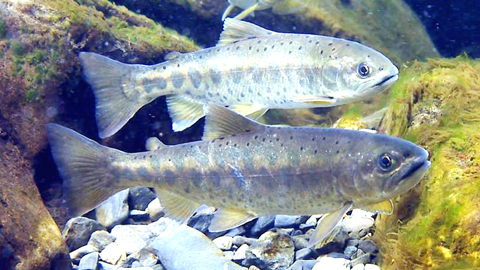
PHOTO COURTESY OF SHEI-PA NATIONAL PARK ADMINISTRATION
Saying that the species traditionally inhabits slow-flowing streams with gently sloping beds at elevations of more than 1,500m, Chung added that the fish is now found mainly in the Cijiawan Stream (七家灣溪) and Gaoshan Stream (高山溪) in the upper stretches of the Dajia River (大甲溪), with the total population exceeding 2,300.
As the fish had been spotted in streams in the Yilan-Taichung border area prior to the 1970s, Chung said the Shei-Pa National Park’s conservation researchers have since 2006 regularly released young and juvenile fish into the Luoyewei and Sihjielan streams.
“Through monitoring, we have found that those fish have survived in the two streams and been able to breed naturally,” Chung said.
He said, however, that many fish perished or were washed away during several typhoons last year.
Late last year, park researchers released more than 100 young fish into the Sihjielan and Luoyewei streams, and they have been growing well, Chung said.
“Although Typhoon Morakot wreaked havoc in southern Taiwan’s mountainous regions in early August, the storm did not affect the Formosan landlocked salmon’s habitat in central Taiwan,” he said, adding that his office would continue to release young fish to reduce the possibility of the species going extinct while increasing the biodiversity of streams in the region.

Considering that most countries issue more than five denominations of banknotes, the central bank has decided to redesign all five denominations, the bank said as it prepares for the first major overhaul of the banknotes in more than 24 years. Central bank Governor Yang Chin-lung (楊金龍) is expected to report to the Legislative Yuan today on the bank’s operations and the redesign’s progress. The bank in a report sent to the legislature ahead of today’s meeting said it had commissioned a survey on the public’s preferences. Survey results showed that NT$100 and NT$1,000 banknotes are the most commonly used, while NT$200 and NT$2,000

The Centers for Disease Control (CDC) yesterday reported the first case of a new COVID-19 subvariant — BA.3.2 — in a 10-year-old Singaporean girl who had a fever upon arrival in Taiwan and tested positive for the disease. The girl left Taiwan on March 20 and the case did not have a direct impact on the local community, it said. The WHO added the BA.3.2 strain to its list of Variants Under Monitoring in December last year, but this was the first imported case of the COVID-19 variant in Taiwan, CDC Deputy Director-General Lin Ming-cheng (林明誠) said. The girl arrived in Taiwan on

South Korea is planning to revise its controversial electronic arrival card, a step Taiwanese officials said prompted them to hold off on planned retaliatory measures, a South Korean media report said yesterday. A Yonhap News Agency report said that the South Korean Ministry of Foreign Affairs is planning to remove the “previous departure place” and “next destination” fields from its e-arrival card system. The plan, reached after interagency consultations, is under review and aims to simplify entry procedures and align the electronic form with the paper version, a South Korean ministry official said. The fields — which appeared only on the electronic form

The Ministry of Foreign Affairs (MOFA) is suspending retaliation measures against South Korea that were set to take effect tomorrow, after Seoul said it is updating its e-arrival system, MOFA said today. The measures were to be a new round of retaliation after Taiwan on March 1 changed South Korea's designation on government-issued alien resident certificates held by South Korean nationals to "South Korea” from the "Republic of Korea," the country’s official name. The move came after months of protests to Seoul over its listing of Taiwan as "China (Taiwan)" in dropdown menus on its new online immigration entry system. MOFA last week


 RSS
RSS