


On Sept. 20, 1964, Peng Ming-min (彭明敏) was arrested for treason for advocating democracy in Taiwan. He was sentenced to eight years in prison in 1965 and put under house arrest later the same year after receiving a special pardon.
On Jan. 2, 1970, Peng left his family and began a 22-year exile.
At a book launch in Taipei yesterday, the 86-year-old shared his successful escape from the then-Chinese Nationalist Party (KMT) regime 39 years ago, which he describes in his book titled A Perfect Escape.

PHOTO: GEORGE TSORNG, TAIPEI TIMES
“I often ask myself: If I had made a different decision, what would have become of me?” Peng, former senior presidential adviser under the Democratic Progressive Party administration, told an audience yesterday.
After Japan’s defeat in World War II, Peng, who at the time was studying political science at the University of Tokyo, had to decide whether to stay in Japan or return to Taiwan.
If he had stayed in Japan, he would have had to change his Chinese name and would probably have ended up teaching, practicing law, writing or working in the public sector, Peng said.
“But I loved this country [Taiwan] so much that I wanted to go home … It did not take me long to decide,” he said.
Filled with patriotism and ideals, Peng was in for a major disappointment after he saw how the KMT was governing Taiwan.
Peng returned to Taiwan in 1946 and studied political science at National Taiwan University. In 1951, he obtained a scholarship to study at McGill University in Montreal. He was offered a job there, but turned it down. He studied law at the University of Paris and obtained a doctor of laws degree in 1954.
Peng said the KMT government tried to recruit him after his return from Paris. But after witnessing the 228 Incident, the imposition of Martial Law and the White Terror, he had to decide between serving under the KMT and securing wealth and status, or following his conscience and fighting for freedom and democracy.
In 1964, Peng was arrested along with two of his students, Hsieh Tsung-min (謝聰敏) and Wei Ting-chao (魏廷朝), for publishing the Declaration of Formosan Self-Salvation.
For his own safety and that of his family, Peng said he decided to flee the country. With help from various individuals — Peng said he had to be careful with details in the book to protect the privacy of individuals and respect the wish of those who helped him but wanted to remain anonymous — his escape took him through Hong Kong, Bangkok, the Soviet Union and Denmark before he arrived in Stockholm, where he was granted political asylum.
Peng later moved to the US with held from his friends and joined the campaign for Taiwan independence.
Peng yesterday lamented the dramatic change in Taiwan’s political climate since President Ma Ying-jeou (馬英九) was elected last year, saying the country seemed to be gradually returning to the old days when the KMT was in power.
“Can we accept that the eight years of freedom and democracy we enjoyed were just a short episode? Is it normal to have a foreign regime govern this land? We must carefully think about that,” he said.

POLAM KOPITIAM CASE: Of the two people still in hospital, one has undergone a liver transplant and is improving, while the other is being evaluated for a liver transplant A fourth person has died from bongkrek acid poisoning linked to the Polam Kopitiam (寶林茶室) restaurant in Taipei’s Far Eastern Sogo Xinyi A13 Department Store, the Ministry of Health and Welfare said yesterday, as two other people remain seriously ill in hospital. The first death was reported on March 24. The man had been 39 years old and had eaten at the restaurant on March 22. As more cases of suspected food poisoning involving people who had eaten at the restaurant were reported by hospitals on March 26, the ministry and the Taipei Department of Health launched an investigation. The Food and
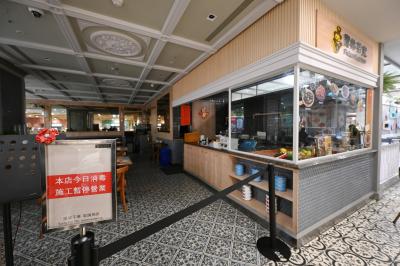
A fourth person has died in a food poisoning outbreak linked to the Xinyi (信義) branch of Malaysian restaurant chain Polam Kopitiam (寶林茶室) in Taipei, Deputy Minister of Health and Welfare Victor Wang (王必勝) said on Monday. It was the second fatality in three days, after another was announced on Saturday. The 40-year-old woman experienced multiple organ failure in the early hours on Monday, and the family decided not to undergo emergency resuscitation, Wang said. She initially showed signs of improvement after seeking medical treatment for nausea, vomiting and diarrhea, but her condition worsened due to an infection, he said. Two others who

The long-awaited Taichung aquarium is expected to open next year after more than a decade of development. The building in Cingshui District (清水) is to feature a large ocean aquarium on the first floor, coral display area on the second floor, a jellyfish tank and Dajia River (大甲溪) basin display on the third, a river estuary display and restaurant on the fourth, and a cafe and garden on the fifth. As it is near Wuci Fishing Port (梧棲漁港), many are expecting the opening of the aquarium to bring more tourism to the harbor. Speaking at the city council on Monday, Taichung City Councilor

Taiwanese should be mindful when visiting China, as Beijing in July is likely to tighten the implementation of policies on national security following the introduction of two regulations, a researcher said on Saturday. China on Friday unveiled the regulations governing the law enforcement and judicial activities of national security agencies. They would help crack down on “illegal” and “criminal” activities that Beijing considers to be endangering national security, according to reports by China’s state media. The definition of what constitutes a national security threat in China is vague, Taiwan Thinktank researcher Wu Se-chih (吳瑟致) said. The two procedural regulations are to provide Chinese


 RSS
RSS