


Residents of Fengyuan (豐原), Taichung County, are making wishes by hanging padlocks on a wire mesh fence at a pedestrian overpass by the city’s train station.
Train station director Lin Ching-shan (林景山) said that despite the fact that overpasses exist at many train stations around the country, to his knowledge, this phenomenon is unique to Fengyuan.
It all began about five years ago when someone observed a few padlocks hanging on the fence with wishes written on them in Chinese and an unidentified foreign language, he said. Before long, the padlocks were known as “wish locks.”
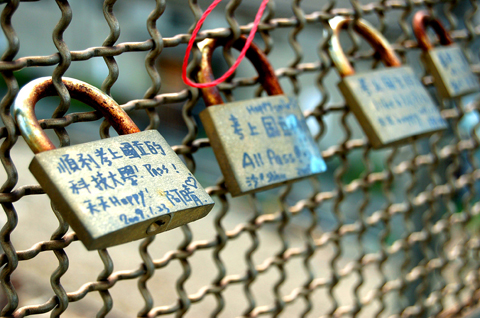
PHOTO: CHANG JUI-CHEN, TAIPEI TIMES
Lin said some people believe the trains generate a magnetic field when they pass under the overpass and the energy that accumulates in the locks will fulfill their wishes. Although authorities have cleared the fence on several occasions, new padlocks keep turning up, Lin said.
The wishes written on the padlocks include: “[I wish to] successfully pass university entrance exams,” “I want happiness” and “[give me] eternal love.”
Sometimes two padlocks are locked together or hung close to each other. These are known as “heart locks,” and are normally hung by lovers.
One lock hung by someone looking for a partner had the wish “Be with me!” written on it. Other examples are “I want money” and “[Let’s] go to National Taiwan University together. We want to move in together.”
The overpass in Fengyuan has attracted students from all over Taiwan, who go to read the padlocks, developing into a youth tourist spot, Lin said.
Folklore specialist Chang Yi-ming (張益銘) said the phenomenon may be an imitation of youth subcultures developed from faith practices in other countries, adding that a magnetic field would imply that the place has a lot of energy.
Whether that energy is beneficial or not is for people to decide on their own, he said.

POLAM KOPITIAM CASE: Of the two people still in hospital, one has undergone a liver transplant and is improving, while the other is being evaluated for a liver transplant A fourth person has died from bongkrek acid poisoning linked to the Polam Kopitiam (寶林茶室) restaurant in Taipei’s Far Eastern Sogo Xinyi A13 Department Store, the Ministry of Health and Welfare said yesterday, as two other people remain seriously ill in hospital. The first death was reported on March 24. The man had been 39 years old and had eaten at the restaurant on March 22. As more cases of suspected food poisoning involving people who had eaten at the restaurant were reported by hospitals on March 26, the ministry and the Taipei Department of Health launched an investigation. The Food and

The long-awaited Taichung aquarium is expected to open next year after more than a decade of development. The building in Cingshui District (清水) is to feature a large ocean aquarium on the first floor, coral display area on the second floor, a jellyfish tank and Dajia River (大甲溪) basin display on the third, a river estuary display and restaurant on the fourth, and a cafe and garden on the fifth. As it is near Wuci Fishing Port (梧棲漁港), many are expecting the opening of the aquarium to bring more tourism to the harbor. Speaking at the city council on Monday, Taichung City Councilor
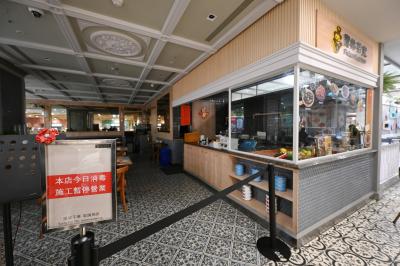
A fourth person has died in a food poisoning outbreak linked to the Xinyi (信義) branch of Malaysian restaurant chain Polam Kopitiam (寶林茶室) in Taipei, Deputy Minister of Health and Welfare Victor Wang (王必勝) said on Monday. It was the second fatality in three days, after another was announced on Saturday. The 40-year-old woman experienced multiple organ failure in the early hours on Monday, and the family decided not to undergo emergency resuscitation, Wang said. She initially showed signs of improvement after seeking medical treatment for nausea, vomiting and diarrhea, but her condition worsened due to an infection, he said. Two others who

Taiwanese should be mindful when visiting China, as Beijing in July is likely to tighten the implementation of policies on national security following the introduction of two regulations, a researcher said on Saturday. China on Friday unveiled the regulations governing the law enforcement and judicial activities of national security agencies. They would help crack down on “illegal” and “criminal” activities that Beijing considers to be endangering national security, according to reports by China’s state media. The definition of what constitutes a national security threat in China is vague, Taiwan Thinktank researcher Wu Se-chih (吳瑟致) said. The two procedural regulations are to provide Chinese


 RSS
RSS