


On Orchid Island, the latest greeting between hotel operators is: “Have you solar paneled yet?”
This is because more and more inns and hostels on the island have begun to install cost-saving and environmentally friendly solar panel water heating systems, sparking a trend that environmentalists hope will spread across Taiwan.
Located off Taiwan’s southeast coast, the island famous for its Aboriginal culture and picturesque scenery now has a higher percentage of hotels with solar panel hot-water systems than any other area in the country.
So far, 10 out of the 52 hotels and hostels there have installed solar water heaters.
Hoteliers on the island never imagined they could help limit greenhouse gases.
“We don’t have much here, except sunshine and the wind, which are endlessly available,” said Chen Tsung-yue, operator of Yueshiuan Hotel.
Taking advantage of the lengthy durations of strong sunshine on the island, Chen was one of the first hotel owners to install a solar hot water system on his hostel’s roof at a cost of about NT$60,000 (US$1,837).
“I recouped the investment in just one year,” he said.
Others on Orchid Island soon followed in his footsteps and the trend is also catching on elsewhere in Taiwan.
Nantou County has the greatest number of solar-powered water heaters in the country and the highest percentage of households with solar water heaters, mainly because almost all the homes rebuilt after the devastating 921 Earthquake in 1999 were equipped with solar water heaters.
Nationwide, 5 percent of all households have installed the devices, ranking Taiwan third behind Israel and Cyprus, the Bureau of Energy said.
Part of the reason for Taiwan’s relatively high installation rate is that in 2000 the bureau initiated a program offering incentives and subsidies to households to install solar water heaters, and 440,000 homes around the country have put in the devices since then.
The 5 percent installation rate in Taiwan is equivalent to a savings of 5 million 20kg canisters of liquefied gas, or a reduction of 370,000 tonnes of carbon dioxide, Bureau of Energy Director Yeh Hui-ching (葉惠青) said.
“It is expected that there will be 20 percent coverage of all homes with water-heating solar panels by 2020, with subsidies rising by 50 percent from this year,” Yeh said.
The subsidy now averages NT$10,800 for a heater capable of generating hot water for a family of four to five people, or solar collectors of an area of 4.8m2, compared to NT$7,200 since 2000.
Besides hotels and homes, some businesses in Taiwan are also joining the trend.
The Fugi Educational Park located in Yunlin County has been one of the major users of solar water heaters in Taiwan.
Chuang Chao-chin (莊朝欽), the head of Fugi’s construction engineering task force, said the institution has had 11 solar water heating systems installed so far since the school’s inception in 2003 at a total cost of NT$13.75 million.
“The hot water has been limitlessly available in dormitories for about 1,000 students, faculty and volunteers,” Chuang said. “Even during peak shower hours in winter time, there was a sufficient supply of hot water without ever hitting a snag.”
“The investment in the installation was paid back in three years,” he said.
The Bureau of Energy has encouraged the installation of solar water heaters in part because of geography.
Taiwan’s solar water heating industry has also matured, with every phase of the installation, from know-how to equipment and materials, developed and sourced locally, said Tseng Kuo-ching (曾國境), a professor at National Cheng Kung University.
But whether solar waterheaters can become more common in Taiwan depends on climate conditions, population structure, urbanization, building types and the status of new construction, said Tseng, who is also the principal investigator of the university’s Research and Development Foundation, which has been authorized by the bureau to oversee the application of solar water heaters in the country.
Tseng and his investigative team found that solar water heating systems are popular in Taiwan’s central and southwestern regions, mainly because sunshine duration there is longer, and there are many more individual bungalows or terraced houses with flat roofs than in northern Taiwan, which makes installation easier.
Solar water heaters have gained less traction in northern Taiwan because of the many high-rise residential buildings and relatively lower sunshine duration.
The government has not done enough to promote the application of solar water heating systems on the island, said Chen Fu-yung (陳富用), chairman of the Taiwan Solar Energy Development Association, a non-profit group of solar water heater installers and dealers.
Compared with Israel, where installation of solar water heaters is mandatory, Germany, where installations grew at an 84 percent rate last year, and Spain, where the installation rate was up 67 percent last year, Taiwan has lagged far behind, Chen Fu-yung said.
He said that during a national energy conference held in April, officials and specialists devoted a lot of time to the further expansion of wind power generation and the development of solar photovoltaic energy.
It is unrealistic, however, to talk about developing wind power generation with each wind turbine unit having to be imported at a cost of NT$100 million, he said.
“It would only benefit the foreign suppliers and dealers,” he said.
“Why doesn’t the government pay greater attention to the solar water heating system sector, whose know-how is mature and the necessary materials are available domestically thanks to Taiwan’s well-developed high-tech industries? Also, solar water heating systems are inexpensive compared with wind and photovoltaic energy,” he said.
The government should live up to its promise to have 140,000 more solar water heating systems installed nationwide in the next four years, Chen Fu-yung said.
“The installation plan should begin in public facilities, such as schools, prisons, fire departments, police stations and military establishments — places with vast spaces and flat roofs that are ideal for solar panels,” he said.
To bolster the popularity of solar water heaters in northern Taiwan, particularly in the Taipei metropolitan area, the government will also need to develop new strategies. In eastern Taiwan, it needs to address the problem of typhoons, which can destroy the roof-top equipment, Chen Fu-yung said.

INCREASED CAPACITY: The flights on Mondays, Wednesdays, Fridays and Sundays would leave Singapore in the morning and Taipei in the afternoon Singapore Airlines is adding four supplementary flights to Taipei per week until May to meet increased tourist and business travel demand, the carrier said on Friday. The addition would raise the number of weekly flights it operates to Taipei to 18, Singapore Airlines Taiwan general manager Timothy Ouyang (歐陽漢源) said. The airline has recorded a steady rise in tourist and business travel to and from Taipei, and aims to provide more flexible travel arrangements for passengers, said Ouyang, who assumed the post in July last year. From now until Saturday next week, four additional flights would depart from Singapore on Monday, Wednesday, Friday
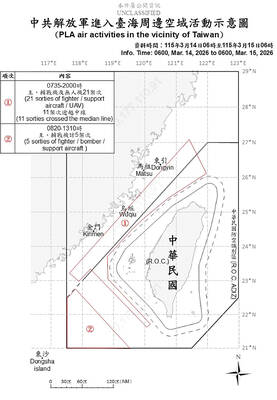
The Ministry of National Defense yesterday reported the return of large-scale Chinese air force activities after their unexplained absence for more than two weeks, which had prompted speculation regarding Beijing’s motives. China usually sends fighter jets, drones and other military aircraft around the nation on a daily basis. Interruptions to such routine are generally caused by bad weather. The Ministry of National Defense said it had detected 26 Chinese military aircraft in the Taiwan Strait over the previous 24 hours. It last reported that many aircraft on Feb. 25, when it spotted 30 aircraft, saying Beijing was carrying out another “joint combat

Taiwan successfully defended its women’s 540 kilogram title and won its first-ever men’s 640 kg title at the 2026 World Indoor Tug of War Championships in Taipei yesterday. In the women’s event, Taiwan’s eight-person squad reached the final following a round-robin preliminary round and semifinals featuring teams from Ukraine, Japan, Thailand, Vietnam, the Basque Country and South Korea. In the finals, they swept the Basque team 2-0, giving the team composed mainly of National Taiwan Normal University students and graduates its second championship in a row, and its fourth in five years. Team captain
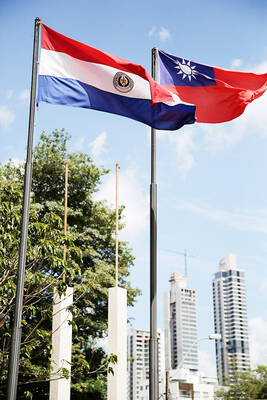
When Paraguayan opposition lawmaker Leidy Galeano returned from an all-expenses-paid tour of six Chinese cities late last year, she was convinced Paraguay risked missing out on major economic gains by sticking with longtime ally Taipei over Beijing — a message that participants on the trip heard repeatedly from Chinese officials. “Everything I saw there, I wanted for my country,” said Galeano, a member of the newly-formed Yo Creo party whose senior figures have spoken favorably about China. This trip and others like it — which people familiar with the visits said were at the invitation of the Chinese consulate in Sao Paulo


 RSS
RSS