


Democratic Progressive Party (DPP) legislators yesterday criticized state-run Taiwan Fertilizer after it was found to be producing bottled water for the China market with “China, Taiwan” listed as the place of production on the label.
DPP Legislator Kuan Bi-ling (管碧玲) said yesterday that Taiwan Yes, a subsidiary of Taiwan Fertilizer, bottled deep ocean water. To sell the products in China, the company labeled the source of the water as “China, Taiwan, Hualien Pacific Ocean, 662m below sea level.”
Kuan said the state-run company was selling out Taiwan to make money in China.
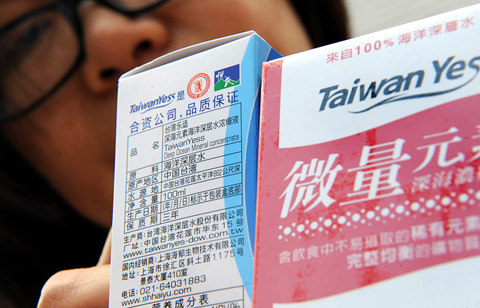
PHOTO: CNA
“When a state-run company does this, how can the country ask the international community not to list Taiwan as a province of China?” she said.
She also said Taiwan had been labeled as “Taiwan, Province of China” on the store locator of the Starbucks Coffee Company’s Web site until last week, but after people complained, Starbucks changed the listing.
Kuan said that Taiwan Fertilizer chairman Chung Jung-chi (鍾榮吉), a former legislative vice speaker for the Chinese Nationalist Party (KMT), should change the label immediately.
DPP Legislator Pan Meng-an (潘孟安) said it was a shame that “Taiwan’s sovereignty is only worth the price of a bottle of water.”
Executive Yuan Spokesman Su Jun-pin (蘇俊賓) said yesterday that Premier Liu Chao-shiuan (劉兆玄) disapproved of the company’s move.
Su said that Liu had demanded a review of the incident and rectification of the problem.
“The Executive Yuan has noticed the problem and [Liu] is very much concerned about it,” Su said.
KMT lawmakers also expressed disapproval.
“We don’t have to denigrate ourselves because Hu Jintao (胡錦濤), the general secretary of the Chinese Communist Party, called us ‘Chinese Taipei,’” KMT Legislator Chiu Yi (邱毅) said.
KMT Legislator Lee Ching-hua (李慶華) said Taiwan Fertilizer should have been more prudent than other private businesses because part of its funding came from the government.

Considering that most countries issue more than five denominations of banknotes, the central bank has decided to redesign all five denominations, the bank said as it prepares for the first major overhaul of the banknotes in more than 24 years. Central bank Governor Yang Chin-lung (楊金龍) is expected to report to the Legislative Yuan today on the bank’s operations and the redesign’s progress. The bank in a report sent to the legislature ahead of today’s meeting said it had commissioned a survey on the public’s preferences. Survey results showed that NT$100 and NT$1,000 banknotes are the most commonly used, while NT$200 and NT$2,000

The Centers for Disease Control (CDC) yesterday reported the first case of a new COVID-19 subvariant — BA.3.2 — in a 10-year-old Singaporean girl who had a fever upon arrival in Taiwan and tested positive for the disease. The girl left Taiwan on March 20 and the case did not have a direct impact on the local community, it said. The WHO added the BA.3.2 strain to its list of Variants Under Monitoring in December last year, but this was the first imported case of the COVID-19 variant in Taiwan, CDC Deputy Director-General Lin Ming-cheng (林明誠) said. The girl arrived in Taiwan on

South Korea is planning to revise its controversial electronic arrival card, a step Taiwanese officials said prompted them to hold off on planned retaliatory measures, a South Korean media report said yesterday. A Yonhap News Agency report said that the South Korean Ministry of Foreign Affairs is planning to remove the “previous departure place” and “next destination” fields from its e-arrival card system. The plan, reached after interagency consultations, is under review and aims to simplify entry procedures and align the electronic form with the paper version, a South Korean ministry official said. The fields — which appeared only on the electronic form

The Ministry of Foreign Affairs (MOFA) is suspending retaliation measures against South Korea that were set to take effect tomorrow, after Seoul said it is updating its e-arrival system, MOFA said today. The measures were to be a new round of retaliation after Taiwan on March 1 changed South Korea's designation on government-issued alien resident certificates held by South Korean nationals to "South Korea” from the "Republic of Korea," the country’s official name. The move came after months of protests to Seoul over its listing of Taiwan as "China (Taiwan)" in dropdown menus on its new online immigration entry system. MOFA last week


 RSS
RSS