


Civil Aeronautics Administration (CAA) Director-General Lee Lung-wen (李龍文) yesterday said the CAA would determine the status of cash-strapped Far Eastern Air Transport (FAT) before allowing the airline to start regular cross-strait flights.
“We have received their plan, but I have not had the chance to look at it,” Lee said, adding that the CAA might need a few days to review the materials.
Lee said the CAA would consider FAT as having a valid air operator’s certificate (AOC) until it decides on the airline’s plan to resume operations.
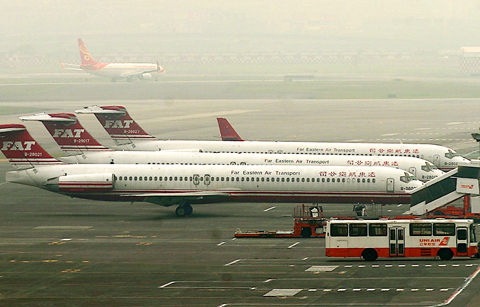
PHOTO: CHIEN JUNG-FONG, TAIPEI TIMES
“Either we approve or reject the company’s plan, or we might ask them to supply additional information on certain points that are unclear,” Lee said.
Lee said FAT would not be able to participate in the distribution of cross-strait regular flights under an uncertain status.
FAT, on the other hand, managed to submit their plan right before the CAA’s office was closed yesterday. FAT spokesperson Tsai Chia-ju (蔡佳儒) said yesterday that the CAA should give them “a fair chance.”
FAT’s certificate expired on Saturday.
The airline submitted a proposal to the CAA before its AOC expired, indicating that it could resume operations by leasing an aircraft from UNI Air (立榮航空).
Later, however, UNI Air and FAT failed to reach an agreement on how the plan would be carried out.
Because the plan was changed after it was submitted, the CAA decided on Thursday to defer its ruling until yesterday and said it would start reviewing FAT’s plan immediately upon receiving the proposal.
Lee also said at a press conference last week that an airline must have a valid certificate to operate regular cross-strait flights, adding that it must also have safe aircraft that can provide the service.
Currently, FAT has four aircraft.
However, the aircraft have all been grounded because the engines are now bank collateral.
FAT must reapply for safety certifications for the aircraft to determine if they are fit to fly.
Meanwhile, FAT still owes the CAA unpaid fees of approximately NT$170 million (US$5.2 million) as of last month.
Because of the unpaid fees, the CAA withdrew FAT’s right to operate 10 international flights.
Lee said that the CAA would set up a strict timeline that lists FAT’s commitments to meet its financial obligations, if it approves the company’s plan to resume operations.
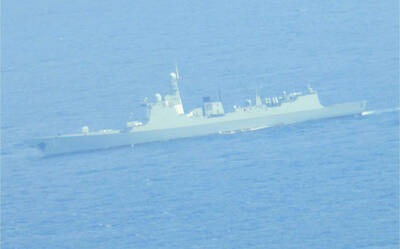
The military has spotted two Chinese warships operating in waters near Penghu County in the Taiwan Strait and sent its own naval and air forces to monitor the vessels, the Ministry of National Defense (MND) said. Beijing sends warships and warplanes into the waters and skies around Taiwan on an almost daily basis, drawing condemnation from Taipei. While the ministry offers daily updates on the locations of Chinese military aircraft, it only rarely gives details of where Chinese warships are operating, generally only when it detects aircraft carriers, as happened last week. A Chinese destroyer and a frigate entered waters to the southwest
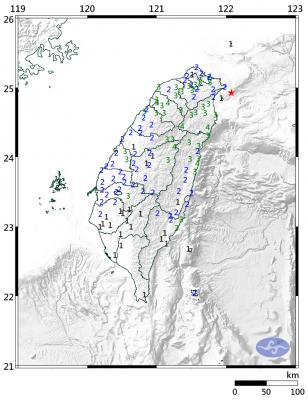
A magnitude 6.1 earthquake struck off the coast of Yilan County at 8:39pm tonight, the Central Weather Administration (CWA) said, with no immediate reports of damage or injuries. The epicenter was 38.7km east-northeast of Yilan County Hall at a focal depth of 98.3km, the CWA’s Seismological Center said. The quake’s maximum intensity, which gauges the actual physical effect of a seismic event, was a level 4 on Taiwan’s 7-tier intensity scale, the center said. That intensity level was recorded in Yilan County’s Nanao Township (南澳), Hsinchu County’s Guansi Township (關西), Nantou County’s Hehuanshan (合歡山) and Hualien County’s Yanliao (鹽寮). An intensity of 3 was
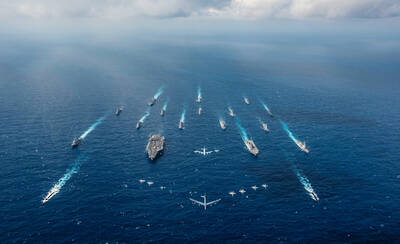
Japanese Prime Minister Sanae Takaichi’s comment last year on Tokyo’s potential reaction to a Taiwan-China conflict has forced Beijing to rewrite its invasion plans, a retired Japanese general said. Takaichi told the Diet on Nov. 7 last year that a Chinese naval blockade or military attack on Taiwan could constitute a “survival-threatening situation” for Japan, potentially allowing Tokyo to exercise its right to collective self-defense. Former Japan Ground Self-Defense Force general Kiyofumi Ogawa said in a recent speech that the remark has been interpreted as meaning Japan could intervene in the early stages of a Taiwan Strait conflict, undermining China’s previous assumptions
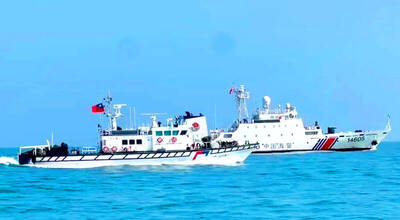
Instead of focusing solely on the threat of a full-scale military invasion, the US and its allies must prepare for a potential Chinese “quarantine” of Taiwan enforced through customs inspections, Stanford University Hoover fellow Eyck Freymann said in a Foreign Affairs article published on Wednesday. China could use various “gray zone” tactics in “reconfiguring the regional and ultimately the global economic order without a war,” said Freymann, who is also a nonresident research fellow at the US Naval War College. China might seize control of Taiwan’s links to the outside world by requiring all flights and ships entering or leaving Taiwan


 RSS
RSS