


The Taipei-based Spanish Chamber of Commerce (CCE) held a tourism fair last Wednesday inviting 200 local travel agents to explore the diversity of Spain’s tourism with the aim of increasing the number of visitors from Taiwan.
CCE director-general Jose-Luis Lamas said the fair was designed not only to promote Spain as a tourist destination for Taiwanese people but also to increase their awareness and knowledge of the country.
FURTHER AFIELD
Ignacio Ducasse, director of the Spanish Tourism Office in Tokyo — which covers Spain’s tourism business in Japan, Taiwan and South Korea — said that while 90 percent of Spain’s tourists come from Europe, the country wants to boost numbers of visitors from further afield.
“We believe that in Taiwan we have strong potential for attracting visitors to Spain. For that reason, Taiwan is a very important market for us,” Ducasse said.
Ducasse said that compared with other Asian countries, Taiwan has one of the highest numbers of travelers to Spain, with an average of 30,000 per year, a number that has been growing steadily over the past decade.
While Taiwanese are familiar with Spain for its culture, art, sports, fashion and food, Spain has much more to offer, he said.
SUNNY
Maria-Luisa Fernandez, deputy director of new markets for Spain’s Institute of Tourism, said Spain is a “green, sunny and modern tourist destination.”
The country also has a rich cultural legacy with some 40 historic sites and 13 cities declared as UNESCO world heritage sites, she said.
These include the Alhambra in Granada, the architectural legacy of Antoni Gaudi in Barcelona and El Escorial in Madrid.
The tourism fair provided travel agents with the latest tourist information and will help them organize various kinds of tourist itineraries for Taiwanese customers, Fernandez said.
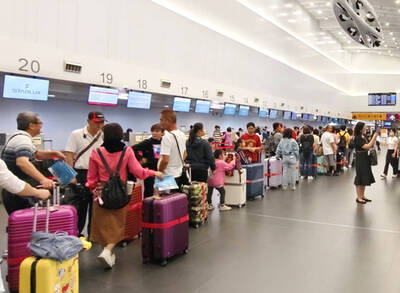
Three Taiwanese airlines have prohibited passengers from packing Bluetooth earbuds and their charger cases in checked luggage. EVA Air and Uni Air said that Bluetooth earbuds and charger cases are categorized as portable electronic devices, which should be switched off if they are placed in checked luggage based on international aviation safety regulations. They must not be in standby or sleep mode. However, as charging would continue when earbuds are placed in the charger cases, which would contravene international aviation regulations, their cases must be carried as hand luggage, they said. Tigerair Taiwan said that earbud charger cases are equipped

Foreign travelers entering Taiwan on a short layover via Taiwan Taoyuan International Airport are receiving NT$600 gift vouchers from yesterday, the Tourism Administration said, adding that it hopes the incentive would boost tourism consumption at the airport. The program, which allows travelers holding non-Taiwan passports who enter the country during a layover of up to 24 hours to claim a voucher, aims to promote attractions at the airport, the agency said in a statement on Friday. To participate, travelers must sign up on the campaign Web site, the agency said. They can then present their passport and boarding pass for their connecting international

Temperatures in northern Taiwan are forecast to reach as high as 30°C today, as an ongoing northeasterly seasonal wind system weakens, the Central Weather Administration (CWA) said. CWA forecaster Tseng Chao-cheng (曾昭誠) said yesterday that with the seasonal wind system weakening, warmer easterly winds would boost the temperature today. Daytime temperatures in northern Taiwan and Yilan County are expected to range from 28°C to 30°C today, up about 3°C from yesterday, Tseng said. According to the CWA, temperature highs in central and southern Taiwan could stay stable. However, the weather is expected to turn cooler starting tonight as the northeasterly wind system strengthens again

Taiwan sweltered through its hottest October on record, the Central Weather Administration (CWA) said yesterday, the latest in a string of global temperature records. The main island endured its highest average temperature since 1950, CWA forecaster Liu Pei-teng said. Temperatures the world over have soared in recent years as human-induced climate change contributes to ever more erratic weather patterns. Taiwan’s average temperature was 27.381°C as of Thursday, Liu said. Liu said the average could slip 0.1°C by the end of yesterday, but it would still be higher than the previous record of 27.009°C in 2016. "The temperature only started lowering around Oct. 18 or 19


 RSS
RSS