


More than 100 people marched in Keelung yesterday in remembrance of those killed by Chinese Nationalist Party (KMT) troops that landed on March 8, 1947, in the aftermath of the 228 Incident.
“It’s raining today [yesterday], and so it was on this day 62 years ago when the KMT troops landed at Keelung in the afternoon,” Chang Yen-hsien (張炎憲), chairman of the 228 Care Association and a historian specializing in modern Taiwanese history, told people gathered at Keelung Harbor’s west pier.
“As soon as they disembarked, soldiers started shooting indiscriminately at people. There were dead bodies everywhere, in the city and floating in the harbor,” Chang said.
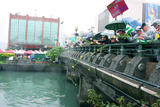
PHOTO: WENG YU-HUANG, TAIPEI TIMES
The troops were sent by dictator Chiang Kai-shek (蔣介石) to quell an uprising against KMT rule that broke out in Taipei on Feb. 28, 1947, and quickly spread.
Chou Chen-tsai (周振才) recalled the trauma.
“The KMT troops began to knock on doors randomly on the morning of March 9 searching for young people [who may have been involved in the uprising] and arrested my uncle and brother,” Chou said, adding that his uncle and brother had not taken part in the uprising and that his father was a KMT Keelung City councilor at the time.
“As soon as my mother — who was pregnant at the time — heard the news, she took a large sum of money and rushed to ‘buy’ their lives,” Chou said.
Chou’s brother returned after his mother bribed officials, but it was too late to save his uncle, who had already been executed and thrown into Tianliao River.
Although Chou’s father was a KMT member, he remained in hiding for months because the government accused him of helping anti-KMT guerillas by stockpiling rice.
“In reality he was handing out rice to poverty-stricken Keelung residents hit by the severe inflation at the time,” Chou said.
After observing a minute of silence, the marchers — holding flowers — proceeded through the city, recounting the details of massacre through a loudspeaker.
The march concluded on a bridge near the mouth of Tianliao River at Keelung Harbor, where marchers threw their flowers into the river to remember those who died.

Considering that most countries issue more than five denominations of banknotes, the central bank has decided to redesign all five denominations, the bank said as it prepares for the first major overhaul of the banknotes in more than 24 years. Central bank Governor Yang Chin-lung (楊金龍) is expected to report to the Legislative Yuan today on the bank’s operations and the redesign’s progress. The bank in a report sent to the legislature ahead of today’s meeting said it had commissioned a survey on the public’s preferences. Survey results showed that NT$100 and NT$1,000 banknotes are the most commonly used, while NT$200 and NT$2,000

The Centers for Disease Control (CDC) yesterday reported the first case of a new COVID-19 subvariant — BA.3.2 — in a 10-year-old Singaporean girl who had a fever upon arrival in Taiwan and tested positive for the disease. The girl left Taiwan on March 20 and the case did not have a direct impact on the local community, it said. The WHO added the BA.3.2 strain to its list of Variants Under Monitoring in December last year, but this was the first imported case of the COVID-19 variant in Taiwan, CDC Deputy Director-General Lin Ming-cheng (林明誠) said. The girl arrived in Taiwan on

South Korea is planning to revise its controversial electronic arrival card, a step Taiwanese officials said prompted them to hold off on planned retaliatory measures, a South Korean media report said yesterday. A Yonhap News Agency report said that the South Korean Ministry of Foreign Affairs is planning to remove the “previous departure place” and “next destination” fields from its e-arrival card system. The plan, reached after interagency consultations, is under review and aims to simplify entry procedures and align the electronic form with the paper version, a South Korean ministry official said. The fields — which appeared only on the electronic form

The Ministry of Foreign Affairs (MOFA) is suspending retaliation measures against South Korea that were set to take effect tomorrow, after Seoul said it is updating its e-arrival system, MOFA said today. The measures were to be a new round of retaliation after Taiwan on March 1 changed South Korea's designation on government-issued alien resident certificates held by South Korean nationals to "South Korea” from the "Republic of Korea," the country’s official name. The move came after months of protests to Seoul over its listing of Taiwan as "China (Taiwan)" in dropdown menus on its new online immigration entry system. MOFA last week


 RSS
RSS