


The Taipei District Court yesterday found former Democratic Progressive Party chairman Shih Ming-teh (施明德) and 15 others not guilty of violating the Assembly and Parade Act (集會遊行法) for unregistered protests during the 2006 Double Ten National Day.
Shih launched a protest movement in August 2006 aimed at forcing then-president Chen Shui-bian (陳水扁) to resign.
On Double Ten National Day, Oct. 10, Shih led thousands of red-clad protesters at a rally outside Taipei Railway Station in an attempt to “besiege” the Presidential Office.
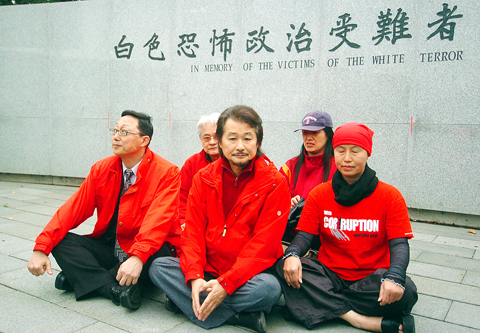
PHOTO: LU CHUN-WEI, TAIPEI TIMES
Prosecutors said that the anti-Chen campaign organizers had not applied for a permit from the Taipei City Police Department to hold a parade or rally, as required by the Assembly and Parade Act.
The Taipei District Court yesterday said in a ruling that although the police had put up warning signs and broadcast requests to the organizers for the crowd to disperse, it was unlikely that so many thousands of protesters could respond to the requests, and therefore under the “principle of proportionality” it could not prove that the organizers violated the Assembly and Parade Act.
The ruling also said that evidence failed to prove that the 16 defendants were in charge of the massive protest.
It said that because the government and the legislature had proposed amendments to the Assembly and Parade Act that would abolish the requirement that protest organizers apply for permits from the police, the act remained in question.
Prosecutors indicted Shih in 2006 along with Chinese Nationalist Party (KMT) Legislator Kuo Su-chun (郭素春), People First Party Legislator Shen Chih-hwei (沈智慧), former KMT legislator and Taipei City Department of Cultural Affairs Director Lee Yong-ping (李永萍), Taipei City Research & Development Evaluation Commission Chairman Emile Sheng (盛治仁) and New Party Taipei City Councilor Lee Hsin (李新).
Nine others were named in the indictment: Chien Hsi-chieh, Liu Kun-li (劉坤鱧), Chang Fu-chung (張富忠), Jerry Fan (范可欽), Wang Li-ping (王麗萍), KMT Legislator Lo Shu-lei (羅淑蕾), former New Party legislator Cheng Lung-shui (鄭龍水), former Chinese Unity Promotion Party chairman Lin Cheng-chieh (林正杰), Chinese Culture University professor Yao Li-ming (姚立明) and lawyer John Wei (魏千峰).
The Taipei District Prosecutors’ Office said yesterday the office would decide whether or not to appeal the case to the Taiwan High Court after reading the ruling.
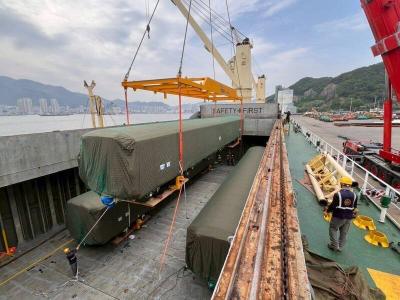
The first of 10 new high-capacity trains purchased from South Korea’s Hyundai Rotem arrived at the Port of Taipei yesterday to meet the demands of an expanding metro network, Taipei Rapid Transit Corp (TRTC) said yesterday. The train completed a three-day, 1,200km voyage from the Port of Masan in South Korea, the company said. Costing NT$590 million (US$18.79 million) each, the new six-carriage trains feature a redesigned interior based on "human-centric" transportation concepts, TRTC said. The design utilizes continuous longitudinal seating to widen the aisles and optimize passenger flow, while also upgrading passenger information displays and driving control systems for a more comfortable
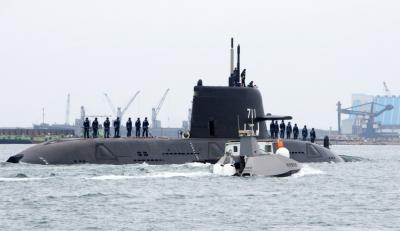
Taiwan's first indigenous defense submarine, the SS-711 Hai Kun (海鯤, or Narwhal), departed for its 13th sea trial at 7am today, marking its seventh submerged test, with delivery to the navy scheduled for July. The outing also marked its first sea deployment since President William Lai (賴清德) boarded the submarine for an inspection on March 19, drawing a crowd of military enthusiasts who gathered to show support. The submarine this morning departed port accompanied by CSBC Corp’s Endeavor Manta (奮進魔鬼魚號) uncrewed surface vessel and a navy M109 assault boat. Amid public interest in key milestones such as torpedo-launching operations and overnight submerged trials,
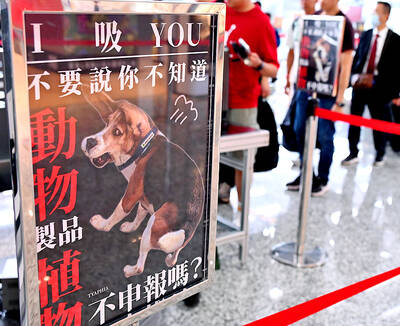
Quarantine awareness posters at Taiwan Taoyuan International Airport have gone viral for their use of wordplay. Issued by the airport branch of the Animal and Plant Health Inspection Agency, the posters feature sniffer dogs making a range of facial expressions, paired with advisory messages built around homophones. “We update the messages for holidays and campaign needs, periodically refreshing materials to attract people’s attention,” quarantine officials said. “The aim is to use the dogs’ appeal to draw focus to quarantine regulations.” A Japanese traveler visiting Taiwan has posted a photo on X of a poster showing a quarantine dog with a

Taiwan’s coffee community has launched a “one-person-one-e-mail” campaign, calling for people to send a protest-e-mail to the World Coffee Championships (WCC) urging it to redesignate Taiwanese competitors as from “Taiwan,” rather than “Chinese Taipei.” The call followed sudden action last week after the WCC changed all references to Taiwanese competitors from “Taiwan” to “Chinese Taipei,” including recent World Latte Art champion Bala (林紹興), who won the World Latte Art Championship in San Diego earlier this month. When Bala received the trophy, he was referred to as representing Taiwan, as well as in the announcement on the WCC’s Web site, until it


 RSS
RSS