


Media studies experts yesterday criticized the National Communications Commission’s (NCC) proposed amendment to the Satellite Radio and Television Act (衛星廣播電視法), saying that although it contained good intentions, it would be difficult for the commission to execute.
Hu Yu-wei (胡幼偉), a professor at National Taiwan Normal University’s Communication Graduate Institute, questioned the viability of new regulations asking TV news channels to establish ethics committees to regulate news quality. He also mentioned problems with the proposed “fact-checking” mechanism and its rules on embedded marketing in TV news.
“What most news channels will be asking now is: How am I going to use these stories paid for by my advertisers and not get caught?” Hu said, adding that the commission would have a hard time determining embedded marketing in journalism as standard evaluations are in dispute.
Hu said all news channels knew the government was the biggest sponsor of TV stations. However, the Satellite Radio and Television Act did not prevent the government from tampering with the content of TV news.
He said that proper use of the government budget should be listed in the Budget Act (預算法), including banning the practice of embedded marketing.
Former Government Information Office deputy director-general Hong Chong-jan (洪瓊娟) said the amendment was too detailed in describing violations, leaving the government no wiggle room to produce TV or radio materials that serve the public interest, such as programs about disease prevention and control and the government’s assistance for foreign spouses.
Hong said the minimum penalty for violations was NT$300,000 and that there was no stipulation that a warning must be issued to a TV station before it was fined.
Hu and Hung made their views known at a hearing hosted by the National Press Council.
Representatives from cable TV news channels, including ERA News, Public Television Service, TVBS, GTV, Formosa News, SET-TV, Unique Satellite TV and China Television, as well as National Communications Commission member Weng Hsiao-ling (翁曉玲), attended the hearing.
Representatives from the channels all said that their stations have their own self-disciplinary mechanism and guidelines for controlling the quality of news. They said that further regulation by the NCC was unnecessary and impeded freedom of the press.
Weng said the NCC had suggested that the regulations on embedded marketing be listed in the Budget Act, but the idea was rejected in a cross-departmental meeting.
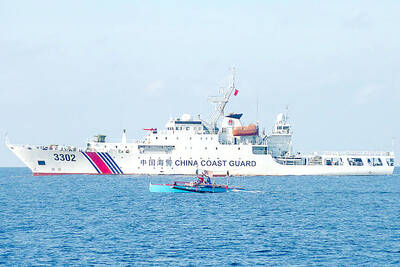
EXPANSIONIST: China deploys an average of 40 to 50 warships and coast guard vessels daily in the South China Sea, despite pledges not to militarize the region, an official said China is attempting to expand its influence across the First Island Chain and increase pressure on Japan by sending coast guard vessels into waters off of Taiwan under the pretext of maritime negotiations with Japan and the Philippines, a national security official said yesterday. China’s recent actions in the waters east of Taiwan and Japan and the Philippines’ exclusive economic zones (EEZ) are attempts to establish dominance in First Island Chain waters, said the official who declined to be named, adding that this is “expansion disguised as law enforcement.” Framing China’s actions solely as a cross-strait issue is a serious misjudgment that
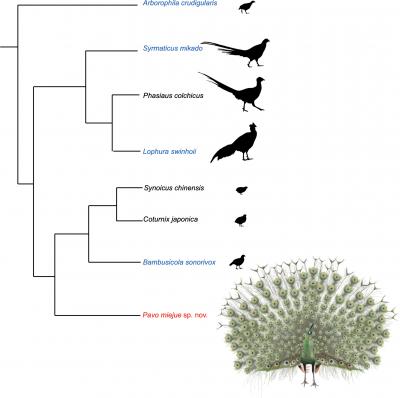
Through analyzing fossil evidence, a research team at National Taiwan University (NTU) discovered the largest endemic bird to have lived in Taiwan, naming it Pavo miejue, or extinct peafowl (滅絕孔雀). The Mikado pheasant, which is printed on the back of the NT$1,000 bank note, was previously believed to be the biggest endemic bird to Taiwan. The research team’s findings suggest that Pavo miejue lived during the Pleistocene epoch tens of thousands of years ago. It is the first endemic extinct bird species discovered and formally named in Taiwan. The study was coauthored by NTU Institute of Ecology and Evolutionary Biology professor Tsai Cheng-hsiu (蔡政修),
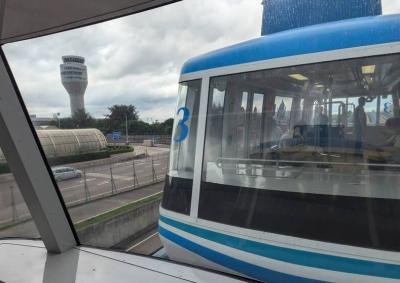
Taiwan Taoyuan International Airport is to suspend its automated Skytrain service connecting Terminal 1 and Terminal 2 starting on July 1 to facilitate connection works for the upcoming Terminal 3, the airport operator said today. Passengers and staff who need to travel between the two terminals after the suspension can instead use the Taoyuan MRT or the airport's 24-hour shuttle bus service, Taoyuan International Airport Corp said. The Taoyuan MRT Airport Line directly links the two terminals, while the shuttle buses are to operate around the clock, the company added. The Skytrain provides free transportation between the airport’s two terminals for travelers and
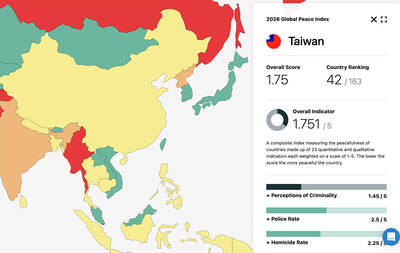
Taiwan ranked 42nd in terms of peacefulness among 163 countries, down five places from last year, according to this year’s Global Peace Index. With an overall score of 1.751, Taiwan dropped from 37th last year, the report published by the global Institute for Economics and Peace showed. The overall score measures a country’s level of peacefulness using 23 quantitative and qualitative indicators across three domains — ongoing domestic and international conflict, societal safety and security, and militarization. While Taiwan ranked 42nd worldwide, it was listed in ninth place among the 19 Asian-Pacific countries in the report, after New Zealand, Singapore, Japan, Malaysia,


 RSS
RSS