


Although they have never set foot on Tibetan soil, Canadian-born Students for a Free Tibet (SFT) executive director Lhadon Tethong and Indian-born deputy executive director Tenzin Dorjee shared their dream of an independent Tibet and views on some current issues in Taiwan during an interview with the Taipei Times yesterday.
“I consider myself a Tibetan and a Canadian both at the same time,” Lhadon said, while sitting in a meeting room at Fujen Catholic University (FJU) before delivering a speech with Tenzin about Tibetan history and the Tibetan struggle to gain independence from China to a group of FJU students yesterday afternoon.
In fact, the FJU was the sixth university that Lhadon and Tzenzin have spoken at since their arrival in Taiwan last Wednesday, and there are two to three more universities to come in their schedule.
Lhadon’s father was a Tibetan refugee in India, while her mother was a Canadian who worked at Tibetan refugee camps in India for 12 years.
Although Lhadon was born and raised in Canada and barely speaks Tibetan, she can understand it and still has a strong sense of Tibetan identity.
“My feelings for Tibet are very strong — although we’re far apart,” Lhadon said. “My inspiration came from [the story of] our parents and story of our people, and for a large part, from the Dalai Lama.”
AMONG TIBETANS
Lhadon said that she grew up among Tibetans in Canada, listening to stories of elders in the community who had lived under Chinese rule.
“Since I was little, I have been going to March 10 rallies, shouting ‘free Tibet,’ and when I wrote essays and papers at school, I wrote about the Tibet issue — so [supporting the Tibetan cause] became naturally just part of us,” she said.
Later in life, Lhadon grabbed every possible opportunity to attend speeches by the Dalai Lama whenever he visited North America.
“His messages are about love and peace, but they are so strong,” she said.
She became an activist after leaving home for college in the small city of Halifax, Nova Scotia in eastern Canada, where the majority of the people were Caucasians who didn’t know much about the Tibet issue.
“The people there [in Halifax] knew little to nothing about Tibet, so I felt it was my duty to start a chapter [of the SFT] there,” Lhadon said.
Hence, with a few classmates, Lhadon began to organize candlelit vigils or film festivals about Tibet.
“It’s quite challenging to put yourself out there for something as important as the Tibet issue in a foreign community,” she said. “But I told myself: ‘you have to do this’ — and gladly, people were friendly and open-minded about the issue.”
SIMILAR SITUATION
Tenzin, who was born and raised in Dharamsala, India — the seat of the Tibetan government in-exile — before moving to the US at the age of 18 to attend college, experienced a similar situation.
“It was difficult at first,” Tenzin said. “First, in India, everybody thinks the same way, but it’s not the case in the US. I was not able to fully express myself in English, and I was brought up in a more conservative culture in which people are less encouraged to speak out.”
But once Tenzin took the initial step, he found it surprisingly rewarding.
“Although it’s more challenging to campaign for the Tibetan cause in the US, it’s actually more inspiring — it’s good to see people from different countries getting together for the same cause,” he said.
“I would say I’m being a little selfish when I’m in it, because I’m a Tibetan, but when I saw people who are not Tibetans also in the movement, I know they’re showing the bright side of human beings,” Tenzin added.
MA COMMENT
When asked to comment on President Ma Ying-jeou’s (馬英九) recent remark that the timing is not appropriate for the Dalai Lama to visit Taiwan at the moment, Tenzin said he felt sad.
“I don’t feel sad for the Dalai Lama, but I feel sad for my friends in Taiwan — it deprives them of the freedom of religion, and their right to learn from the Dalai Lama,” he said. “I’m a Buddhist, and I know how it feels.”
Tenzin then added that the incident shows that “the dictatorship in China not only undermines the freedom for Tibetans in Tibet, but also freedom in other countries.”
He also warned the Taiwanese to be cautious when developing a relationship with China.
He said that while many Tibetans insisted on resisting Chinese invasion in the late 1940s and early 1950s, the Tibetan government at the time tried to convince the people that “if we’re nice to the Chinese, they would be nice to us as well” and some even suggested that working with the Chinese could improve the economy in Tibet.
“For a little gain, we’ve lost the entire economy; to appease the powerful neighbor, we’ve plunged into the greatest tragedy,” Tenzin said.
“We learned a bitter and harsh lesson. We don’t want our tragedy to happen to anyone else. We don’t want that to happen to the Taiwanese people,” he said. “Absolutely do not trust [the Chinese].”


UPGRADE: The Kang Ding-class frigate is replacing its Chaparall missiles with Tien Chien II and Hua Yang VLS, which would provide it with long-range, 360° air defense Taiwan plans to produce 1,200 to 1,376 Hai Chien II missiles (海劍二, Sea Sword II) — also known as TC-2N — to serve as the standard air defense system of the navy’s surface combatant fleet, a source said yesterday. Last week, the Hai Chien II, the naval version of the Tien Kung II missile (天劍二, Sky Sword II), completed a live-fire test in waters off the National Chungshan Institute of Science and Technology’s Jiupeng facility (九鵬) in Pingtung County’s Manjhou Township (滿州). The MIM72 Chaparral and other dated air defense missiles that currently arm Taiwanese ships have inadequate range to combat Chinese

REASONS FOR TRAVEL: An assistant professor said that proposed amendments to penalize drivers if they used drugs overseas would not deter people from traveling People who operate a motor vehicle under the influence of marijuana would have their driver’s license revoked, even if they used the substance while overseas, the Ministry of Transportation and Communications said yesterday, citing proposed amendments to the Road Traffic Management and Penalty Act (道路交通管理處罰條例). The amendments would also authorize the government to revoke the licenses of people determined to have used Category 1 or Category 2 narcotics, even if they were not operating a vehicle while under the influence of drugs, as well as ban them from taking the license test for three years, the ministry said. People aged 18 or
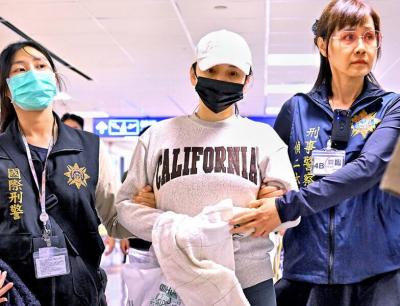
Johanne Liou (劉喬安), a Taiwanese woman who shot to unwanted fame during the Sunflower movement protests in 2014, returned to Taiwan last night after being deported from the US. She is to stand trial in Taiwan for charges involving embezzlement, fraud and drug crimes. The Criminal Investigation Bureau (CIB) said it took her into custody at Taiwan Taoyuan International Airport and would first question her before transferring her to the New Taipei District Prosecutors’ Office. She was arrested upon disembarking a flight from San Francisco that landed shortly before 7pm. Liou absconded to the US in 2019 after jumping bail
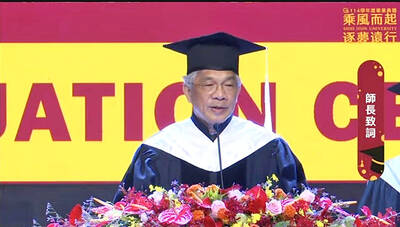
Shih Hsin University President Chen Ching-he (陳清河) yesterday issued a public apology for comments made in his commencement speech last week, stating that he has asked the school to suspend his duties and halt his wages for two months as a show of contrition. At the commencement ceremony on May 30, Chen said, “If you don’t manage your time well, or your own emotions, or your health, then I am telling every one of you — put a quick end to ‘you,’ because the world has no need for ‘you.’” The comments have sparked significant controversy online, and Chen through an open


 RSS
RSS