


The International Federation for Human Rights has become the latest international group to express concern regarding the response of police to protests against Association for Relations Across the Taiwan Strait Chairman Chen Yun-lin (陳雲林) earlier this month.
The Paris-based group sent letters to President Ma Ying-jeou (馬英九) and Premier Liu Chao-shiuan (劉兆玄) on Wednesday, expressing concern over what it called “grave violations of human rights” committed by police during the protests.
The police’s actions were aimed at suppressing freedom of speech, the group said.
In the letter, the federation said the authorities “had taken many dramatic measures, including: confiscating and damaging private property, harassing and assaulting people who came too close to undefined or vaguely defined areas, clearing communal highway lanes with force, conducting random searches and arrests, and restricting the freedom of movement of citizens.”
The organization said it feared the “aggressions” were intended to suppress “freedom of expression of citizens.”
“These measures seem to be aimed at silencing political opinions rather than protecting security, and they blatantly violate the Constitution of Taiwan [sic], notably Article[s] 11 and 14 which protect freedom of expression and international human rights standards.”
“The police and national security authority should be held responsible for violating their legal obligations,” the group said.
It called on the Judicial Yuan and Control Yuan to investigate the allegations of human rights violations.
It also called on the government to amend the Assembly and Parade Law (集會遊行法) to abolish the requirement that protest organizers apply for permits from the police.
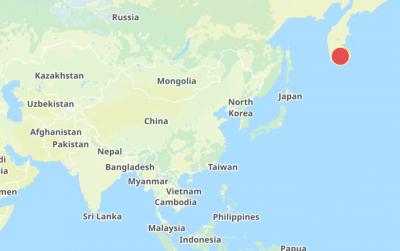
The Central Weather Administration (CWA) today issued a "tsunami watch" alert after a magnitude 8.7 earthquake struck off the Kamchatka Peninsula in northeastern Russia earlier in the morning. The quake struck off the east coast of the Kamchatka Peninsula at 7:25am (Taiwan time) at a depth of about 19km, the CWA said, citing figures from the Pacific Tsunami Warning Center. The CWA's Seismological Center said preliminary assessments indicate that a tsunami could reach Taiwan's coastal areas by 1:18pm today. The CWA urged residents along the coast to stay alert and take necessary precautions as waves as high as 1m could hit the southeastern

The National Museum of Taiwan Literature is next month to hold an exhibition in Osaka, Japan, showcasing the rich and unique history of Taiwanese folklore and literature. The exhibition, which is to run from Aug. 10 to Aug. 20 at the city’s Central Public Hall, is part of the “We Taiwan” at Expo 2025 series, highlighting Taiwan’s cultural ties with the international community, National Museum of Taiwan Literature director Chen Ying-fang (陳瑩芳) said. Folklore and literature, among Taiwan’s richest cultural heritages, naturally deserve a central place in the global dialogue, Chen said. Taiwan’s folklore would be immediately apparent at the entrance of the
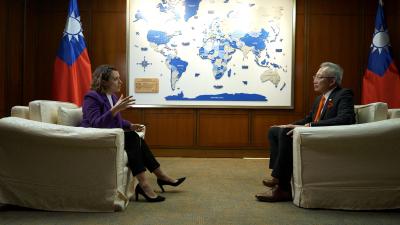
“China is preparing to invade Taiwan,” Deputy Minister of Foreign Affairs Francois Wu (吳志中) said in an exclusive interview with British media channel Sky News for a special report titled, “Is Taiwan ready for a Chinese invasion?” the Ministry of Foreign Affairs said today in a statement. The 25-minute-long special report by Helen Ann-Smith released yesterday saw Sky News travel to Penghu, Taoyuan and Taipei to discuss the possibility of a Chinese invasion and how Taiwan is preparing for an attack. The film observed emergency response drills, interviewed baseball fans at the Taipei Dome on their views of US President
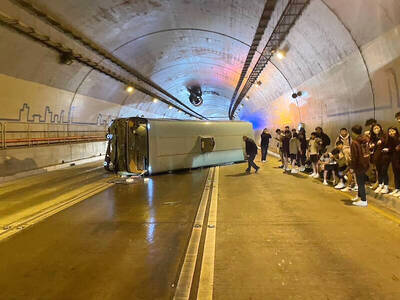
Speeding and badly maintained roads were the main causes of a school bus accident on a rainy day in Taipei last year that severely injured two people and left 22 with minor injuries, the Taiwan Transportation and Safety Board said. On March 11 last year, a Kang Chiao International School bus overturned inside the Wenshan Tunnel (文山隧道) on the northbound lane of the Xinyi Expressway. The tour bus, owned by Long Lai Co, exceeded the speed limit after entering the tunnel, the board’s investigation found. Sensing that the rear of the vehicle was swaying, the driver attempted to use the service and exhaust


 RSS
RSS