


Legislative Speaker Wang Jin-pyng (王金平) said yesterday he was opposed to a suggestion by a Chinese Nationalist Party (KMT) think tank that the legislature speed up its review of the government’s budget requests by treating all the requests as a “package deal.”
Asked for comment in the legislature, Wang said the KMT think tank had previously suggested to KMT Chairman Wu Poh-hsiung (吳伯雄) during a conference that the legislature help the Cabinet pass the fiscal budget proposals as a “package deal” as soon as possible.
“[But] it is illegal to do so. The Council of Grand Justices had also previously ruled against this,” Wang said.
“[The budget requests] should be dealt with item by item ... everything should be handled in accordance with legislative procedures,” he said.
Wang said the think tank had not made the suggestion at the instruction of the Executive Yuan or the Presidential Office.
Wang’s remarks came in response to a story on the Chinese-language Liberty Times (the Taipei Times’ sister newspaper) said yesterday the government hoped to achieve “political redemption” through the execution of NT$6 trillion (US$184.1 billion) in fiscal budget requests for next year.
The story quoted Wang as saying that “senior KMT officials” once proposed that the legislature handle the budget proposals as a package deal.
Meanwhile, two KMT legislators vowed to slash the government’s budget requests intended to cover public officials’ extra bonuses.
KMT Legislator John Chiang (蔣孝嚴) said the Ministry of Foreign Affairs had requested about NT$600 million to reward officials in its budget proposal for next year.
“Although it is necessary to reward [government officials], the money should not be granted to the ministry if the funds are treated as [officials’] additional salary,” Chiang said, urging the ministry to make “reasonable” adjustments to the budget request.
The government drew ire yesterday as a number of agencies — the ministry not included — requested NT$300 million for extra bonuses for officials for the next fiscal year.
“The public has been suffering. [The government] should not request that people spend their hard-earned money covering officials’ bonuses,” KMT Legislator Lin Te-fu (林德福) said.
In a press release later yesterday, the Cabinet defended the budget requests, saying it had ratified the requests after thorough evaluation of the agencies’ needs.
The Cabinet said the requested bonuses would not be granted to personnel until after the legislature has approved the requests.
In response, the Democratic Progressive Party (DPP) accused the KMT-dominated legislature of failing to supervise the government’s budget for next year.
DPP deputy caucus whip Pan Meng-an (潘孟安) said next year’s budget bill had only been cut by 0.011 percent in the legislature, meaning KMT legislators were not keeping check on government spending.
He said that while the country was facing a recession, the government was allocating handsome year-end bonuses for employers of state-run companies, adding that state-run oil refiner CPC Corp, Taiwan (台灣中油) had proposed a 4.6 month bonus for each employee, Taiwan Power Co (台電) two months, the Bureau of Labor Insurance 3.76 months and the Bureau of National Health Insurance — which faces huge deficits — 3.75 months.
DPP caucus whip William Lai (賴清德) said that as the DPP only has 27 seats in the legislature, it is unable to supervise the government budget bill.
In a meeting of the Education and Culture Committee yesterday, DPP Legislator Kuan Bi-ling (管碧玲) said the DPP only has three seats on the Diplomacy and National Defense Committee, Education and Culture Committee, Transportation Committee, Finance Committee and Judiciary and Organic Laws and Statues Committee, which means that DPP legislators in those committees are unable to reach the threshold of four legislators for a bill to be introduced.
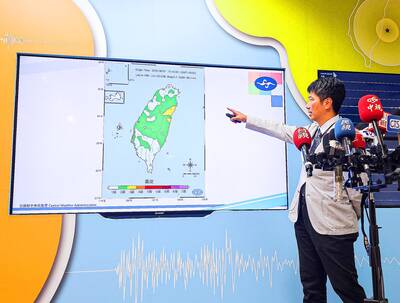
Aftershocks from a magnitude 6.2 earthquake that struck off Yilan County at 3:45pm yesterday could reach a magnitude of 5 to 5.5, the Central Weather Administration (CWA) said. Seismological Center technical officer Chiu Chun-ta (邱俊達) told a news conference that the epicenter of the temblor was more than 100km from Taiwan. Although predicted to measure between magnitude 5 and 5.5, the aftershocks would reach an intensity of 1 on Taiwan’s 7-tier scale, which gauges the actual effect of an earthquake, he said. The earthquake lasted longer in Taipei because the city is in a basin, he said. The quake’s epicenter was about 128.9km east-southeast

GENSLER SURVEY: ‘Economic infrastructure is not enough. A city needs to inspire pride, offer moments of joy and foster a sense of belonging,’ the company said Taipei was named the city with the “highest staying power” in the world by US-based design and architecture firm Gensler. The Taiwanese capital earned the top spot among 65 cities across six continents with 64 percent of Taipei respondents in a survey of 33,000 people saying they wanted to stay in the city. Rounding out the top five were Vietnam’s Ho Chi Minh City (61 percent), Singapore (59 percent), Sydney (58 percent) and Berlin (51 percent). Sixth to 10th place went to Monterrey, Mexico; Munich, Germany; Sao Paulo, Brazil; Vancouver; and Seoul. Cities in the US were ranked separately, with Minneapolis first at
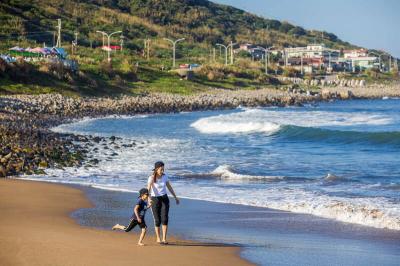
The New Taipei City Government today warned about the often-overlooked dangers of playing in water, and recommended safe swimming destinations to cool off from the summer heat. The following locations in the city as safe and fun for those looking to enjoy the water: Chienshuiwan (淺水灣), Baishawan (白沙灣), Jhongjiao Bay (中角灣), Fulong Beach Resort (福隆海水浴場) and Sansia District’s (三峽) Dabao River (大豹溪), New Taipei City Tourism and Travel Department Director-General Yang Tsung-min (楊宗珉) said. Outdoor bodies of water have variables outside of human control, such as changing currents, differing elevations and environmental hazards, all of which can lead to accidents, Yang said. Sudden
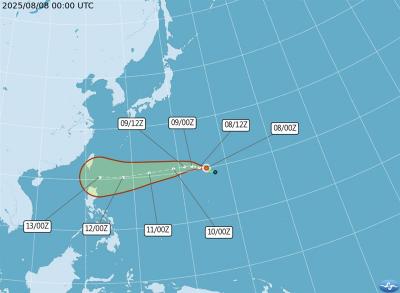
Tropical Storm Podul has formed over waters north-northeast of Guam and is expected to approach the seas southeast of Taiwan next week, the Central Weather Administration (CWA) said today. The 11th Pacific storm of the year developed at 2am over waters about 2,660km east of Oluanpi (歐鑾鼻), Pingtung County — Taiwan's southernmost tip. It is projected to move westward and could have its most significant impact on Taiwan on Wednesday and Thursday next week, the CWA said. The agency did not rule out the possibility of issuing a sea warning at that time. According to the CWA's latest update, Podul is drifting west-northwest


 RSS
RSS