


When Yeh Ming-hsun (葉明勳), the first correspondent sent by the Central News Agency (CNA) in China to Taiwan after World War II, was interviewed by a Chinese-language daily two years ago, he said he had not made enough contributions to journalism in Taiwan.
But the rounds of applause and cheers for him during an honorary doctorate award ceremony at a crowded auditorium at Shih Hsin University (SHU) yesterday morning suggests he was being too humble.
The university yesterday awarded the 96-year-old Yeh its first honorary doctorate since its foundation 52 years ago, a recognition that Yeh originally declined.
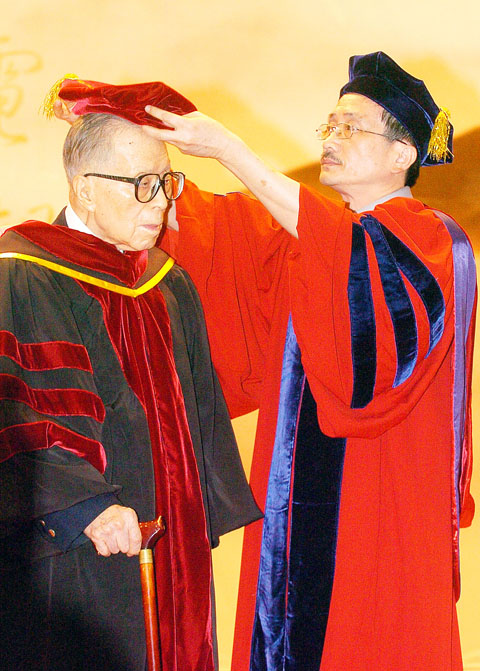
PHOTO: WANG MIN-WEI, TAIPEI TIMES
As he stood on the stage before hundreds of attendees, including senior politicians and college students, Yeh said: “Receiving an honorary doctorate at the age of 96, I might be able to be included in Guinness’ World Records.”
Yeh can be considered a legendary figure of Taiwanese journalism and his career reads like a chapter of the country’s media history.
Born in 1913, Yeh’s proficiency in both English and Hoklo helped him become the first CNA correspondent dispatched to Taiwan.
He flew on a military charter flight along with four other reporters from Chongqing to Taiwan on Oct. 5, 1945, where he filed a story on the Chinese Nationalist Party (KMT) government’s official acceptance of Tokyo’s surrender at Taipei’s Zhongshan Hall.
As he was busy filing reports back to Chongqing, Yeh was also tasked with organizing CNA’s Taipei branch after the agency took over the office of Domei Tsushinsha — the official news service of the Japanese government.
lack of funding
The branch was officially opened in February 1946, but operation of the organization was difficult because of lack of funding from CNA headquarters for three consecutive years.
But Yeh still managed to meet branch expenses by spending several tens of thousands of yen left over by the Japanese news agency.
Yeh left CNA in November 1950, after the agency headquarters moved to Taipei, but his journalism career did not end there.
In July 1954, Yeh’s career in newspapers kicked off when he became president of the KMT-owned Chunghwa Daily.
During his four-year term, Yeh reformed the paper, adding sports and entertainment sections while giving importance to columns.
He then served as president of the Independence Evening Post between 1959 and 1965 and acting chairman of the Taiwan Shin Sheng Daily News between 1998 and 1999.
He also expanded his media affiliations to television and radio by serving as supervisor of the Taiwan Television Enterprise and Chengsheng Broadcasting Corp. He was also a co-founder of United Advertising (聯廣公司), the biggest local advertising firm in the country.
While Yeh was developing his professional career, he did not forget to promote journalism education in Taiwan.
In the 1950s, he helped Cheng She-wo (成舍我) establish the Shih Hsin School of Journalism — one of the few journalism schools at that stage of Taiwanese history — and worked as vice president of the school in 1966 and served as chairman of the board of SHU in 1991 and 2006.
“Mr Yeh served journalism and promoted the education of journalists for more than 50 years ... He insisted on his journalistic ideals and played an active role in professional organizations to defend freedom of speech and journalistic ethics,” said James Hsiung (熊杰), dean of SHU’s College of Journalism and Communications.
Yeh is renowned not only for his professional career and promotion of journalistic training but also for his personality.
mediation
Huang Chao-heng (黃肇珩), former director of the CNA domestic news department, once described Yeh as “efficacious,” a compliment of his mediation ability.
Yeh’s six decades in the media have earned him friends across party lines and from all walks of life.
“Many disputes were resolved because of his mediation. We once asked him how he managed to achieve this. He told us if one is calm in mind, one is peaceful in disposition,” SHU chairwoman Cheng Chia-ling (成嘉玲) said.
But this does not mean Yeh was afraid of speaking out, she said.
“In the matter of right and wrong, he usually says what is on his mind instead of making a compromise,” she said.
Yeh’s bold conversation with then-governor of Taiwan Chen Yi (陳儀) right after the 228 Incident -— a massacre in 1947 when KMT troops suppressed a Taiwanese uprising, leaving tens of thousands dead, missing or imprisoned — exemplified Yeh’s character.
Yeh told Chen that he had “failed to impose enough regulations in politics but put too many bans on the economy” during his term in office.

REASONS FOR TRAVEL: An assistant professor said that proposed amendments to penalize drivers if they used drugs overseas would not deter people from traveling People who operate a motor vehicle under the influence of marijuana would have their driver’s license revoked, even if they used the substance while overseas, the Ministry of Transportation and Communications said yesterday, citing proposed amendments to the Road Traffic Management and Penalty Act (道路交通管理處罰條例). The amendments would also authorize the government to revoke the licenses of people determined to have used Category 1 or Category 2 narcotics, even if they were not operating a vehicle while under the influence of drugs, as well as ban them from taking the license test for three years, the ministry said. People aged 18 or

GLOBALGIVING: ‘ Caving to external pressure is not acceptable for an organization that has cultivated justice reform and human rights for 30 years,’ one NGO said A slew of non-government organizations (NGOs) have withdrawn from the GlobalGiving fundraising platform after it announced it would use “Chinese Taipei” instead of “Taiwan” from next month. The Taiwan Good Rice Association wrote on Facebook on Friday that it was informed on April 28 via a teleconference call of the change, which was made because the platform wanted to operate in China. Taiwan Good Rice is to terminate all cooperative relationships with GlobalGiving in response to the platform’s “unilateral and non-negotiable” decision to remove references to Taiwan, the NGO said. “Taiwan is in the official name of Taiwan Good Rice Association and the

HEAVY WEATHER: Typhoon Jangmi is due to crash straight into the Ryukyus as airlines look to shift flights to larger aircraft or cancel flights to Okinawa entirely Taiwan’s international air carriers announced flight adjustments over the weekend as Typhoon Jangmi is forecast to hit the Ryukyu Islands today and tomorrow. The Central Weather Administration (CWA) upgraded Jangmi from a tropical storm to a typhoon at 8am yesterday, with the eye located 580km south of Naha city. It was moving north at 19kph. Today, China Airlines’ CI-120, CI-121, CI-122 and CI-123 flights between Taoyuan and Naha, Okinawa, have been canceled as well as CI-132 and CI-133 between Kaohsiung and Naha. EVA Air’s BR-112, BR-113, BR-186 and BR-185 flights between Taoyuan and Naha are also canceled. Low-cost carrier Tigerair Taiwan canceled IT-230,
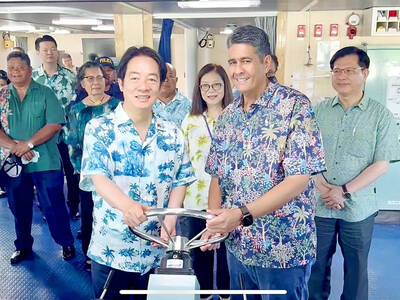
MULTIPRONGED APPROACH: China has sought to pressure Palau across a number of fronts, but the island nation has staunchly resisted overtures to ditch Taiwan Palau has been firm in backing Taiwan despite Chinese pressure that uses tourism economics, cyberattacks and criminal infiltration as tools to threaten the Pacific ally into renouncing its recognition of Taiwan as a sovereign state. The Presidential Office yesterday announced that Vice President Hsiao Bi-khim (蕭美琴) would visit Palau from Saturday to Wednesday next week at the invitation of Palauan President Surangel Whipps Jr. Whipps in April said in an interview that China had outspokenly asked Palau to “denounce Taiwan.” “And we have said: ‘We have no enemies, but nobody tells us who our friends are,’” he said. Whipps has told reporters multiple times


 RSS
RSS