


Thick incense smoke fills the gilded, elaborately carved temple. A 50-year-old woman kneels down and bows before a table piled high with plastic toys and baby bottles.
Clasping her hands in supplication, Lin Shu-wen utters a short prayer for the two abortions she had more than 20 years ago.
The retired history teacher is one of scores of women who have come to Chingshui Temple (清水祖師廟) in Taipei this month to make similar prayers. With abortion becoming less taboo, several dozen Buddhist and Taoist temples are offering a “baby souls mourning” service during ghost month, a time when people honor wandering ghosts in the hope they will be placated and cease to haunt the living.
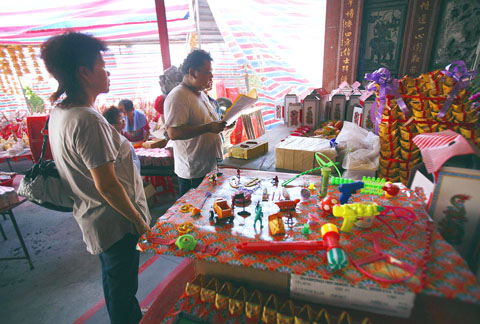
PHOTO: AP
In offering the baby souls service, the temples — longtime opponents of abortion — are recognizing a reality they nonetheless regret: Abortion is on the rise.
Many ridicule the new ritual, seeing it as a backward superstition. Some respected monks condemn it for not reflecting official Buddhist doctrine.
But Lin said she had no hesitation about taking part in the ceremony, during which a red-robed Taoist priest rang a bell to summon baby spirits as she prayed for the redemption of her aborted fetuses.
The mother of two adult daughters, Lin said she had the abortions in her mid-20s because she feared the extra burden would short-circuit her budding career.
Now, she regrets the decision.
“I could have raised them,” she said. “My mother sold fish in the market with her big tummy and yet she raised all her seven kids.”
In Taiwan’s Confucian society, abortions used to be frowned on, because they were seen as the outcome of loose or illicit sex.
That began to change in the 1970s, when the economy grew spectacularly and many working women wanted to limit their families to one or two children.
Growth in teenage sex also fueled abortions. By last year, gynecologists say, one fetus was aborted for every three births.
The law permits abortion, but those under 18 need parental consent, and that drives many of them to seek illegal clinics or abortion drugs to keep their pregnancies secret from parents, abortion rights activists say.
Religious groups were once at the forefront of the anti-abortion movement, railing against the legalization of the practice in 1985 and pushing unsuccessfully to roll back the law in the following decade.
Now, with the battle effectively lost, some temples are trying to spur soul-searching among women who have had abortions.
Chingshui Temple is a leading proponent of the new approach.
Elaborate “baby souls mourning” rituals are a chance to help unborn children be reincarnated, possibly into well-to-do families, provided the mothers pray hard enough, temple priest Chen Chun-kai says.
“We tell the women fetuses are complete with souls and must not be removed on a whim,” Chen said. “In the old days, babies only died at birth or through natural deaths, they were not aborted.”
Unlike the elderly, young women generally don’t make regular temple visits. But the baby souls ritual is drawing a growing number, Chen said.
“When they ran into mishaps in their lives or careers, they began to wonder if the aborted babies were taking revenge,” he said.
Some small temples are offering online mourning rituals for women who do not want to risk public exposure.
The “Baby Palace” set up by Taoist monk Chi Chin-cheng charges NT$2,000 to reincarnate aborted fetuses by e-mail.
This marriage of high technology and religious ritual is far from universally popular.
Tsai Wan-fen (蔡宛芬), secretary general of feminist group Taiwan Women’s Link, says sex education needs to be stepped up, rather than practicing superstition.
Schools “still mainly teach students to avoid premarital sex, not addressing their sexual desires and the need for birth control,” she said.

Considering that most countries issue more than five denominations of banknotes, the central bank has decided to redesign all five denominations, the bank said as it prepares for the first major overhaul of the banknotes in more than 24 years. Central bank Governor Yang Chin-lung (楊金龍) is expected to report to the Legislative Yuan today on the bank’s operations and the redesign’s progress. The bank in a report sent to the legislature ahead of today’s meeting said it had commissioned a survey on the public’s preferences. Survey results showed that NT$100 and NT$1,000 banknotes are the most commonly used, while NT$200 and NT$2,000

The Centers for Disease Control (CDC) yesterday reported the first case of a new COVID-19 subvariant — BA.3.2 — in a 10-year-old Singaporean girl who had a fever upon arrival in Taiwan and tested positive for the disease. The girl left Taiwan on March 20 and the case did not have a direct impact on the local community, it said. The WHO added the BA.3.2 strain to its list of Variants Under Monitoring in December last year, but this was the first imported case of the COVID-19 variant in Taiwan, CDC Deputy Director-General Lin Ming-cheng (林明誠) said. The girl arrived in Taiwan on

South Korea is planning to revise its controversial electronic arrival card, a step Taiwanese officials said prompted them to hold off on planned retaliatory measures, a South Korean media report said yesterday. A Yonhap News Agency report said that the South Korean Ministry of Foreign Affairs is planning to remove the “previous departure place” and “next destination” fields from its e-arrival card system. The plan, reached after interagency consultations, is under review and aims to simplify entry procedures and align the electronic form with the paper version, a South Korean ministry official said. The fields — which appeared only on the electronic form

The Ministry of Foreign Affairs (MOFA) is suspending retaliation measures against South Korea that were set to take effect tomorrow, after Seoul said it is updating its e-arrival system, MOFA said today. The measures were to be a new round of retaliation after Taiwan on March 1 changed South Korea's designation on government-issued alien resident certificates held by South Korean nationals to "South Korea” from the "Republic of Korea," the country’s official name. The move came after months of protests to Seoul over its listing of Taiwan as "China (Taiwan)" in dropdown menus on its new online immigration entry system. MOFA last week


 RSS
RSS