


Much to the excitement of local researchers, artificially raised Formosan landlocked salmon — a critically endangered species — has been successfully breeding since being introduced into new habitats in the wild, an ichthyologist said on Tuesday.
Researchers from the Wuling Formosan Landlocked Salmon Conservation Center in Sheipa National Park (雪霸國家公園) in central Taiwan have released about 1,000 artificially bred rare salmon into the Sihjielan River (司界蘭溪) and Nanhu River (南湖溪) over the past two years.
Center director Liao Lin-yan (廖林彥) said a new generation of Formosan landlocked salmon, numbering about 80 to 90, were seen swimming in Sihjielan River in June.
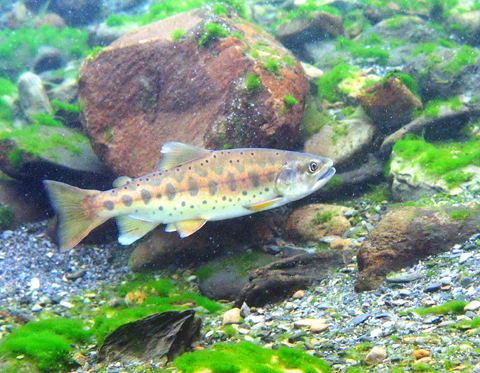
PHOTO COURTESY OF LIAO LIN-YAN
“It marks the first time that the rare fish — a holdover from the last Ice Age — has survived and reproduced in a new habitat,” Liao said.
In the past, the fish could only be found in the Cijiawan River (七家灣溪), a protected sanctuary for the Formosan landlocked salmon in the park.
In Nanhu River, Liao said, only previously released salmon bearing identification tags have been seen so far, which meant they had yet to spawn.
The migration of the rare fish, however, has provoked mixed reactions, with opponents saying the species should not be propagated in a location where the fish has not previously been documented, while proponents say migration is vital to preserve the salmon.
Liao said the center was neutral on the matter and that its main concern was conservation of the center’s water supply.
“As the water in Cijiawan River tends to be very turbid following typhoons, the conservation center needs to store water in advance to ensure that fry being raised there can survive,” Liao said.
Although the environmental devastation caused by rampant overcultivation of orchards and vegetable farms in the nearby Wuling Farm area has been brought under control, landslides in the upper reaches of the river continue to occur, causing serious turbidity downstream in the wake of typhoons or heavy rain, Liao said.
Without a large storage pond, the water supply is often insufficient, Liao said, adding that the center was considering drilling wells as a secondary water source.
Meanwhile, Liao said that although the park had built a special structure in which the rare fish can take refuge in emergencies, the population still suffers a steep decline after every rainstorm or typhoon.
“The number of salmon in Cijiawan River has declined by about 25 percent to some 1,500, because of Tropical Storm Kamaelgi and Typhoon Fung-wong,” he said.
The Formosan landlocked salmon, or Oncorhynchus masou formosanus, is a subspecies of the seema, which is also found in Taiwan. It is critically endangered and was once classified as facing a high risk of extinction.
As a result of overfishing, there were about 400 salmon left before efforts to protect them were launched. Today, their biggest enemy is pollution, as the fish requires very clean and cold water to thrive.
The salmon became landlocked during the last glacial epoch and its discovery in Taiwan is considered a biological miracle.
Formosan landlocked salmon grow to about 30cm in length and inhabit cold, slow-flowing streams with gently sloping beds at elevations above 1,500m, such as the Cijiawan River in the upper reaches of Tachia River (大甲溪).

Considering that most countries issue more than five denominations of banknotes, the central bank has decided to redesign all five denominations, the bank said as it prepares for the first major overhaul of the banknotes in more than 24 years. Central bank Governor Yang Chin-lung (楊金龍) is expected to report to the Legislative Yuan today on the bank’s operations and the redesign’s progress. The bank in a report sent to the legislature ahead of today’s meeting said it had commissioned a survey on the public’s preferences. Survey results showed that NT$100 and NT$1,000 banknotes are the most commonly used, while NT$200 and NT$2,000

The Centers for Disease Control (CDC) yesterday reported the first case of a new COVID-19 subvariant — BA.3.2 — in a 10-year-old Singaporean girl who had a fever upon arrival in Taiwan and tested positive for the disease. The girl left Taiwan on March 20 and the case did not have a direct impact on the local community, it said. The WHO added the BA.3.2 strain to its list of Variants Under Monitoring in December last year, but this was the first imported case of the COVID-19 variant in Taiwan, CDC Deputy Director-General Lin Ming-cheng (林明誠) said. The girl arrived in Taiwan on

South Korea is planning to revise its controversial electronic arrival card, a step Taiwanese officials said prompted them to hold off on planned retaliatory measures, a South Korean media report said yesterday. A Yonhap News Agency report said that the South Korean Ministry of Foreign Affairs is planning to remove the “previous departure place” and “next destination” fields from its e-arrival card system. The plan, reached after interagency consultations, is under review and aims to simplify entry procedures and align the electronic form with the paper version, a South Korean ministry official said. The fields — which appeared only on the electronic form

The Ministry of Foreign Affairs (MOFA) is suspending retaliation measures against South Korea that were set to take effect tomorrow, after Seoul said it is updating its e-arrival system, MOFA said today. The measures were to be a new round of retaliation after Taiwan on March 1 changed South Korea's designation on government-issued alien resident certificates held by South Korean nationals to "South Korea” from the "Republic of Korea," the country’s official name. The move came after months of protests to Seoul over its listing of Taiwan as "China (Taiwan)" in dropdown menus on its new online immigration entry system. MOFA last week


 RSS
RSS