


President Ma Ying-jeou’s (馬英九) nominees for the Control and Examination yuans received a lukewarm response when they visited the legislature yesterday, with the Democratic Progressive Party (DPP) caucus refusing to meet them and the Non-Partisan Solidarity Union (NPSU) airing grievances.
Led by Presidential Office Secretary-General Chan Chun-po (詹春柏), the 29 Control Yuan and 21 Examination Yuan nominees met Legislative Speaker Wang Jin-pyng (王金平), as well as NPSU and Chinese Nationalist Party (KMT) legislators.
Wang urged the Presidential Office to investigate and answer legislators’ question today whether any nominee possesses a green card or foreign residency, adding that the law prohibits officials from holding dual citizenship.
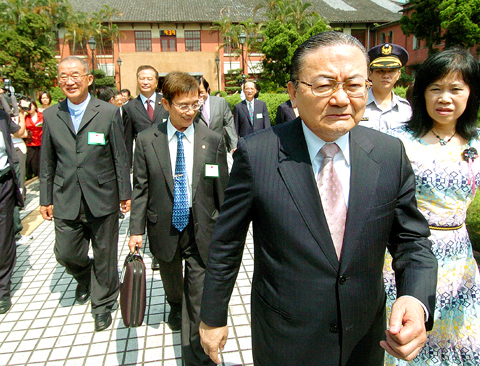
PHOTO: FANG PIN-CHAO, TAIPEI TIMES
He said that it was an “important and urgent” matter to fill the Control Yuan because the nation’s top supervisory body, which monitors and arbitrates matters concerning elected officials and civil servants, has been empty since the term of office of the previous members expired on Jan. 31, 2005.
The pan-blue controlled legislature had repeatedly boycotted former president Chen Shui-bian’s (陳水扁) nominees.
The term of the current Examination Yuan members will expire on Aug. 31. Their successors will be sworn in on Sept. 1. The Examination Yuan is in charge of recruiting and managing the country’s civil servants.
Once the legislature confirms the Control Yuan nominees on July 4 and the Examination Yuan nominees on July 11, Wang said he hoped they would perform their duties in a fair, objective and impartial manner.
It requires the approval of half of the legislators to confirm the nominees. The 113-member legislative chamber has 81 KMT legislators, 27 DPP, three NPSU and two independent lawmakers.
Former National Chiao Tung University president Chang Chun-yen (張俊彥), tapped to head the Examination Yuan, received the cold shoulder from KMT Legislator Hung Shiu-chu (洪秀柱), who had questioned Chang’s political affiliation.
Chang told Hung that “enemies often cross each other’s path.” Hung responded by saying that she would “definitely veto his nomination.”
The KMT caucus has yet to decide whether to let KMT legislators have a free vote.
NPSU Legislator Lin Pin-kuan (林炳坤) insinuated that former finance minister Wang Chien-shien, nominated for Control Yuan president, had caused trouble by making improper remarks.
Lin was referring to Wang’s request that Control Yuan nominees refrain from conducting individual visits to the legislature to canvass support.
Lin said it was natural for the Control and Examination yuans to interact with the Legislative Yuan, and there was no need to “pretend someone is morally superior to others.”
He added that he had told Ma to avoid overemphasizing “incorruptibility,” as the more the president mentioned it, the easier it would be for someone to slip up.
Once a person makes a mistake, his opponents would take advantage of it, Lin said.
Former DPP legislator Shen Fu-hsiung (沈富雄), nominated for Control Yuan vice president, said yesterday he was prepared to face his confirmation meeting with an open mind amid comments that DPP lawmakers were preparing to grill him during the procedure.
Former Taiwan Solidarity Union legislator Chien Lin Hui-chun (錢林慧君), a nominee for the Control Yuan, said she would do her best to convince her critics that she was not an opportunist but a person with principles.
DPP legislators said that the visit to the legislature did not serve any purpose.
“I have no idea why they came here today,” DPP Legislator Lee Chun-yee (李俊毅) said.
“They have yet to respond to our previous complaint about the lack of information on their backgrounds,” Lee said.
Lee made the remarks while the nominees were visiting the legislature.
Lee added that he would remain in the DPP legislative caucus office along with DPP members. If the nominees needed to speak with them, they would be more than happy to talk to them but he did not believe it would help break any ice.
ADDITIONAL REPORTING BY JIMMY CHUANG

Considering that most countries issue more than five denominations of banknotes, the central bank has decided to redesign all five denominations, the bank said as it prepares for the first major overhaul of the banknotes in more than 24 years. Central bank Governor Yang Chin-lung (楊金龍) is expected to report to the Legislative Yuan today on the bank’s operations and the redesign’s progress. The bank in a report sent to the legislature ahead of today’s meeting said it had commissioned a survey on the public’s preferences. Survey results showed that NT$100 and NT$1,000 banknotes are the most commonly used, while NT$200 and NT$2,000

The Centers for Disease Control (CDC) yesterday reported the first case of a new COVID-19 subvariant — BA.3.2 — in a 10-year-old Singaporean girl who had a fever upon arrival in Taiwan and tested positive for the disease. The girl left Taiwan on March 20 and the case did not have a direct impact on the local community, it said. The WHO added the BA.3.2 strain to its list of Variants Under Monitoring in December last year, but this was the first imported case of the COVID-19 variant in Taiwan, CDC Deputy Director-General Lin Ming-cheng (林明誠) said. The girl arrived in Taiwan on

South Korea is planning to revise its controversial electronic arrival card, a step Taiwanese officials said prompted them to hold off on planned retaliatory measures, a South Korean media report said yesterday. A Yonhap News Agency report said that the South Korean Ministry of Foreign Affairs is planning to remove the “previous departure place” and “next destination” fields from its e-arrival card system. The plan, reached after interagency consultations, is under review and aims to simplify entry procedures and align the electronic form with the paper version, a South Korean ministry official said. The fields — which appeared only on the electronic form

The Ministry of Foreign Affairs (MOFA) is suspending retaliation measures against South Korea that were set to take effect tomorrow, after Seoul said it is updating its e-arrival system, MOFA said today. The measures were to be a new round of retaliation after Taiwan on March 1 changed South Korea's designation on government-issued alien resident certificates held by South Korean nationals to "South Korea” from the "Republic of Korea," the country’s official name. The move came after months of protests to Seoul over its listing of Taiwan as "China (Taiwan)" in dropdown menus on its new online immigration entry system. MOFA last week


 RSS
RSS