


The Presidential Office will not declassify documents concerning former president Chen Shui-bian’s (陳水扁) controversial “state affairs fund,” but will give the court access to allow the legal proceeding to continue.
Presidential Office spokesman Wang Yu-chi (王郁琦) said that Presidential Office Secretary-General Chan Chun-po (詹春柏) would soon send a letter of consent to court on behalf of President Ma Ying-jeou (馬英九).
An official, who asked to remain anonymous, said that with the consent of the Presidential Office, the onus would be on the court to keep the classified documents secret during the proceeding, in accordance with the Classified National Security Information Protection Act (國家機密保護法) and other decrees regulating secret trials.
With access to the documents, the court will be able to continue the proceeding, the official said, and President Ma would fully respect the judicial inquest into the matter.
”The decision is not a political maneuver,” he said. “Such a description is melodramatic.”
The court proceeding has been suspended since October after the Chen government said that documents pertaining to six diplomatic missions were classified material under the protection of the Classified National Security Information Protection Act and that prosecutors and the court should not be allowed to see them.
Prosecutors and the courts have asked the Presidential Office to declassify the documents in order to continue the trial. Chen’s office has threatened to take legal action if the documents are declassified, arguing that whether the new president has the right to declassify documents listed as confidential by previous presidents is a constitutional issue.
Chen was declared a defendant in the case shortly after his term ended on May 20. Taipei prosecutors indicted his wife, Wu Shu-jen (吳淑珍), in November 2006 on corruption and forgery charges in connection with the mishandling of Chen’s “state affairs fund.” Chen could not be charged at the time because of presidential immunity.
Wu is suspected of using receipts from a number of people to have personal expenses reimbursed from the fund between March 2002 and March 2006. Chen has claimed that the funds were used to conduct six secret diplomatic missions. But the prosecutors said that while two of the diplomatic missions were real, the suspects failed to offer any proof for the remaining four.
The Presidential Office official said yesterday that the decision to allow the court access to the documents sought to establish a constitutional precedent and represented a sign of respect for the judiciary.
This should allow the judiciary to perform its constitutional duty independently, he said.
Chen’s office said it would seek legal advice before making any comment.
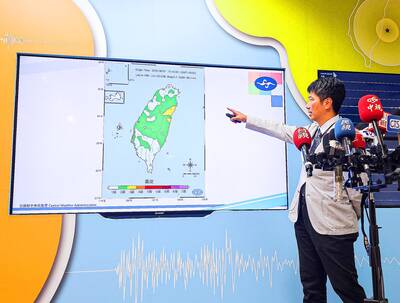
Aftershocks from a magnitude 6.2 earthquake that struck off Yilan County at 3:45pm yesterday could reach a magnitude of 5 to 5.5, the Central Weather Administration (CWA) said. Seismological Center technical officer Chiu Chun-ta (邱俊達) told a news conference that the epicenter of the temblor was more than 100km from Taiwan. Although predicted to measure between magnitude 5 and 5.5, the aftershocks would reach an intensity of 1 on Taiwan’s 7-tier scale, which gauges the actual effect of an earthquake, he said. The earthquake lasted longer in Taipei because the city is in a basin, he said. The quake’s epicenter was about 128.9km east-southeast
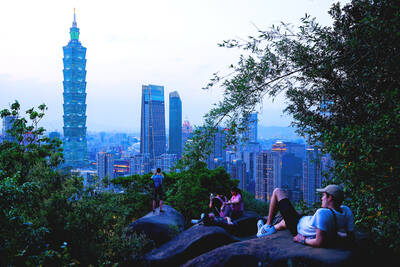
GENSLER SURVEY: ‘Economic infrastructure is not enough. A city needs to inspire pride, offer moments of joy and foster a sense of belonging,’ the company said Taipei was named the city with the “highest staying power” in the world by US-based design and architecture firm Gensler. The Taiwanese capital earned the top spot among 65 cities across six continents with 64 percent of Taipei respondents in a survey of 33,000 people saying they wanted to stay in the city. Rounding out the top five were Vietnam’s Ho Chi Minh City (61 percent), Singapore (59 percent), Sydney (58 percent) and Berlin (51 percent). Sixth to 10th place went to Monterrey, Mexico; Munich, Germany; Sao Paulo, Brazil; Vancouver; and Seoul. Cities in the US were ranked separately, with Minneapolis first at
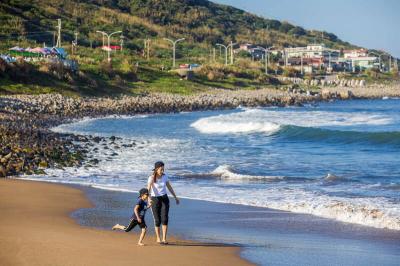
The New Taipei City Government today warned about the often-overlooked dangers of playing in water, and recommended safe swimming destinations to cool off from the summer heat. The following locations in the city as safe and fun for those looking to enjoy the water: Chienshuiwan (淺水灣), Baishawan (白沙灣), Jhongjiao Bay (中角灣), Fulong Beach Resort (福隆海水浴場) and Sansia District’s (三峽) Dabao River (大豹溪), New Taipei City Tourism and Travel Department Director-General Yang Tsung-min (楊宗珉) said. Outdoor bodies of water have variables outside of human control, such as changing currents, differing elevations and environmental hazards, all of which can lead to accidents, Yang said. Sudden
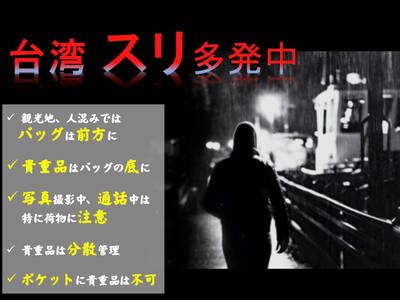
The Japan-Taiwan Exchange Association has cautioned Japanese travelers to be vigilant against pickpockets at several popular tourist spots in Taiwan, including Taipei’s night markets, the Yongkang Street area, Zhongshan MRT Station, and Jiufen (九份) in New Taipei City. The advisory, titled “Recent Development of Concerns,” was posted on the association’s Web site under its safety and emergency report section. It urges travelers to keep backpacks fully zipped and carried in front, with valuables placed at the bottom of the bag. Visitors are advised to be especially mindful of their belongings when taking photos or speaking on the phone, avoid storing wallets and


 RSS
RSS