


There are 13 members of the Military Police force that are entirely devoted to the nation and willing to make the ultimate sacrifice, and all they ask in return is a total monthly budget of NT$1,300 for food and medication.
They are the force's 13 German Shepherds.
"Know your dogs and love them with your all your heart. If you do, they will pay you back by sacrificing themselves and keeping you alive on the battlefield," Military Police dog squad chief Lieutenant Yeh Yu-ming (
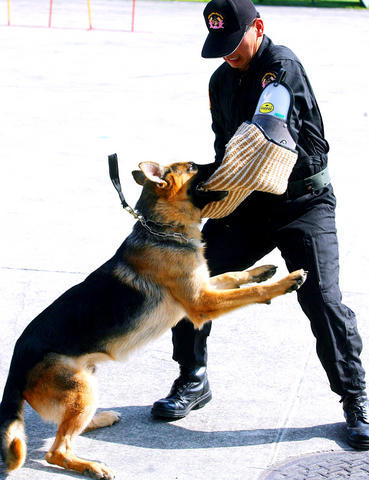
PHOTO: WANG YI-SUNG, TAIPEI TIMES
Yeh said the squad's top priority is to keep the dogs healthy and fit so they can be commissioned for any assignment at short notice.
"They give everything, including their lives, to help human beings. The least we can do for them in return is to make sure that they are in good shape," Yeh said.
Communication
He said that, while a regular soldier's top priority is to make sure that his weapons are in good condition so that nothing goes wrong when he needs them, the handlers of the military dog squad's priorities include making sure that communication with the dogs is adequate and that the dogs receive the necessary care and attention.
"It is not as easy as cleaning your rifle," Yeh said. "For us, the dogs are our `weapons,' but they are more than `weapons'; they are alive and need our attention all the time."
Yeh said the most important thing for his fellow dog squad members was to establish good relationships with their dogs.
He said that a well-trained dog would follow only the commands of his handler.
"If the dog does not recognize you as the `boss,' everything will be in vain," he said.
To do that, Yeh said, the squad members do their best to get to know their dogs.
"Like human beings, every dog has its own character and emotional behavior. You have to be his `friend' before he will accept you, recognize you as the `boss' and follow your orders. It takes a lot of time and patience," Yeh said.
Securing Taipei
The Military Police first established a "Military Dog Team" in 1964. In 1999, the team was downsized and merged with the Military Police's 202 Command Headquarters, which is responsible for securing the capital city.
Yeh said the German Shepherds' main mission is to help the National Security Bureau (NSB) and the regular police carry out anti-drug crackdowns or special escort missions. As puppies the dogs are also trained to sniff out explosives, and they help out the bomb squad every now and then.
"They have good noses," Yeh said. "With well-organized training courses, every one of them helps make law enforcement a lot easier. That is what they do."
Yeh said that the dogs' training courses include compliance training, barrier training and explosives and drug search training.
Compliance training is a daily routine in which squad members spend most of their day with assigned military dogs. The end goal is to help dogs develop a relationship with their handlers so that orders can be carried out efficiently.
Barrier training helps the dogs overcome their fear of strange environments to enable them to carry out orders under pressure.
This training also includes socialization training, which is designed to help the dogs socialize so they will not panic when they encounter a new situation or unfamiliar place.
The explosives and drug search training regime is the most important, Yeh said, as it enables the dogs to take advantage of their nasal prowess to help law enforcement officers crack down on drugs or discover explosives.
"Our puppies are able to find even a minute amount of drugs or explosives when a detecting machine cannot," Yeh said. "As a result, our puppies often help NSB agents secure a location before the visit of the president, vice president or foreign VIPs."
3km run
Private Lee Ming-han (
"When you are always there for your dogs whenever they need you, they will always be there for you when you need them," Lee said.

AGING: While Japan has 22 submarines, Taiwan only operates four, two of which were commissioned by the US in 1945 and 1946, and transferred to Taiwan in 1973 Taiwan would need at least 12 submarines to reach modern fleet capabilities, CSBC Corp, Taiwan chairman Chen Cheng-hung (陳政宏) said in an interview broadcast on Friday, citing a US assessment. CSBC is testing the nation’s first indigenous defense submarine, the Hai Kun (海鯤, Narwhal), which is scheduled to be delivered to the navy next month or in July. The Hai Kun has completed torpedo-firing tests and is scheduled to undergo overnight sea trials, Chen said on an SET TV military affairs program. Taiwan would require at least 12 submarines to establish a modern submarine force after assessing the nation’s operational environment and defense

Yangmingshan National Park authorities yesterday urged visitors to respect public spaces and obey the law after a couple was caught on a camera livestream having sex at the park’s Qingtiangang (擎天崗) earlier in the day. The Shilin Police Precinct in Taipei said it has identified a suspect and his vehicle registration number, and would summon him for questioning. The case would be handled in accordance with public indecency charges, it added. The couple entered the park at about 11pm on Thursday and began fooling around by 1am yesterday, the police said, adding that the two were unaware of the park’s all-day live
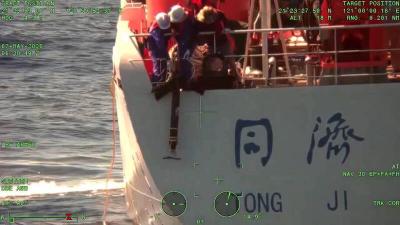
The coast guard today said that it had disrupted "illegal" operations by a Chinese research ship in waters close to the nation and driven it away, part of what Taipei sees a provocative pattern of China's stepped up maritime activities. The coast guard said that it on Thursday last week detected the Chinese ship Tongji (同濟號), which was commissioned only last year, 29 nautical miles (54km) southeast of the southern tip of Taiwan, although just outside restricted waters. The ship was observed lowering ropes into the water, suspected to be the deployment of scientific instruments for "illegal" survey operations, and the coast
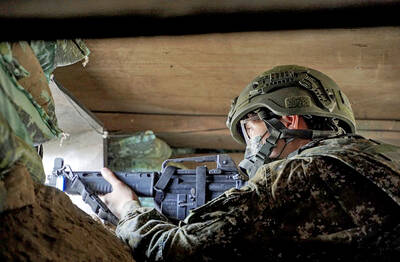
A former soldier and an active-duty army officer were yesterday indicted for allegedly selling classified military training materials to a Chinese intelligence operative for a total of NT$79,440. The Taipei District Prosecutors’ Office indicted Chen Tai-yin (陳泰尹) and Lee Chun-ta (李俊達) for contravening the National Security Act (國家安全法) and the Anti-Corruption Act (貪污治罪條例). Chen left the military in September 2013 after serving alongside then-staff sergeant Lee, now an army lieutenant, at the 21st Artillery Command of the army’s Sixth Corps from 2011 to 2013, according to the indictment. Chen met a Chinese intelligence operative identified as “Wang” (王) through a friend in November


 RSS
RSS