


The military's new air defense system was hurt somewhat by an intelligence leak to China, but its key technology was not compromised, a Ministry of National Defense (MND) official said yesterday.
The Po Sheng ("Broad Victory") system -- a sophisticated command, control and communications network that the government is purchasing from US defense contractor Lockheed Martin -- was one of the targets highlighted in an espionage affidavit filed earlier this month against a Pentagon analyst in a US court.
The analyst, Gregg Bergersen, was accused of providing classified information to Kuo Tai-sheng (
PHOTO: CNA
intact
Speaking to reporters yesterday, ministry spokesman Yu Sy-tue (
"The US provides Taiwan with the system's infrastructure, but Taiwan still controls the key integral technology," he said.
"The damage was within our expectations," he said.
A Defense News report said ministry officials were particularly concerned that a program to modernize its C4ISR network might have been compromised.
C4ISR stands for command, control, communications, computers, intelligence, surveillance and reconnaissance, all considered crucial to winning any military confrontation.
The Defense News reported that "Bergersen managed negotiations on the Communications and Information Security Memorandum of Agreement, which allows the United States to release the Type 1 cryptography techniques that would be used for US-Taiwan communications during a war."
It added that "If true, there are concerns that China now has access to the crypto/keying material/algorithms that could allow Beijing to penetrate Taiwan and US networks."
knowledge
Yu acknowledged that Bergersen had knowledge of the Po Sheng system and said he met with Taiwan's defense ministry on that project, and on other issues, which he declined to specify.
He said that Kuo had never been in contact with the ministry.
The Chinese government has called the accusations of espionage in the Po Sheng affair groundless and accused the US of "Cold War thinking."
The Po Sheng system would be a critical element of Taiwan's defense in the event of an attack from China.
Additional reporting by staff writer
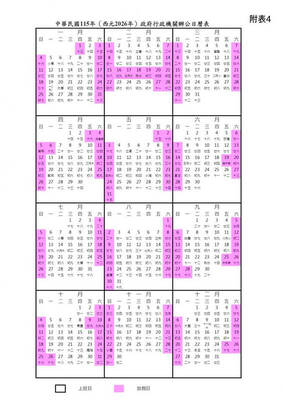
Taiwan is to have nine extended holidays next year, led by a nine-day Lunar New Year break, the Cabinet announced yesterday. The nine-day Lunar New Year holiday next year matches the length of this year’s holiday, which featured six extended holidays. The increase in extended holidays is due to the Act on the Implementation of Commemorative and Festival Holidays (紀念日及節日實施條例), which was passed early last month with support from the opposition Chinese Nationalist Party (KMT) and Taiwan People’s Party. Under the new act, the day before Lunar New Year’s Eve is also a national holiday, and Labor Day would no longer be limited

COMMITMENTS: The company had a relatively low renewable ratio at 56 percent and did not have any goal to achieve 100 percent renewable energy, the report said Pegatron Corp ranked the lowest among five major final assembly suppliers in progressing toward Apple Inc’s commitment to be 100 percent carbon neutral by 2030, a Greenpeace East Asia report said yesterday. While Apple has set the goal of using 100 percent renewable energy across its entire business, supply chain and product lifecycle by 2030, carbon emissions from electronics manufacturing are rising globally due to increased energy consumption, it said. Given that carbon emissions from its supply chain accounted for more than half of its total emissions last year, Greenpeace East Asia evaluated the green transition performance of Apple’s five largest final

Taiwan is to extend its visa-waiver program for Philippine passport holders for another year, starting on Aug. 1, Minister of Foreign Affairs Lin Chia-lung (林佳龍) said on Friday. Lin made the announcement during a reception in Taipei marking the 127th anniversary of Philippine independence and the 50th anniversary of the establishment of the Manila Economic and Cultural Office (MECO) in Taiwan, the Ministry of Foreign Affairs said. The decision reflected Taiwan’s commitment to deepening exchanges with the Philippines, the statement cited Lin as saying, adding that it was a key partner under the New Southbound Policy launched in 2016. Lin also expressed hope
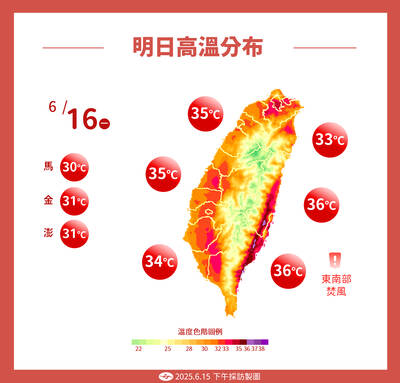
Temperatures in New Taipei City’s Sindian District (新店) climbed past 37°C yesterday, as the Central Weather Administration (CWA) issued heat alerts for 16 municipalities, warning the public of intense heat expected across Taiwan. The hottest location in Taiwan was in Sindian, where the mercury reached 37.5°C at about 2pm, according to CWA data. Taipei’s Shilin District (士林) recorded a temperature of 37.4°C at noon, Taitung County’s Jinfeng Township (金峰) at 12:50 pm logged a temperature of 37.4°C and Miaoli County’s Toufen Township (頭份) reached 36.7°C at 11:40am, the CWA said. The weather agency yesterday issued a yellow level information notice for Taipei, New


 RSS
RSS