


New ships don't come easily for the nation's Navy. While commanding officers were celebrating the 20 years of service for the nation's two Dutch-made Zwaardvis-class diesel-electric submarines earlier this month, they must have been hoping for speedy legislative approval of a budget proposal for eight new US diesel-electric submarines.
The budget remains blocked in the legislature by the Chinese Nationalist Party (KMT). KMT Legislator Su Chi (
While attending the celebrations on Dec. 18 marking the 20th anniversary of the SS-793 Sea Dragon and SS-794 Sea Tiger at Mercury Port at the nation's largest naval base in Tsoying, Kaohsiung, President Chen Shui-bian (
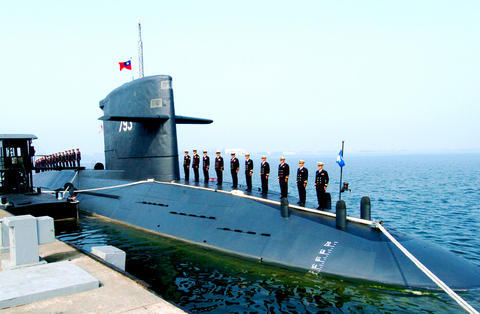
PHOTO: CHANG CHUNG-YI, TAIPEI TIMES
Mercury Port houses the Navy's full complement of four submarines, which include two US-made Guppy-class (World War II era) vessels -- the SS-791 Sea Lion and SS-792 Sea Leopard -- as well as the two Dutch-made vessels.
The Navy's submarine fleet commander Rear Admiral Huang Shu-kuang (
"I would venture that we still have quality submariners despite the age of our vessels. I am also confident that our remaining submarines are all in very good shape and capable of accomplishing all our necessary missions," Huang said.
Just last month, the Sea Tiger and its crew completed a challenging long-term mission. But because of the sensitive nature of the exercise, the Navy could not provide any details.
Naval Commander-in-Chief Admiral Wang Li-shen (
TOUGH JOB
Retired Rear Admiral Ding Chien-ching (
The first group of sailors that was assigned to the two Dutch-made submarines had it even tougher as they participated in the entire building process of the two vessels.
"I am quite proud to say that we know every single nut and bolt on those vessels," Ding said.
The retired captain said he and his fellow sailors arrived in Holland in 1983, when construction was just beginning on the two submarines. Every one of them participated in the process and they also did the final tests on their own when the two vessels were completed.
"Our only hope was to finish the job as soon as possible so the two submarines could begin service as soon as possible," Ding said.
In the Navy, submariners are regarded as hard-working and low-profile navy boys, he said.
"That is because most of the time on board a submarine, we have to get a lot of things done instead of wasting our time complaining," Ding said. "That is what we were trained for and also the spirit of submarine personnel -- just shut up and do it."
Ding's remarks were echoed by Captain Chan Ying-chi (
"People ask me what it takes to become a submarine captain. I tell them the spirit of `follow me' is the key in leading the crew," Chan said.
As a leader, Chang said he always tries to encourage his fellow seamen by doing it first and doing it himself.
"Gradually, you become a role model and the rest of the sailors will follow you," Chan said. "Do not complain. Just do it."
The Zwaardvis Class (Swordfish) is a conventional attack submarine that replaced the Dolfijn Class in the Royal Netherlands Navy. It is based on the US Barbel Class with a teardrop hull design. Taiwan ordered two modified Zwaardvis Class submarines in September of 1981.
A repeat order for four additional vessels was turned down by the Netherlands in 1992 following pressure from China.
The Zwaardvis, which is 66.9m long, weighs 2,376 tonnes on the surface and 2,660 tonnes when submerged. It has six torpedo tubes. Top speed is about 20 knots (37kph). It carries 67 sailors, including eight officers and can dive to 240m.

UPGRADE: The Kang Ding-class frigate is replacing its Chaparall missiles with Tien Chien II and Hua Yang VLS, which would provide it with long-range, 360° air defense Taiwan plans to produce 1,200 to 1,376 Hai Chien II missiles (海劍二, Sea Sword II) — also known as TC-2N — to serve as the standard air defense system of the navy’s surface combatant fleet, a source said yesterday. Last week, the Hai Chien II, the naval version of the Tien Kung II missile (天劍二, Sky Sword II), completed a live-fire test in waters off the National Chungshan Institute of Science and Technology’s Jiupeng facility (九鵬) in Pingtung County’s Manjhou Township (滿州). The MIM72 Chaparral and other dated air defense missiles that currently arm Taiwanese ships have inadequate range to combat Chinese

REASONS FOR TRAVEL: An assistant professor said that proposed amendments to penalize drivers if they used drugs overseas would not deter people from traveling People who operate a motor vehicle under the influence of marijuana would have their driver’s license revoked, even if they used the substance while overseas, the Ministry of Transportation and Communications said yesterday, citing proposed amendments to the Road Traffic Management and Penalty Act (道路交通管理處罰條例). The amendments would also authorize the government to revoke the licenses of people determined to have used Category 1 or Category 2 narcotics, even if they were not operating a vehicle while under the influence of drugs, as well as ban them from taking the license test for three years, the ministry said. People aged 18 or

HEAVY WEATHER: Typhoon Jangmi is due to crash straight into the Ryukyus as airlines look to shift flights to larger aircraft or cancel flights to Okinawa entirely Taiwan’s international air carriers announced flight adjustments over the weekend as Typhoon Jangmi is forecast to hit the Ryukyu Islands today and tomorrow. The Central Weather Administration (CWA) upgraded Jangmi from a tropical storm to a typhoon at 8am yesterday, with the eye located 580km south of Naha city. It was moving north at 19kph. Today, China Airlines’ CI-120, CI-121, CI-122 and CI-123 flights between Taoyuan and Naha, Okinawa, have been canceled as well as CI-132 and CI-133 between Kaohsiung and Naha. EVA Air’s BR-112, BR-113, BR-186 and BR-185 flights between Taoyuan and Naha are also canceled. Low-cost carrier Tigerair Taiwan canceled IT-230,

Johanne Liou (劉喬安), a Taiwanese woman who shot to unwanted fame during the Sunflower movement protests in 2014, returned to Taiwan last night after being deported from the US. She is to stand trial in Taiwan for charges involving embezzlement, fraud and drug crimes. The Criminal Investigation Bureau (CIB) said it took her into custody at Taiwan Taoyuan International Airport and would first question her before transferring her to the New Taipei District Prosecutors’ Office. She was arrested upon disembarking a flight from San Francisco that landed shortly before 7pm. Liou absconded to the US in 2019 after jumping bail


 RSS
RSS