


Lawmakers from Taiwan, the US and the EU meeting in Washington on Tuesday to kick off a new "Taiwan Transatlantic Dialogue"pledged to cooperate in fostering Taiwan's participation in the UN, the WHO and other organizations
The meeting, made possible by the Formosan Association for Public Affairs (FAPA), a lobbying organization, sought to find areas of mutual concern regarding Taiwan's future on which the participants could press their governments to agree.
"The dialogue seeks to help ensure that a full expression of the opinions of the people of Taiwan is clearly heard and that an ongoing discussion of issues of mutual concern will work to the benefit of the national interests of the United States, Europe and Taiwan," said a joint statement issued after the three-hour inaugural session in a US House of Representatives office building.
ATTENDEES
Joining the discussion were Taiwan Solidarity Union Legislator George Liu (劉寬平) and Democratic Progressive Party Legislator Chen Min-jen (陳明真), representative to Washington Joseph Wu (吳釗燮) and representative-designate to Ireland Parris Chang (張旭成).
Bastiaan Belder of the Netherlands and Graham Watson of the UK, both members of the European Parliament, also attended.
Seven members of the US Congressional Taiwan Caucus also joined the discussion, including two co-chairmen, representatives Steve Chabot and Dana Rohrabacher.
"Participants concluded that further cooperation in US and European trade with Taiwan and in the overall US-Taiwan economic relationship, including a possible free trade agreement, should be fostered. Joint efforts working toward Taiwan's participation in international organizations such as the UN and the WHO should be promoted, as well as joint efforts to promote democracy in Asia," the statement said.
"Participants also noted that the US and Europe's policy regarding cross-strait relations calls for a peaceful resolution of the dispute between the two sides, and, because Taiwan is a democracy, [call for] a resolution that has the full consent of the people of Taiwan," the statement said.
The statement also called on China to establish direct dialogue with the Taiwanese government as soon as possible.
Chabot told reporters after the meeting that the dialogue was "particularly timely as Taiwan continues to push for membership in the United Nations. The dialogue helps further Taiwan's strategy for entry. Support for membership will come not only with the help of the United States but also with the help of our European allies."
Belder called on the Europeans to help "put an end to the Chinese obsession with Taiwan."
The European governing bodies, including the European Parliament, the European Commission and the European Council, "should listen to their democratic principles and not help the Chinese authorities to negate" Taiwan and its population, which "especially in Asia is an example of democracy, of development, of shared values," he said.
CRITICISM
He criticized members of the European Parliament who "speak about shared values with regimes that have no shared values with us, and who speak of strategic partnerships with China and Russia, and to silence the rightful, legitimate case of Taiwan's place in the sun in the international community."
Turning to the UN, Belder said "it is up to the Taiwan people to have a referendum on membership in the United Nations."
He said that if the resolution passes next March, "then it is the obligation of the United States as the most responsible power in the region, and also of the members of the European Union, to give a strong signal that in this Olympics year of Beijing, not to escalate, not to intimidate again the Taiwanese authorities and people."
Representative Ileana Ros-Lehtinen, the ranking republican on the House Foreign Affairs Committee, described Taiwan as "a beacon of democracy shining its light directly across the Taiwan Strait and in [to] the very heart of Tiananmen Square."
Recalling the Tiananmen massacre of 1989 that prompted Europe to impose a ban on arms sales to China, Ros-Lehtinen said, "The recent, brutal crackdown in Burma reminds us once again that we should never turn our backs on martyrs for liberty."


UPGRADE: The Kang Ding-class frigate is replacing its Chaparall missiles with Tien Chien II and Hua Yang VLS, which would provide it with long-range, 360° air defense Taiwan plans to produce 1,200 to 1,376 Hai Chien II missiles (海劍二, Sea Sword II) — also known as TC-2N — to serve as the standard air defense system of the navy’s surface combatant fleet, a source said yesterday. Last week, the Hai Chien II, the naval version of the Tien Kung II missile (天劍二, Sky Sword II), completed a live-fire test in waters off the National Chungshan Institute of Science and Technology’s Jiupeng facility (九鵬) in Pingtung County’s Manjhou Township (滿州). The MIM72 Chaparral and other dated air defense missiles that currently arm Taiwanese ships have inadequate range to combat Chinese

REASONS FOR TRAVEL: An assistant professor said that proposed amendments to penalize drivers if they used drugs overseas would not deter people from traveling People who operate a motor vehicle under the influence of marijuana would have their driver’s license revoked, even if they used the substance while overseas, the Ministry of Transportation and Communications said yesterday, citing proposed amendments to the Road Traffic Management and Penalty Act (道路交通管理處罰條例). The amendments would also authorize the government to revoke the licenses of people determined to have used Category 1 or Category 2 narcotics, even if they were not operating a vehicle while under the influence of drugs, as well as ban them from taking the license test for three years, the ministry said. People aged 18 or
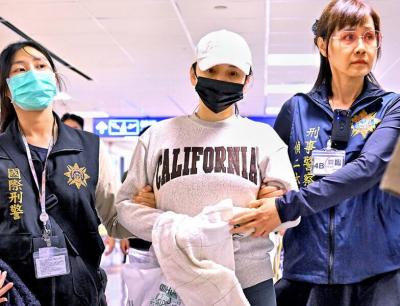
Johanne Liou (劉喬安), a Taiwanese woman who shot to unwanted fame during the Sunflower movement protests in 2014, returned to Taiwan last night after being deported from the US. She is to stand trial in Taiwan for charges involving embezzlement, fraud and drug crimes. The Criminal Investigation Bureau (CIB) said it took her into custody at Taiwan Taoyuan International Airport and would first question her before transferring her to the New Taipei District Prosecutors’ Office. She was arrested upon disembarking a flight from San Francisco that landed shortly before 7pm. Liou absconded to the US in 2019 after jumping bail
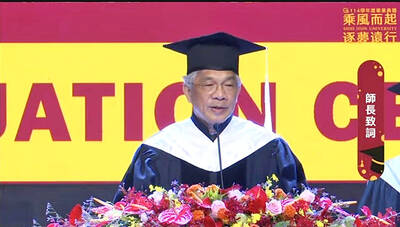
Shih Hsin University President Chen Ching-he (陳清河) yesterday issued a public apology for comments made in his commencement speech last week, stating that he has asked the school to suspend his duties and halt his wages for two months as a show of contrition. At the commencement ceremony on May 30, Chen said, “If you don’t manage your time well, or your own emotions, or your health, then I am telling every one of you — put a quick end to ‘you,’ because the world has no need for ‘you.’” The comments have sparked significant controversy online, and Chen through an open


 RSS
RSS