


Sporting a blue wig, an eye patch and a white lace gown embellished with a pair of wings, 15-year-old Candice Chen looks ready to hit a costume party.
She is among a growing number of Taiwanese youth who call themselves "cosers" and follow a fashion that aims to combine costume and roleplay based on characterizations in Japanese animation, or "manga."
As the fashion catches on across Taiwan, experts have said that it could help young people break out of the strictures forced on them by the traditional Chinese pressure to conform.
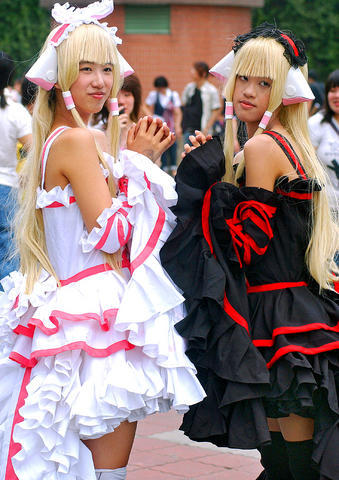
PHOTO: AFP
Since "cosplay" first hit Taiwan a little over a decade ago, its enthusiasts have been dressing up like their favorite manga characters and gathering at cafes, parks and manga expos across the nation.
"I started reading Japanese manga in elementary school. I like characters in action and adventure stories and want to be like them," said Chen, describing the role she portrays as "spirited and sportive."
In Taipei where large-scale manga expos are held several times a year at stadiums and conference centers, hundreds of cosplayers gather to show off their flamboyant outfits and accessories.
At a recent expo at National Taiwan University's stadium, cosers were seen portraying a wide variety of roles from princesses to maids, space warriors, martial arts masters and even Death.
"Cosplay helps me release pressure from studies and boost my self-confidence," said a 19-year-old coser who asked to be identified only by her nickname "Dawn."
Lawmaker Cheng Yun-peng (
"Taiwan's education does not encourage students to express themselves, to stand out or face the public. Young cosers who dare to do so might achieve more than their shy peers," he said. "We should not look down on cosplay as a teenage subculture. I don't see why adults can't do cosplay to relive their childhood dreams. It can become a family recreation."
Huang Chen-yuan (
"Cosplay can be a form of art for teenagers who seek to demonstrate their ideas, creativities and even a sense of fashion through designing," said Huang.
The appeal of cosplay appears to be spreading beyond youth.
Former president Lee Teng-hui (
"The popularity of cosplay shows that Taiwan's society is more diverse and less suppressed as time changes. Cosplay would have been deemed as corrupting morals decades ago," said Huang.
In Taiwan, role-playing dates back to around 1995 but has been gaining in popularity in recent years largely thanks to the Internet, said Mio Chang, supervising editor of bi-monthly cosplay magazine Cosmore.
"Cosers admire the `manga' or `anime' characters and want to imitate them. It is a passion for them to recreate the looks, the costumes and props," said Chang, herself a coser for many years. "It is similar to worshipping heroes. It's like when we were little we tied a sheet around our neck like a cape and pretended to be Superman saving the world."
Most of Cosmore's readership are high school girls, who also make up the bulk of cosers, said Chang.
The business potential of a niche cosers market appears promising with new cafes, tailor shops and props stores opening up to cater for the growing number of cosers.
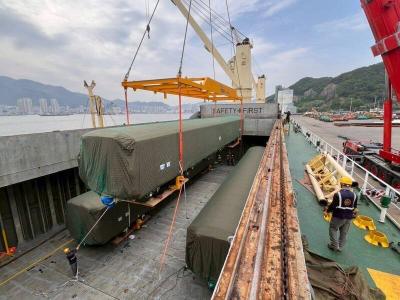
The first of 10 new high-capacity trains purchased from South Korea’s Hyundai Rotem arrived at the Port of Taipei yesterday to meet the demands of an expanding metro network, Taipei Rapid Transit Corp (TRTC) said yesterday. The train completed a three-day, 1,200km voyage from the Port of Masan in South Korea, the company said. Costing NT$590 million (US$18.79 million) each, the new six-carriage trains feature a redesigned interior based on "human-centric" transportation concepts, TRTC said. The design utilizes continuous longitudinal seating to widen the aisles and optimize passenger flow, while also upgrading passenger information displays and driving control systems for a more comfortable
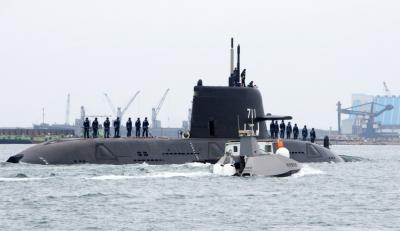
Taiwan's first indigenous defense submarine, the SS-711 Hai Kun (海鯤, or Narwhal), departed for its 13th sea trial at 7am today, marking its seventh submerged test, with delivery to the navy scheduled for July. The outing also marked its first sea deployment since President William Lai (賴清德) boarded the submarine for an inspection on March 19, drawing a crowd of military enthusiasts who gathered to show support. The submarine this morning departed port accompanied by CSBC Corp’s Endeavor Manta (奮進魔鬼魚號) uncrewed surface vessel and a navy M109 assault boat. Amid public interest in key milestones such as torpedo-launching operations and overnight submerged trials,
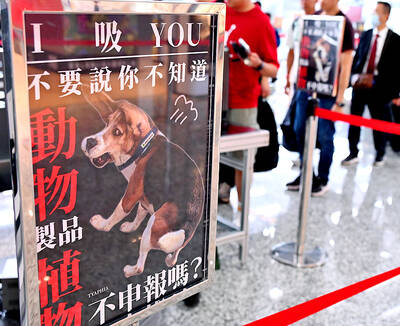
Quarantine awareness posters at Taiwan Taoyuan International Airport have gone viral for their use of wordplay. Issued by the airport branch of the Animal and Plant Health Inspection Agency, the posters feature sniffer dogs making a range of facial expressions, paired with advisory messages built around homophones. “We update the messages for holidays and campaign needs, periodically refreshing materials to attract people’s attention,” quarantine officials said. “The aim is to use the dogs’ appeal to draw focus to quarantine regulations.” A Japanese traveler visiting Taiwan has posted a photo on X of a poster showing a quarantine dog with a
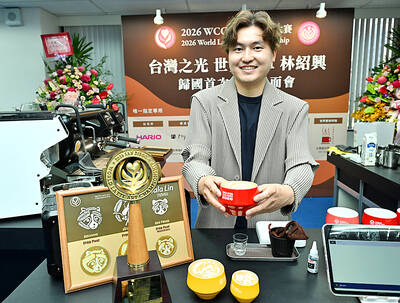
Taiwan’s coffee community has launched a “one-person-one-e-mail” campaign, calling for people to send a protest-e-mail to the World Coffee Championships (WCC) urging it to redesignate Taiwanese competitors as from “Taiwan,” rather than “Chinese Taipei.” The call followed sudden action last week after the WCC changed all references to Taiwanese competitors from “Taiwan” to “Chinese Taipei,” including recent World Latte Art champion Bala (林紹興), who won the World Latte Art Championship in San Diego earlier this month. When Bala received the trophy, he was referred to as representing Taiwan, as well as in the announcement on the WCC’s Web site, until it


 RSS
RSS