


Long-term independence advocate Su Beng (史明) says Taiwan will become a sovereign nation, but to do so it will need help from the US.
Commenting on the recent uproar over the Democratic Progressive Party's (DPP) push for UN membership and a referendum on the nation's UN bid, Su urged the DPP administration to respect the role the US has played protecting Taiwan's safety over the years.
Su said he was worried that President Chen Shui-bian's (
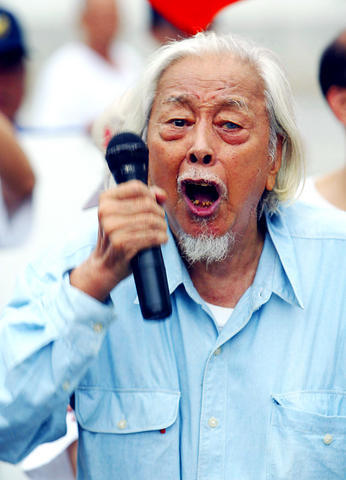
PHOTO: CNA
"He may stir up the emotions of some people, but had he taken the national interest into consideration, he would have adopted a more diplomatic approach," 89-year-old Su said in an interview with the Taipei Times.
Without the support of the US, Su said the nation faces an uphill battle to become a member of the UN despite the backing of its 24 diplomatic allies.
He sees the UN campaign more as an election ploy targeted at winning next year's presidential race than as a means to confirm the nation's independence.
Su was pessimistic on whether the DPP and the Chinese Nationalist Party (KMT) would be willing to combine their referendums or drop them altogether, saying the two proposals were politically motivated.
As Taiwan is strategically important to the US in the Western Pacific, Su said the US could not afford to see it occupied by a hostile force.
"Taiwan has become the world's, not our own," he said. "However, it will be very difficult to achieve independence without a clear plan for nation-building and an effective strategy to achieve the goal."
The nation has been safe from a Chinese invasion since World War II thanks to the US, Su said. That was not because Americans love the Taiwanese, he said, but because of the US' national interests in the Asia-Pacific region.
The US government has been consistent in its commitment to protect Taiwan, despite the absence of diplomatic relations, he said.
Taking the Shanghai Communique of February 1972 as an example, Su said the US government stated its interest in a peaceful settlement of the Taiwan issue, while the People's Republic of China (PRC) opposed any activities that aimed to create "two Chinas."
The US reaffirmed its position in the 1979 Communique on the Establishment of Diplomatic Relations between the US and the PRC and the Joint Communique of the US and the PRC in 1982, Su said.
The Taiwan Relations Act of 1979 has also helped maintain peace, security and stability in the Taiwan Strait, while China has long had the ambition to take Taiwan and become a more dominant power in the Pacific and the world, Su said.
Unlike some pro-independence activists who claim Taiwan is already an independent nation, Su said it is not yet sovereign and the reason was simple.
"Former dictator Chiang Kai-shek (蔣介石) and his son Chiang Ching-kuo (蔣經國) have been dead for decades, but the colonial rule of the Republic of China system still exists," he said.
Su criticized the KMT regime for continuing colonialism after taking over Taiwan. The KMT ruled Taiwan with an iron fist after losing the Chinese civil war to the Chinese Communist Party and withdrawing to Taiwan in 1949.
Su said Taiwanese had pinned their hopes on a change of government to bring justice, but, much to their disappointment, the DPP administration had failed to resolve the problems with the system of government.
The independence movement over the past five decades has been based on emotion rather than on reason, Su said.
To build an independent nation, Su said the political standards of the Taiwanese must change and reason should be allied with the general public's emotion.
Two paths must be adopted, he said.
First, overturn the political system, remove old colonial thinking that says "Taiwan is part of China," and practice democratic politics.
Second, demolish the old colonial systems and institutions one by one, promote "Taiwanese nationalism" and steadily approach the ideal of nation-building.
With Chen's "four noes" still in place, Su said he can not see any real prospect of realizing the goal of building an independent nation in the near future.
However, he believes the dream will eventually come true if the ambition and courage of the Taiwanese are sufficient and the strategy put in place is effective and well-planned.

NATIONAL SECURITY: Authorities are working to confirm the identities of the military personnel involved and investigating possible illegal conduct and regulatory violations Authorities are probing possible national security implications after Kinmen police and immigration officers on Sunday found a Chinese woman allegedly posing as a tourist while engaging in prostitution involving more than 10 military personnel. The woman, surnamed Chen (陳), has since been deported, authorities said, adding that investigators are still working to confirm the identities of those implicated, as the records only listed code names and aliases. The case stemmed from a report received by the Kinmen District Prosecutors’ Office on Friday last week from the Jinhu Precinct of the Kinmen County Police Bureau. On Sunday, police, along with the National Immigration

GLOBALGIVING: ‘ Caving to external pressure is not acceptable for an organization that has cultivated justice reform and human rights for 30 years,’ one NGO said A slew of non-government organizations (NGOs) have withdrawn from the GlobalGiving fundraising platform after it announced it would use “Chinese Taipei” instead of “Taiwan” from next month. The Taiwan Good Rice Association wrote on Facebook on Friday that it was informed on April 28 via a teleconference call of the change, which was made because the platform wanted to operate in China. Taiwan Good Rice is to terminate all cooperative relationships with GlobalGiving in response to the platform’s “unilateral and non-negotiable” decision to remove references to Taiwan, the NGO said. “Taiwan is in the official name of Taiwan Good Rice Association and the

HEAVY WEATHER: Typhoon Jangmi is due to crash straight into the Ryukyus as airlines look to shift flights to larger aircraft or cancel flights to Okinawa entirely Taiwan’s international air carriers announced flight adjustments over the weekend as Typhoon Jangmi is forecast to hit the Ryukyu Islands today and tomorrow. The Central Weather Administration (CWA) upgraded Jangmi from a tropical storm to a typhoon at 8am yesterday, with the eye located 580km south of Naha city. It was moving north at 19kph. Today, China Airlines’ CI-120, CI-121, CI-122 and CI-123 flights between Taoyuan and Naha, Okinawa, have been canceled as well as CI-132 and CI-133 between Kaohsiung and Naha. EVA Air’s BR-112, BR-113, BR-186 and BR-185 flights between Taoyuan and Naha are also canceled. Low-cost carrier Tigerair Taiwan canceled IT-230,
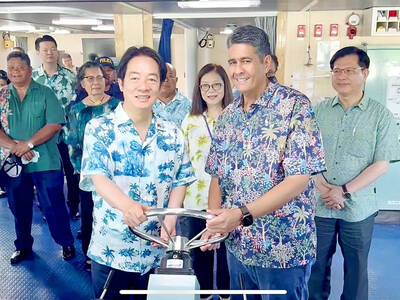
MULTIPRONGED APPROACH: China has sought to pressure Palau across a number of fronts, but the island nation has staunchly resisted overtures to ditch Taiwan Palau has been firm in backing Taiwan despite Chinese pressure that uses tourism economics, cyberattacks and criminal infiltration as tools to threaten the Pacific ally into renouncing its recognition of Taiwan as a sovereign state. The Presidential Office yesterday announced that Vice President Hsiao Bi-khim (蕭美琴) would visit Palau from Saturday to Wednesday next week at the invitation of Palauan President Surangel Whipps Jr. Whipps in April said in an interview that China had outspokenly asked Palau to “denounce Taiwan.” “And we have said: ‘We have no enemies, but nobody tells us who our friends are,’” he said. Whipps has told reporters multiple times


 RSS
RSS