


For 65-year-old historian and Taipei resident Chuang Yung-ming (莊永明), the rapid development and transformation of Taipei City throughout the years is best observed in bus tickets.
In the 1940s, when there was only one city government-run bus company, "bus ladies" on the bus would punch passengers' tickets, and the tickets had ads or route maps on the back, said Chuang, a committee member at the Taipei City Archive.
Long before Taipei Smart Card Corp began selling IC tokens at MRT stations this year, Taipei city's first air-conditioned bus "Tzu Chiang Bus" (
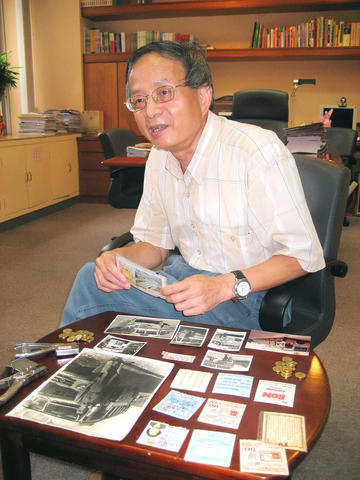
PHOTO: LIN HSIU-TZU, TAIPEI TIMES
"It is the small things in daily life that truly document the development of the city," Chuang said, as he displayed his collection of municipal bus tickets dating back to the Japanese colonial period at an exhibition, which opened on Friday, celebrating the 40th anniversary of the city's elevation to the status of special municipality.
In light of Taipei's rapid development, the central government elevated the city to the status of special municipality on July 1, 1967.
Directly administered by the central government, Taipei's jurisdiction was expanded to 272km2 with the number of residents increasing to 1.45 million. In 1990, under mayor Wu Poh-hsiung (
Taipei covers an area of 271km2 and has a population of more than 2.6 million.
In the 40 years following its elevation, Taipei was governed by 12 mayors: Kao Yu-shu (
The mayorship was an appointed position from the moment it became a centrally administered municipality until 1994, when a public election was held. Chen became the first mayor since the city was granted Special Municipality Status to be directly elected by Taipei residents.
Having worked under five former mayor administrations, former Taipei City government secretariat Ma Cheng-feng (馬鎮方) said the city government renewed municipal development plans every six years and that he was glad to see the rapid developments in recent years.
Taipei resident Chuang Mei-feng (
"The MRT made my life so much easier and convenient," she said, but added that the expansion of the city also took away many old memories with the disappearance of Jiancheng Circle (
The circle, located at the intersection of Chongqing N Road and Nanjing W Road, was closed last July after a NT$200 million (US$6.17 million) reconstruction project initiated by the city government failed to attract sufficient crowds to regain market competitiveness.
Forty years ago, Mengjia (艋舺) and Dadaocheng (大稻埕) were the busiest sectors of the city, until the east district and Xinyi District gradually replaced them and became the business centers they are today.
Kao privatized bus companies during his term in 1968 to allow for further development.
The construction of the Feitsui Reservoir -- the source of Taipei's drinking water -- was completed under Lee's administration, while Huang established the city's biggest park, Taipei Daan Park, and the first MRT line, the Muzha line, in 1994.
Under the Chen administration, from 1994 to 1998, the Muzha line and the Tamsui Line began operation, and Taipei New Park was renamed Taipei 228 Memorial Park, while Jieshou Road became Ketagalan Boulevard.
During his term from 1998 until lat year, Ma Ying-jeou initiated the trash collection fee policy and established the Neihu Science Park and Nangang Software Park.
In a documentary produced by Taipei City Archives to commemorate the anniversary, Chen said his earliest memories of the city were characterized by his awe at the the city's energy and the smell of diesel oil from the buses.
"Taipei is constantly transforming, and I wanted Taipei to be a friendly city with plenty of opportunities and diversity," Chen said in the documentary.
Chuang Yung-ming said the greatest losses suffered by the city over the years were the human element and historical relics.

UPGRADE: The Kang Ding-class frigate is replacing its Chaparall missiles with Tien Chien II and Hua Yang VLS, which would provide it with long-range, 360° air defense Taiwan plans to produce 1,200 to 1,376 Hai Chien II missiles (海劍二, Sea Sword II) — also known as TC-2N — to serve as the standard air defense system of the navy’s surface combatant fleet, a source said yesterday. Last week, the Hai Chien II, the naval version of the Tien Kung II missile (天劍二, Sky Sword II), completed a live-fire test in waters off the National Chungshan Institute of Science and Technology’s Jiupeng facility (九鵬) in Pingtung County’s Manjhou Township (滿州). The MIM72 Chaparral and other dated air defense missiles that currently arm Taiwanese ships have inadequate range to combat Chinese

REASONS FOR TRAVEL: An assistant professor said that proposed amendments to penalize drivers if they used drugs overseas would not deter people from traveling People who operate a motor vehicle under the influence of marijuana would have their driver’s license revoked, even if they used the substance while overseas, the Ministry of Transportation and Communications said yesterday, citing proposed amendments to the Road Traffic Management and Penalty Act (道路交通管理處罰條例). The amendments would also authorize the government to revoke the licenses of people determined to have used Category 1 or Category 2 narcotics, even if they were not operating a vehicle while under the influence of drugs, as well as ban them from taking the license test for three years, the ministry said. People aged 18 or

GLOBALGIVING: ‘ Caving to external pressure is not acceptable for an organization that has cultivated justice reform and human rights for 30 years,’ one NGO said A slew of non-government organizations (NGOs) have withdrawn from the GlobalGiving fundraising platform after it announced it would use “Chinese Taipei” instead of “Taiwan” from next month. The Taiwan Good Rice Association wrote on Facebook on Friday that it was informed on April 28 via a teleconference call of the change, which was made because the platform wanted to operate in China. Taiwan Good Rice is to terminate all cooperative relationships with GlobalGiving in response to the platform’s “unilateral and non-negotiable” decision to remove references to Taiwan, the NGO said. “Taiwan is in the official name of Taiwan Good Rice Association and the

HEAVY WEATHER: Typhoon Jangmi is due to crash straight into the Ryukyus as airlines look to shift flights to larger aircraft or cancel flights to Okinawa entirely Taiwan’s international air carriers announced flight adjustments over the weekend as Typhoon Jangmi is forecast to hit the Ryukyu Islands today and tomorrow. The Central Weather Administration (CWA) upgraded Jangmi from a tropical storm to a typhoon at 8am yesterday, with the eye located 580km south of Naha city. It was moving north at 19kph. Today, China Airlines’ CI-120, CI-121, CI-122 and CI-123 flights between Taoyuan and Naha, Okinawa, have been canceled as well as CI-132 and CI-133 between Kaohsiung and Naha. EVA Air’s BR-112, BR-113, BR-186 and BR-185 flights between Taoyuan and Naha are also canceled. Low-cost carrier Tigerair Taiwan canceled IT-230,


 RSS
RSS