


Prominent Taiwanese literary figures Chung Chao-cheng (
Chung and Lee, both Hakkas, received the Lifelong Contribution to Hakka Award from the Council for Hakka Affairs at a ceremony held in Taipei on June 16.
Historically, the voice of the Hakka people has been little heard because of their minority status and the Mandarin-only policy imposed during the martial law period between 1949 and 1987.
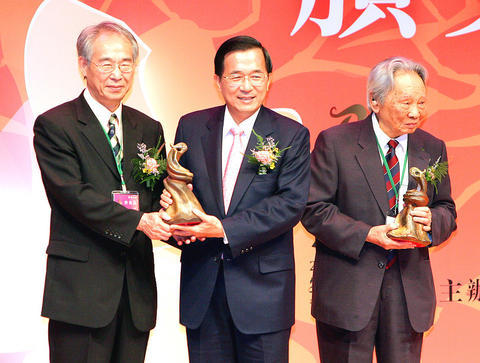
PHOTO: CNA
However, Chung and Lee didn't give up on Hakka culture and seized the opportunity to revive it once martial law was lifted in 1987.
Chung shared his story with the Taipei Times at his residence in Longtan (龍潭), Taoyuan County.
In the late 1980s after martial law rule was lifted, Chung realized that most Hakka people, especially those who live in big cities like Taipei, still tended to hide their identity because of past discrimination and government policies.
"So I decided to found the Hakka Association for Public Affairs [HAPA] to encourage Hakkas to be more actively involved in public affairs and to create a new Hakka image," Chung said.
Along with the association, Chung also helped to create Formosa Hakka Radio, which broadcasts in Hakka.
Before the founding of HAPA in 1990, most other Hakka organizations "were all about eating and singing Hakka mountain songs," Chung said.
The mountain song is a genre of traditional Hakka music.
"The goal of HAPA was to encourage Hakkas to be proud of their identity and their language," Chung said.
To that end, Chung chose to create a Hakka voting bloc.
"The plan was to throw our support behind a Hakka-friendly candidate and once the candidate was elected, we'd ask for Hakka-friendly policies in exchange," he said.
The organization's first test case was President Chen Shui-bian (
Chen ran in the first public Taipei mayoral election in 1994 on the Democratic Progressive Party ticket.
Before the 1994 election, most of Taipei's mayors were appointed by the central government.
"I didn't really know who he [Chen] was, but I was amazed to see that someone dared to challenge the Chinese Nationalist Party [KMT], which suppressed the Hakka language for such a long time," Chung said.
Chen won the election and Chung's choice proved to be the correct one.
In addition to a gathering place for Hakka groups that HAPA asked for in Taipei, Chen also built a Hakka Culture Center and a foundation to promote Hakka culture, Chung said.
Chung was satisfied with Chen's performance as Taipei mayor and decided to support Chen in the 2000 presidential election.
"Again, Chen didn't let us down, as he pushed for the founding of Council for Hakka Affairs in the Cabinet and Hakka TV," Chung said.
"All I have done so far is to help to restore the Hakka language, culture and dignity," Chung said.
In the future, Chung hopes to promote the idea of "Taiwanese Hakka."
"Our ancestors may be from China, but we must remember that we're Hakka from Taiwan -- we're different," Chung said.
Chung said as Hakkas in China are a continental people, while Hakkas in Taiwan are an oceanic people, "we should set our goals across the oceans into the world."
Lee also told his story to the Taipei Times at his residence in Miaoli County.
"The award wasn't for me alone, I just accepted it on behalf of the many teams that I've worked with," Lee said.
"I've hosted many TV shows broadcast in Hakka on many different TV channels since 1998 ? It's the production teams and the TV channels I've worked with that gave me the opportunity to win the recognition," Lee said.
In all the shows that Lee hosted -- including a news program, a show on Taiwanese literature and various documentaries -- he attempted to interpret local events from the Hakka point of view.
"The Hakkas have been silent as far as the interpretation of historic events is concerned," Lee said.
"For example, people usually don't see the armed conflicts between the Hoklos and the Hakkas from a Hakka point of view. Therefore, sometimes, Yimin [righteous people, 義民] seems to become evidence of Hakkas' `original sin,'" Lee said.
Yimin refers to a title that China's Qing dynasty gave to Hakka people who helped the Qing government to put down an armed uprising led by Hoklo people.
Although most of the Yimin merely wanted to defend their communities against Hoklo rebels, they are often considered "traitors" who helped the government against the Hoklos.
Hence, Lee felt it was his responsibility to establish a Hakka interpretation of history.
In addition, Lee also wanted to promote the idea of Taiwanese identity among Hakkas.
"I'm a Hakka, but I often feel very sad about the strong emotional ties to the ancestral land among Hakkas," Lee said. "Many Hakkas think themselves as Hakkas before they consider themselves as Taiwanese, and it's not right."


UPGRADE: The Kang Ding-class frigate is replacing its Chaparall missiles with Tien Chien II and Hua Yang VLS, which would provide it with long-range, 360° air defense Taiwan plans to produce 1,200 to 1,376 Hai Chien II missiles (海劍二, Sea Sword II) — also known as TC-2N — to serve as the standard air defense system of the navy’s surface combatant fleet, a source said yesterday. Last week, the Hai Chien II, the naval version of the Tien Kung II missile (天劍二, Sky Sword II), completed a live-fire test in waters off the National Chungshan Institute of Science and Technology’s Jiupeng facility (九鵬) in Pingtung County’s Manjhou Township (滿州). The MIM72 Chaparral and other dated air defense missiles that currently arm Taiwanese ships have inadequate range to combat Chinese

REASONS FOR TRAVEL: An assistant professor said that proposed amendments to penalize drivers if they used drugs overseas would not deter people from traveling People who operate a motor vehicle under the influence of marijuana would have their driver’s license revoked, even if they used the substance while overseas, the Ministry of Transportation and Communications said yesterday, citing proposed amendments to the Road Traffic Management and Penalty Act (道路交通管理處罰條例). The amendments would also authorize the government to revoke the licenses of people determined to have used Category 1 or Category 2 narcotics, even if they were not operating a vehicle while under the influence of drugs, as well as ban them from taking the license test for three years, the ministry said. People aged 18 or
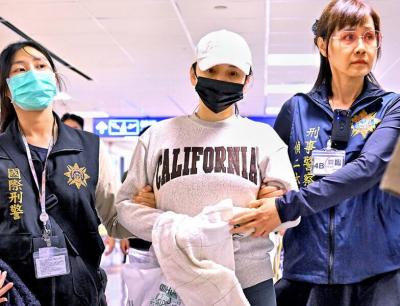
Johanne Liou (劉喬安), a Taiwanese woman who shot to unwanted fame during the Sunflower movement protests in 2014, returned to Taiwan last night after being deported from the US. She is to stand trial in Taiwan for charges involving embezzlement, fraud and drug crimes. The Criminal Investigation Bureau (CIB) said it took her into custody at Taiwan Taoyuan International Airport and would first question her before transferring her to the New Taipei District Prosecutors’ Office. She was arrested upon disembarking a flight from San Francisco that landed shortly before 7pm. Liou absconded to the US in 2019 after jumping bail
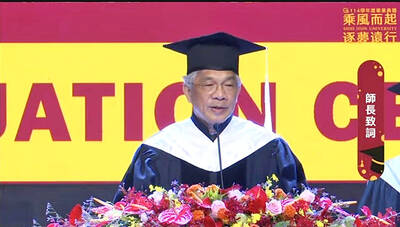
Shih Hsin University President Chen Ching-he (陳清河) yesterday issued a public apology for comments made in his commencement speech last week, stating that he has asked the school to suspend his duties and halt his wages for two months as a show of contrition. At the commencement ceremony on May 30, Chen said, “If you don’t manage your time well, or your own emotions, or your health, then I am telling every one of you — put a quick end to ‘you,’ because the world has no need for ‘you.’” The comments have sparked significant controversy online, and Chen through an open


 RSS
RSS