


When the MV Doulos docked over the weekend in Kaohsiung, hundreds of city residents swarmed its decks to witness one of the world's largest floating international book fairs.
To many, the idea of reading one of more than 6,000 books while at sea sounds altogether appealing.
But a closer look at the ship itself unveils a much more attractive incentive as the ship is full of stories -- stories that may not be so "beautiful" but that could take the visitors on a journey into the world of the crewmembers.
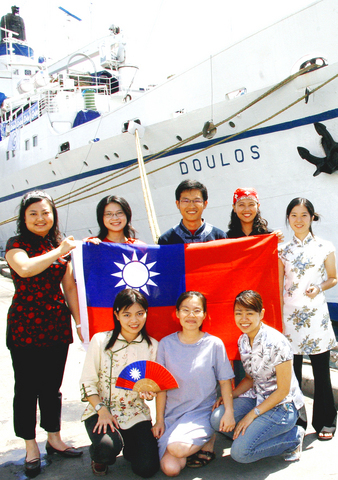
PHOTO: COURTESY OF THE MV DOULOS.
Owned by the German non-government organization Gute Bucher Fur Alle, or "Good Books for All," the ship carries 320 Christian volunteers from more than 54 different countries who do charity work -- most of which involves making books accessible to the general public -- around the world.
Each of the volunteers, aged 18 to 65, has made a commitment to do voluntary work for a minimum of two years.
But joining the program has nothing to do with getting a travel package around the world. Rather, it offers a chance to do hard work and demonstrate one's dedication to a cause.
Before joining the program, every volunteer has to raise money to support their expenses while on board. While the amount of money necessary can reach 450 euros (US$590) per month for an ordinary French volunteer, it can vary depending on the country of origin of each volunteer.
Volunteers are also required to travel, using their own means, to where the ship is located to join the crew.
Ray Peng (
Volunteers may be assigned a variety of jobs on deck, some of which -- like a six-month stint in the engine room wearing jumpsuits and oil sludge on their face, or cleaning the kitchen where meals for the 320 crew members are prepared -- can get ugly.
"We are encouraged to accept [the jobs we are assigned]," said Stephane Kapitaniuk, a young French volunteer.
The 20-year-old said he had spent more than one year in the program, starting out as a waterman. He is now looking forward to receiving an extension.
His decision to join the program stemmed from a need to discover the meaning of life, a need which came from his first encounter with death, at age 17, when he attended a girl's funeral, whereupon he decided to take a break from school and sign up as a volunteer at a church construction site in Germany.
"I realized I was there for a purpose," Kapitaniuk said. "Up until that time, in high school, I was really enjoying math and economics. I was hoping to go to business school, but I started rethinking everything ... I wanted something that has a lasting value."
"I don't believe in going and giving your whole life, taking time from your children, wife and friends to give it to work, well, when you die, you left nothing behind," he told the Taipei Times on Saturday.
Kapitaniuk is not the only one in the program to have given up on their original life plans in exchange for the opportunity to do hard work.
Ivy Chou (
Chou's first stop after entering the program a month ago was Cebu, Philippines, where she and other volunteers hosted charity activities for children on the ship.
"The Taiwanese are so rich. They don't know how people in Cambodia feel and how hungry they are. And they know nothing about the street kids in Cebu, who are everywhere and need love," the 28-year-old woman said, adding that the volunteer program had allowed her to discover how to bring love to children.
Kapitaniuk and Chou said that the volunteer work would help them to become better people.
"Someone once told me that I joined the program in order to enjoy being loved ... but on the ship, you have to learn to be loved, to love others and, above all, to lower your self-esteem," Chou said.
Kapitaniuk, who previously spent two weeks among Burmese refugees along the Thai border, said making a stop in Thailand opened his eyes to the ongoing conflict in Myanmar.
"We never hear about that stuff," he said. After going through all this, he added, "I don't think I can just go home and resume my life ... it would be cruel of me. It would be thoughtless."
"We are constantly put face to face with a reality we've never [known before]," he said. "Simply going home after seeing so much need and resuming my normal life, having a wife, kids ... I cannot see myself doing that anymore."
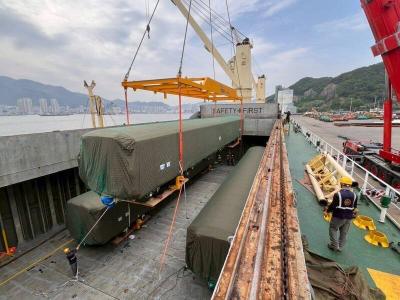
The first of 10 new high-capacity trains purchased from South Korea’s Hyundai Rotem arrived at the Port of Taipei yesterday to meet the demands of an expanding metro network, Taipei Rapid Transit Corp (TRTC) said yesterday. The train completed a three-day, 1,200km voyage from the Port of Masan in South Korea, the company said. Costing NT$590 million (US$18.79 million) each, the new six-carriage trains feature a redesigned interior based on "human-centric" transportation concepts, TRTC said. The design utilizes continuous longitudinal seating to widen the aisles and optimize passenger flow, while also upgrading passenger information displays and driving control systems for a more comfortable
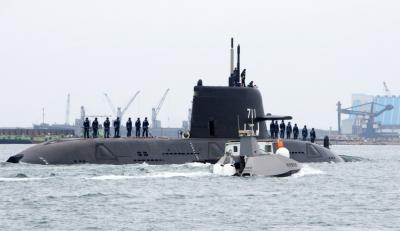
Taiwan's first indigenous defense submarine, the SS-711 Hai Kun (海鯤, or Narwhal), departed for its 13th sea trial at 7am today, marking its seventh submerged test, with delivery to the navy scheduled for July. The outing also marked its first sea deployment since President William Lai (賴清德) boarded the submarine for an inspection on March 19, drawing a crowd of military enthusiasts who gathered to show support. The submarine this morning departed port accompanied by CSBC Corp’s Endeavor Manta (奮進魔鬼魚號) uncrewed surface vessel and a navy M109 assault boat. Amid public interest in key milestones such as torpedo-launching operations and overnight submerged trials,

Quarantine awareness posters at Taiwan Taoyuan International Airport have gone viral for their use of wordplay. Issued by the airport branch of the Animal and Plant Health Inspection Agency, the posters feature sniffer dogs making a range of facial expressions, paired with advisory messages built around homophones. “We update the messages for holidays and campaign needs, periodically refreshing materials to attract people’s attention,” quarantine officials said. “The aim is to use the dogs’ appeal to draw focus to quarantine regulations.” A Japanese traveler visiting Taiwan has posted a photo on X of a poster showing a quarantine dog with a

Taiwan’s coffee community has launched a “one-person-one-e-mail” campaign, calling for people to send a protest-e-mail to the World Coffee Championships (WCC) urging it to redesignate Taiwanese competitors as from “Taiwan,” rather than “Chinese Taipei.” The call followed sudden action last week after the WCC changed all references to Taiwanese competitors from “Taiwan” to “Chinese Taipei,” including recent World Latte Art champion Bala (林紹興), who won the World Latte Art Championship in San Diego earlier this month. When Bala received the trophy, he was referred to as representing Taiwan, as well as in the announcement on the WCC’s Web site, until it


 RSS
RSS