


President Chen Shui-bian (
A "Pan-Chinese Celebrity Roster for 2006" was compiled by the university's Language Information Sciences Research Center based on the cumulative exposure from biweekly rosters gathered by the center throughout the year.
The lists consists of regional rankings of media figures in Beijing, Hong Kong, Shanghai and Taipei, as well as the "Pan-Chinese" ranking covering all four cities.
In addition to getting the top position on the "Pan-Chinese" ranking, Chen also tops the Taipei and Hong Kong lists.
According to Benjamin Tsou, director of the center, Chen's high media exposure this year is related to the corruption allegations surrounding himself and his family.
Meanwhile, a group of Chinese media representatives is visiting Taiwan at the invitation of the Communication Management Association of Taiwan (CMAT).
The delegation arrived Wednesday, and is scheduled to travel to southern Taiwan to visit cultural establishments and local broadcasting stations, as well as to meet local journalists before returning home on Dec. 27, according to the CMAT.
The group comprises senior journalists and editors of media outlets including Hunan TV, Beijing People Broadcasting Station, the Tienjin newspaper group, and broadcasting stations of Shuzhou, Wuhan and Guangdong.
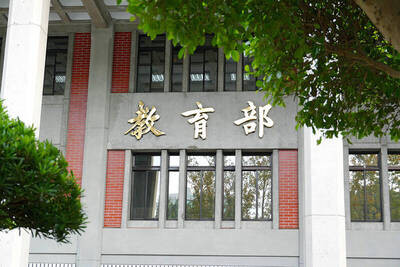
The Ministry of Education (MOE) is to launch a new program to encourage international students to stay in Taiwan and explore job opportunities here after graduation, Deputy Minister of Education Yeh Ping-cheng (葉丙成) said on Friday. The government would provide full scholarships for international students to further their studies for two years in Taiwan, so those who want to pursue a master’s degree can consider applying for the program, he said. The fields included are science, technology, engineering, mathematics, semiconductors and finance, Yeh added. The program, called “Intense 2+2,” would also assist international students who completed the two years of further studies in
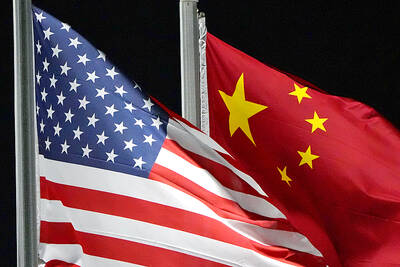
The brilliant blue waters, thick foliage and bucolic atmosphere on this seemingly idyllic archipelago deep in the Pacific Ocean belie the key role it now plays in a titanic geopolitical struggle. Palau is again on the front line as China, and the US and its allies prepare their forces in an intensifying contest for control over the Asia-Pacific region. The democratic nation of just 17,000 people hosts US-controlled airstrips and soon-to-be-completed radar installations that the US military describes as “critical” to monitoring vast swathes of water and airspace. It is also a key piece of the second island chain, a string of
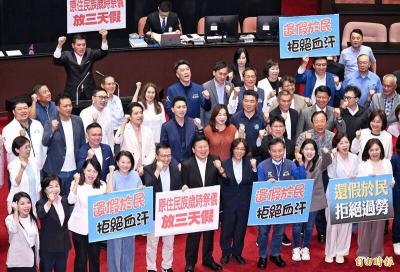
Taiwan will now have four additional national holidays after the Legislative Yuan passed an amendment today, which also made Labor Day a national holiday for all sectors. The Chinese Nationalist Party (KMT) and Taiwan People’s Party (TPP) used their majority in the Legislative Yuan to pass the amendment to the Act on Implementing Memorial Days and State Holidays (紀念日及節日實施辦法), which the parties jointly proposed, in its third and final reading today. The legislature passed the bill to amend the act, which is currently enforced administratively, raising it to the legal level. The new legislation recognizes Confucius’ birthday on Sept. 28, the
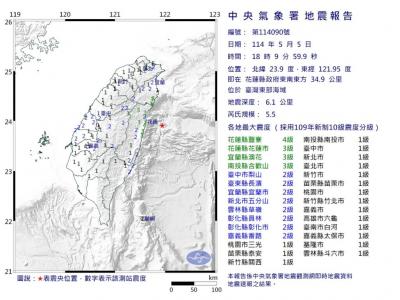
A magnitude 5.9 earthquake that struck about 33km off the coast of Hualien City was the "main shock" in a series of quakes in the area, with aftershocks expected over the next three days, the Central Weather Administration (CWA) said yesterday. Prior to the magnitude 5.9 quake shaking most of Taiwan at 6:53pm yesterday, six other earthquakes stronger than a magnitude of 4, starting with a magnitude 5.5 quake at 6:09pm, occurred in the area. CWA Seismological Center Director Wu Chien-fu (吳健富) confirmed that the quakes were all part of the same series and that the magnitude 5.5 temblor was


 RSS
RSS