


A portrait of Sun Yat-sen (孫逸仙) by the famous Taiwanese painter Li Mei-shu (李梅樹), set in a frame made by well known sculptor Huang Kui-lee (黃龜李), has been discarded as garbage, thrown away, and is now lost for ever.
"We have handed the case over to the ethics department," Sansia Township Administration Chief Secretary Chan Yi-shu (詹亦樹) said.
The size 30 painting -- painting size in Taiwan has traditionally been determined by the size of a postcard, with a painting the size of one postcard being a size one, a painting the size of 30 postcards a size 30, and so on -- has been valued between NT$8 million (US$243,000) to NT$9 million.
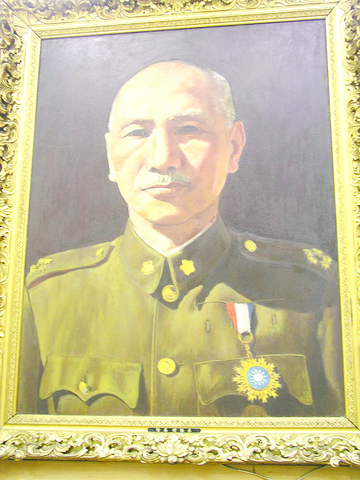
PHOTOS: CHENG SHU-TING, TAIPEI TIMES
Postcard counting is traditionally also included when calculating prices: In Li's case, one of his size 1 paintings once sold for NT$400,000, which means that a size 30 painting by him might sell for 30 times that price, or as much NT$12 million.
During the 1950s and 1960s, Li painted a series of portraits of Sun and former dictator Chiang Kai-shek (
The county council has treated the paintings as valuable pieces of art that are now hanging on the its walls.
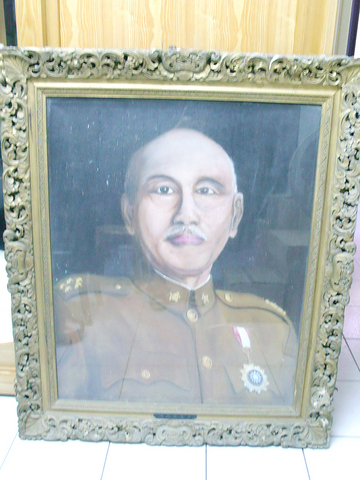
The portrait of Sun has also faired fairly well at Sansia Elementary School, but a few years ago, their portrait of Chiang was "improved" to the point were it lost much of its semblance to Chiang.
That painting has now been given to the Li Mei-shu Memorial Gallery.
The two paintings at Sansia Township Government have fared worse. The portrait of the dictator was lost several years ago, while Sun's portrait was stored inappropriately -- it was cracked and full of holes, and the frame had began to rot away.
Prior to the inauguration of the new township mayor in March this year, another picture of Sun was hung in its place in the auditorium and it was sent to a Sansia frame maker for restoration.
Although that was seven months ago, the township administration didn't seem to be in a hurry to get the painting back; when asked, the reply was that it had been sent to a frame maker for restoration.
"That old painting of Sun Yat-sen? I threw that away a long time ago,"the framemaker said. "When they sent it over, it was so full of holes after having been thrown around during transport that the guy from the township office who brought it said we'd just as well throw it away."
He said he dumped it at the local garbage dump, and that it probably had been incinerated at the Shulin incinerator.
When told that it was a Li Mei-shu painting, he said, "If I'd known that, I'd have kept it."
After seven months, the township administration still thought the painting was being restored, completely unaware that the person they'd sent to have it restored had taken it upon himself to determine the fate of a painting by one of Taiwan's greatest masters.
Li's son, Li Chin-kuan (
"When my father made these paintings, he didn't sign them since that would have been disrespectful to the portrayed giants," he said.
He said he knew the portrait of Chiang had disappeared years ago but had done nothing about it at the time.
But when he learned of the decayed state of Sun's portrait, he wrote the township administration to offer help restoring it and even keeping it in the memorial gallery.
Li Mei-shu was born in 1902 in Sansia. In March, 1929, he was admitted to the Tokyo School of Fine Arts, and he never abandoned the realism he learned there. From 1947 through 1982, he chaired the Reconstruction Committee of Sansia Zushi Temple where he created what has been called a "Temple to East Asian Art."

Considering that most countries issue more than five denominations of banknotes, the central bank has decided to redesign all five denominations, the bank said as it prepares for the first major overhaul of the banknotes in more than 24 years. Central bank Governor Yang Chin-lung (楊金龍) is expected to report to the Legislative Yuan today on the bank’s operations and the redesign’s progress. The bank in a report sent to the legislature ahead of today’s meeting said it had commissioned a survey on the public’s preferences. Survey results showed that NT$100 and NT$1,000 banknotes are the most commonly used, while NT$200 and NT$2,000

The Centers for Disease Control (CDC) yesterday reported the first case of a new COVID-19 subvariant — BA.3.2 — in a 10-year-old Singaporean girl who had a fever upon arrival in Taiwan and tested positive for the disease. The girl left Taiwan on March 20 and the case did not have a direct impact on the local community, it said. The WHO added the BA.3.2 strain to its list of Variants Under Monitoring in December last year, but this was the first imported case of the COVID-19 variant in Taiwan, CDC Deputy Director-General Lin Ming-cheng (林明誠) said. The girl arrived in Taiwan on

South Korea is planning to revise its controversial electronic arrival card, a step Taiwanese officials said prompted them to hold off on planned retaliatory measures, a South Korean media report said yesterday. A Yonhap News Agency report said that the South Korean Ministry of Foreign Affairs is planning to remove the “previous departure place” and “next destination” fields from its e-arrival card system. The plan, reached after interagency consultations, is under review and aims to simplify entry procedures and align the electronic form with the paper version, a South Korean ministry official said. The fields — which appeared only on the electronic form

The Ministry of Foreign Affairs (MOFA) is suspending retaliation measures against South Korea that were set to take effect tomorrow, after Seoul said it is updating its e-arrival system, MOFA said today. The measures were to be a new round of retaliation after Taiwan on March 1 changed South Korea's designation on government-issued alien resident certificates held by South Korean nationals to "South Korea” from the "Republic of Korea," the country’s official name. The move came after months of protests to Seoul over its listing of Taiwan as "China (Taiwan)" in dropdown menus on its new online immigration entry system. MOFA last week


 RSS
RSS