


Democratic Progressive Party (DPP) legislators yesterday demanded that prosecutors include former chief of the general staff Hau Pei-tsun (
DPP Legislator Hsu Kuo-yung (
Hsu said at a press conference that prosecutors believed officials from the Ministry of National Defense and the navy must have been involved in the corruption behind the arms deal and would therefore continue their investigations.
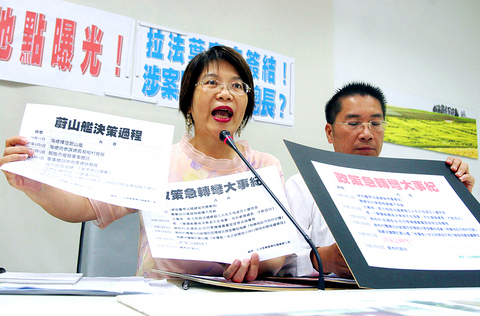
PHOTO: CNA
Prosecutors said in their indictments that the defense ministry and the navy had accepted the soaring price of the frigates "no matter how unreasonable this was," Hsu said, which made it unlikely that indicted arms broker Andrew Wang (汪傳浦) and former naval officer Kuo Li-heng (郭力恆) were alone responsible for overturning the navy's decision to purchase 16 warships from South Korea in favor of buying six Lafayette-class frigates.
The ministry had agreed to start negotiations on the contents of the South Korean contract on May 4, 1989, Hsu said, citing the indictment as saying that the arms sale was almost finalized at that time.
Crucial cable
However, Hsu said the Control Yuan's report mentioned that a cable filed by Hau on May 5, 1989, during his visit to France, had caused a change of tack.
Wang and Kuo were subsequently indicted on charges of gaining illegal commissions through the Lafayette deal.
DPP Legislator Kuan Bi-ling (
Drawing on the indictments, Kuan said that Kuo had also suggested to Wang and the manufacturer that they try to communicate with Hau, who was then chief of the general staff, in a bid to have him order the navy to abandon the South Korean deal.
"Many decisions were referred to Hau back then, and we can all see that Hau enjoyed the full authority to make decisions unilaterally," Kuan said. "Therefore, without Hau, there would not have been a Lafayette purchase."
At the press conference, Hsu and Kuan also produced photographs of a house on Dunhua S. Rd which they said they believed was used by Hau.
Kuan said that although there was no household record available for the abode, a reliable military source had told her and Hsu that it was frequently visited by high-ranking military officers.
Evidence
Kuan said she and Hsu had further evidence of what Hua had been doing in the house since 1992.
"If Hau does not tell the truth, we will present the evidence," Kuan said.
Hau served as chief of the general staff from 1981 to 1989. In December 1989 he was appointed minister of national defense and became premier in May 1990.
When questioned by investigators in late July, Hau said: "As the then-chief of the general staff, I did not have a predominant position in arms procurement. The chief of the armed forces [the president] had the final say on the arms bill."
Yesterday Hau denied ever having met Kuo or Wang and said the accusations leveled at him by Hsu and Kuan were "beneath contempt."
In a statement released yesterday, Hau said his meeting with the French defense minister in 1989 was open and transparent, and denied ever having been invited to attend any private briefings in "VIP" rooms.
Hau also denied having a "secret base" and argued that the residence on Dunhua S. Rd was provided by the Ministry of National Defense when he served as minister of justice.
The residence, Hau said, had been returned to the ministry.
"The Lafayette case has been used by a tool in the DPP's election season smear campaigns for the past six years," Hau said in the statement, adding that he would file a slander lawsuit against Hsu and Kuan.
Echoing his father's condemnation, Chinese Nationalist Party (KMT) Taipei mayoral candidate Hau Lung-bin (
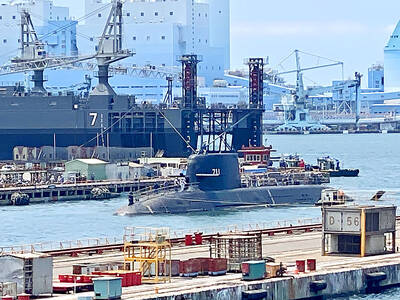
AGING: While Japan has 22 submarines, Taiwan only operates four, two of which were commissioned by the US in 1945 and 1946, and transferred to Taiwan in 1973 Taiwan would need at least 12 submarines to reach modern fleet capabilities, CSBC Corp, Taiwan chairman Chen Cheng-hung (陳政宏) said in an interview broadcast on Friday, citing a US assessment. CSBC is testing the nation’s first indigenous defense submarine, the Hai Kun (海鯤, Narwhal), which is scheduled to be delivered to the navy next month or in July. The Hai Kun has completed torpedo-firing tests and is scheduled to undergo overnight sea trials, Chen said on an SET TV military affairs program. Taiwan would require at least 12 submarines to establish a modern submarine force after assessing the nation’s operational environment and defense
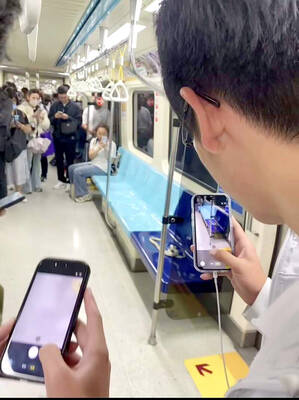
A white king snake that frightened passengers and caused a stir on a Taipei MRT train on Friday evening has been claimed by its owner, who would be fined, Taipei Rapid Transit Corp (TRTC) said yesterday. A person on Threads posted that he thought he was lucky to find an empty row of seats on Friday after boarding a train on the Bannan (Blue) Line, only to spot a white snake with black stripes after sitting down. Startled, he jumped up, he wrote, describing the encounter as “terrifying.” “Taipei’s rat control plan: Release snakes on the metro,” one person wrote in reply, referring
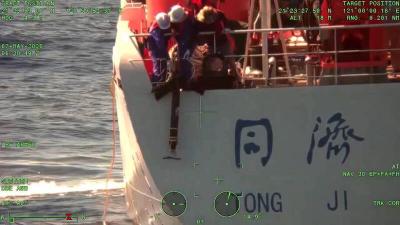
The coast guard today said that it had disrupted "illegal" operations by a Chinese research ship in waters close to the nation and driven it away, part of what Taipei sees a provocative pattern of China's stepped up maritime activities. The coast guard said that it on Thursday last week detected the Chinese ship Tongji (同濟號), which was commissioned only last year, 29 nautical miles (54km) southeast of the southern tip of Taiwan, although just outside restricted waters. The ship was observed lowering ropes into the water, suspected to be the deployment of scientific instruments for "illegal" survey operations, and the coast
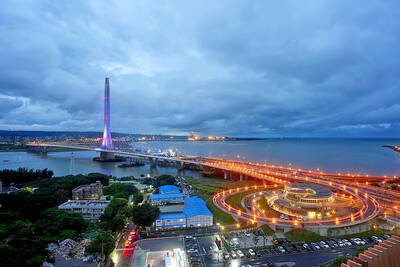
An inauguration ceremony was held yesterday for the Danjiang Bridge, the world’s longest single-mast asymmetric cable-stayed bridge, ahead of its official opening to traffic on Tuesday, marking a major milestone after nearly three decades of planning and construction. At the ceremony in New Taipei City attended by President William Lai (賴清德), Premier Cho Jung-tai (卓榮泰), Minister of Transportation and Communications Chen Shih-kai (陳世凱) and New Taipei City Mayor Hou Yu-ih (侯友宜), the bridge was hailed as both an engineering landmark and a long-awaited regional transport link connecting Tamsui (淡水) and Bali (八里)


 RSS
RSS