


Sixty-five years ago, a group of young Americans boarded a Dutch packet and crossed the Pacific at the invitation of Madame Chiang Kai-shek. Their passports identified them simply as teachers or farmers. If asked at the time, "Why in God's name are you going to the Orient amid World War II?" they probably would have responded, "For sightseeing, of course."
But these were no tourists. They were members of the American Volunteer Group (AVG) -- better known as the "Flying Tigers" -- a top-secret fighter unit that picked dogfights with Japanese planes in the skies over China and Southeast Asia in 1941 and 1942.
"The experts said the AVG wouldn't last three weeks against the Japanese, as its Air Force enjoyed numerical superiority in the Pacific theater," said Jon Pensyl, 81, a former AVG member. "Well, we smashed the Japanese Air Force over China for over seven months, keeping their bombers away from strategic points in that country."
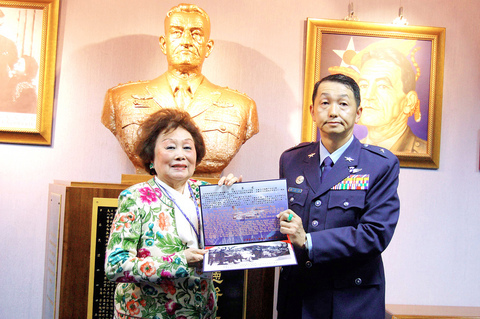
PHOTO: HUA MENG-JIN, TAIPEI TIMES
Pensyl, Director of the 5th Fighter Group Association -- a club comprised of former AVG pilots and ground crew -- was back in the Pacific theater yesterday, along with his comrades in arms, to attend a ceremony at the Hualien Air Force Base honoring General Claire Chennault, the founder of the AVG.
Chennault's group was a force to be reckoned with, achieving a kill ratio of 15:1 -- or 15 Japanese aircraft shot down for every one Flying Tiger P-40 fighter plane -- in the skies over what was then Burma. Nowadays, Chennault and his Flying Tigers are a potent symbol of the friendship between the US and Taiwan.
FRIEND OF `FREE CHINA'
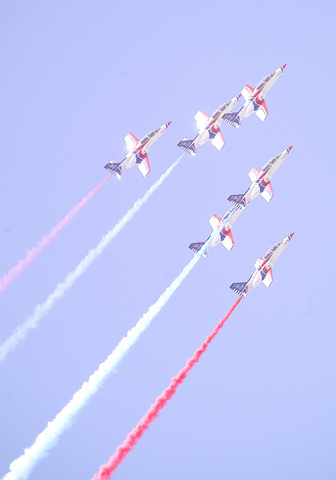
PHOTO: YU TAI-LAN, TAIPEI TIMES
Once a captain in the US Army Air Corps, Chennault left his post in 1937, traveling to China at the behest of the Chinese Nationalist Army (KMT) to help overhaul the Chinese Air Force. Two years later, "the Japanese began to break the back of the Chinese resistance by sustained bombing of every major population center in Free China," the Flying Tigers' official Web site states.
In the face of that withering Japanese bombing campaign, Chennault scrambled to lobby Washington to give him planes and pilots, which he finally received in the summer of 1941. The US fighter contingent was officially a part of the Chinese Air Force, but was commanded by Chennault. He trained the pilots in Rangoon, eventually moving the unit to China, where it fought pitched battles against Japanese fighters and bombers.
ENDURING TIES
That the US contributed scores of talented men and first-class planes to the Republic of China's (ROC) Air Force reveals as much about its trust of, and friendship with, Taiwan as its determination to defeat Japan in World War II.
It was that American spirit of friendship and sacrifice that led Major General Mike Tien (
"We were recently awarded a grant worth US$100,000 to renovate an already existing museum [on the base], and I wished to recreate it as a memorial to General Chennault," Tien said.
On July 19, with the approval of the Taipei City Government, a bronze bust of Chennault was relocated from a Taipei park to the 401st TCW Museum, which was officially opened to the public yesterday amid much fanfare.
"General Chennault's statue is home now," Tien announced, misty-eyed, at a ribbon-cutting ceremony at the museum. "[The 401st TCW] will take care of him now."
The ceremony was attended by Chennault's wife, Anna Chan Chennault (
"When Claire Chennault first came to China [in the 1930s], I was only in the third grade," Chennault said.
The two first met in China in 1945, when Mrs. Chennault was a 20-year-old reporter for the Central News Agency and Chennault was a dashing US commander in his 50s helping China to fight the Japanese. She said they were taken with each other from their first meeting, despite their age difference. They were married soon after their first encounter, but Chennault died of lung cancer just a decade later, widowing Anna with two children.
Mrs. Chennault quickly became popular in Washington's social circles, charming Presidents Kennedy, Johnson, Nixon, Ford, Carter, and Reagan, according to her autobiography The Education of Anna.
Under President Kennedy, she became the first Chinese-American person to work in the White House. She served as chairwoman of the Chinese Refugees Relief Committee and later earned a reputation as a "secret ambassador" of the US seeking to broker cross-strait reconciliation.
She was also the inheritor of an airline that Chennault had founded in the Asia-Pacific region; she was forced to sell it to the CIA after Chennault's death to fend off insolvency, according to her book. The airline eventually became "Air America," the CIA's private fleet of cargo planes.
In spite of a few cloak-and-dagger legends, however, Mrs. Chennault's life story is overwhelmingly about charity and honoring her husband. Her humility and graciousness were on full display yesterday, as she joined the Taiwanese Air Force in paying tribute to Chennault and his storied Flying Tigers.
She was not alone.
"General Chennault just gave off an aura of leadership," said James Bennie, 84, an American fighter plane mechanic who served under Chennault. "He was a man who instinctively knew how to lead."
Harold Javitt, a former P-40 fighter pilot who destroyed "quite a number [of Japanese planes] on the ground," and who also served under Chennault, praised his commander as a "great and approachable leader" who would play baseball with his men during downtime.
Other US dignitaries in attendance included American Institute in Taiwan (AIT) Liaison Affairs Chief Albert Willner.
"It's great for us to be representing veterans on both sides," Willner said, emphasizing the spirit of cooperation that the US and Taiwan have enjoyed since the Flying Tigers first graced the skies over Asia.
Pensyl concluded a tour of the museum by donating his original leather aviator jacket, complete with "blood chit," to the museum. Blood chits are square fabric linings of Flying Tigers' jackets, identifying the pilots in Chinese as "foreigners who have come to China to help it wage war against the Japanese."
An additional inscription asks in Chinese to help aid and protect the wearer.
DAZZLING DISPLAY
The ceremony was topped off with an F-16 air show that dazzled thousands of spectators: Jet fighters roared through the sky at Mach 1 against a backdrop of jungle-covered mountains. The old Flying Tigers looked on from their seats, wide-eyed, perhaps reminiscing about their days behind the throttle of the single propeller-driven P-40 with a grinning shark's mouth painted on either side.
Aerial combat has changed considerably since the Flying Tigers' dicey dogfights with the Japanese.
"Nowadays, we don't have to be all that maneuverable [in the F-16] because we have missiles that can destroy an enemy before he can even be seen by the pilot," a Taiwanese F-16 pilot dressed in an orange jumpsuit told the Taipei Times.
Joe Rosbert, a late Flying Tiger who served in Burma, gave a gritty account of some of the Flying Tigers' fights in his book Flying Tiger Joe's Adventure Story Cookbook.
"I was getting my finger set on the gun button when we found ourselves in the midst of a group of [Japanese] fighters flying crazily in a bunch like bees. In a flash, one appeared in my sight at close range; the two ugly red suns on the wings stood out. I managed one quick burst and almost immediately flew through the smoke and pieces that came from the plane. As I dove down and away, I saw him catch fire and spin earthward."
On their way to board the bus back to their hotel, the last of the Flying Tigers looked up at the sky in which aerial combat is now an almost science-fiction affair, with computers doing the aiming, firing and flying.
"I'm not so young anymore, you know," Pensyl said, before his son helped him onto the bus. "I'm 81 -- the others are nearing 90. I think this is my last visit here."

NATIONAL SECURITY: Authorities are working to confirm the identities of the military personnel involved and investigating possible illegal conduct and regulatory violations Authorities are probing possible national security implications after Kinmen police and immigration officers on Sunday found a Chinese woman allegedly posing as a tourist while engaging in prostitution involving more than 10 military personnel. The woman, surnamed Chen (陳), has since been deported, authorities said, adding that investigators are still working to confirm the identities of those implicated, as the records only listed code names and aliases. The case stemmed from a report received by the Kinmen District Prosecutors’ Office on Friday last week from the Jinhu Precinct of the Kinmen County Police Bureau. On Sunday, police, along with the National Immigration

REASONS FOR TRAVEL: An assistant professor said that proposed amendments to penalize drivers if they used drugs overseas would not deter people from traveling People who operate a motor vehicle under the influence of marijuana would have their driver’s license revoked, even if they used the substance while overseas, the Ministry of Transportation and Communications said yesterday, citing proposed amendments to the Road Traffic Management and Penalty Act (道路交通管理處罰條例). The amendments would also authorize the government to revoke the licenses of people determined to have used Category 1 or Category 2 narcotics, even if they were not operating a vehicle while under the influence of drugs, as well as ban them from taking the license test for three years, the ministry said. People aged 18 or

GLOBALGIVING: ‘ Caving to external pressure is not acceptable for an organization that has cultivated justice reform and human rights for 30 years,’ one NGO said A slew of non-government organizations (NGOs) have withdrawn from the GlobalGiving fundraising platform after it announced it would use “Chinese Taipei” instead of “Taiwan” from next month. The Taiwan Good Rice Association wrote on Facebook on Friday that it was informed on April 28 via a teleconference call of the change, which was made because the platform wanted to operate in China. Taiwan Good Rice is to terminate all cooperative relationships with GlobalGiving in response to the platform’s “unilateral and non-negotiable” decision to remove references to Taiwan, the NGO said. “Taiwan is in the official name of Taiwan Good Rice Association and the

HEAVY WEATHER: Typhoon Jangmi is due to crash straight into the Ryukyus as airlines look to shift flights to larger aircraft or cancel flights to Okinawa entirely Taiwan’s international air carriers announced flight adjustments over the weekend as Typhoon Jangmi is forecast to hit the Ryukyu Islands today and tomorrow. The Central Weather Administration (CWA) upgraded Jangmi from a tropical storm to a typhoon at 8am yesterday, with the eye located 580km south of Naha city. It was moving north at 19kph. Today, China Airlines’ CI-120, CI-121, CI-122 and CI-123 flights between Taoyuan and Naha, Okinawa, have been canceled as well as CI-132 and CI-133 between Kaohsiung and Naha. EVA Air’s BR-112, BR-113, BR-186 and BR-185 flights between Taoyuan and Naha are also canceled. Low-cost carrier Tigerair Taiwan canceled IT-230,


 RSS
RSS