


A Democratic Progressive Party (DPP) spokesman yesterday produced what he said was proof that allegations about the president's "secret" bank account were spurious, but the opposition legislator who made the charges stood by his claim that the account was illicit.
The DPP's Tsai Huang-liang (
"The account number that Chiu alleged was that of the president's `secret' account is the same as the fund-raising account [in the ad], which was a totally open account," Tsai said.
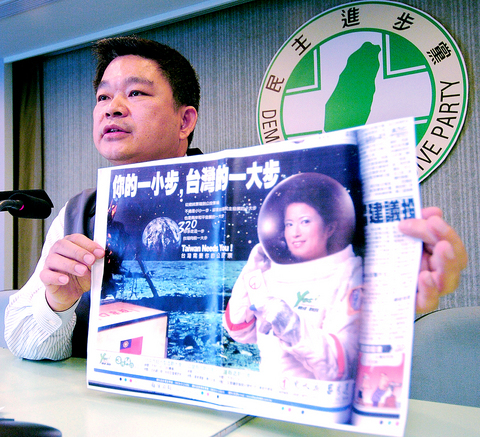
PHOTO: WANG MIN-WEI, TAIPEI TIMES
Tsai made the comments while showing the press an ad that was first run in the March 14, 2004 edition of the Chinese-language Apple Daily.
He said that Chiu had intentionally smeared the president, and urged the president to sue Chiu.
Accusations
Last Friday, Chiu held a press conference to accuse the president of opening a "secret" account, depositing about NT$169 million (US$5.15 million) into it and later transferring funds abroad.
After hearing about Chiu's accusations, some high-ranking officials of the Presidential Office identified the bank account cited by Chiu as a fund-raising account that the DPP established so voters could donate to the president's re-election bid during the 2004 presidential election, Tsai said yesterday.
But Chiu has further alleged that Chen's two children made four deposits into the account at Taishin International Bank, which he said demonstrated that it was not merely a campaign war chest.
However, since banks were closed during the weekend, DPP employees from the Department of Culture and Information spent all Sunday searching for the campaign ad printed with the fund-raising bank account in the newspaper archives of the National Library on Sunday, in order to demonstrate that Chiu's accusation was false, Tsai said.
Tsai also pointed out that the fundraising account was opened on Jan. 5, 2004 and that the account balance was about NT$1.7 million on April, 1, 2004 -- nowhere near the NT$169 million amount that Chiu cited.
"Chiu intentionally made the false accusation during the weekend so that the DPP and the Presidential Office was unable to check the banks to refute Chiu's charges," Tsai said. "Chiu took advantage of the weekend and attained his goal of vilifying the president, which is despicable."
"We think the Presidential Office should file a lawsuit against Chiu so that Chiu will stop his baseless muckraking," Tsai said.
Not giving up
But Chiu yesterday stuck to his guns, arguing that the account could not have been only for campaign purposes. Chiu said that Chen was already using the account before it was publicly announced as an account for receiving campaign donations.
"If [the account] was used for receiving political donations, why were there already some funds deposited before [Chen's camp] declared that it was an account open to donations for Chen's campaign for the 2004 presidential election?" Chiu said.
"The DPP said that the account was made known to the public on March 14, 2004. However, before then, five deposits, amounting to NT$24.5 million, were made into the account," Chiu said. "The more the [DPP] says, the more lies emerge."
The legislator said that the president had two accounts with Taishin International Bank, the "secret" account, and another one opened in the name of the "Formosa Foundation," a foundation established by Chen when he was a lawmaker.
"The funds of the secret account were first transferred into another account opened in the name of the `Formosa Foundation' and then transferred abroad," Chiu said.

Considering that most countries issue more than five denominations of banknotes, the central bank has decided to redesign all five denominations, the bank said as it prepares for the first major overhaul of the banknotes in more than 24 years. Central bank Governor Yang Chin-lung (楊金龍) is expected to report to the Legislative Yuan today on the bank’s operations and the redesign’s progress. The bank in a report sent to the legislature ahead of today’s meeting said it had commissioned a survey on the public’s preferences. Survey results showed that NT$100 and NT$1,000 banknotes are the most commonly used, while NT$200 and NT$2,000

The Centers for Disease Control (CDC) yesterday reported the first case of a new COVID-19 subvariant — BA.3.2 — in a 10-year-old Singaporean girl who had a fever upon arrival in Taiwan and tested positive for the disease. The girl left Taiwan on March 20 and the case did not have a direct impact on the local community, it said. The WHO added the BA.3.2 strain to its list of Variants Under Monitoring in December last year, but this was the first imported case of the COVID-19 variant in Taiwan, CDC Deputy Director-General Lin Ming-cheng (林明誠) said. The girl arrived in Taiwan on

South Korea is planning to revise its controversial electronic arrival card, a step Taiwanese officials said prompted them to hold off on planned retaliatory measures, a South Korean media report said yesterday. A Yonhap News Agency report said that the South Korean Ministry of Foreign Affairs is planning to remove the “previous departure place” and “next destination” fields from its e-arrival card system. The plan, reached after interagency consultations, is under review and aims to simplify entry procedures and align the electronic form with the paper version, a South Korean ministry official said. The fields — which appeared only on the electronic form

The Ministry of Foreign Affairs (MOFA) is suspending retaliation measures against South Korea that were set to take effect tomorrow, after Seoul said it is updating its e-arrival system, MOFA said today. The measures were to be a new round of retaliation after Taiwan on March 1 changed South Korea's designation on government-issued alien resident certificates held by South Korean nationals to "South Korea” from the "Republic of Korea," the country’s official name. The move came after months of protests to Seoul over its listing of Taiwan as "China (Taiwan)" in dropdown menus on its new online immigration entry system. MOFA last week


 RSS
RSS