


The air force is preparing to test two upgraded versions of its locally developed fighter aimed at increasing the plane's range and firepower, the authoritative Jane's Defense Weekly said.
The two prototypes, being produced by the Aerospace Industrial Development Corp (AIDC), are an improved version of the Indigenous Defense Fighter (IDF), the weekly said in an article to be published on Wednesday.
It said both the range and weaponry of the plane were intentionally limited under the US technology-transfer program that was crucial to the IDF's development in the 1980s.
Prototypes
"We are preparing for ground tests. We have only manufactured two prototypes. If everything goes well we can put it into production after the air force approves the prototypes," Sun Tao-yu (
The upgrade allows the IDF to carry an additional 771kg of fuel and includes an improved avionics suite, retrofitted electronic-warfare capabilities and new weapon systems.
The landing gear has been strengthened to accommodate the added fuel and payload, but a plan to include dielectric radar-absorbing properties for a "stealth" fuselage was dropped due to concerns over weight.
The three-phase program was launched in 2001 and recently saw completion of its second phase.
More missiles
The first phase involved increasing the number of Tien Chien 2 (Sky Sword 2) air-to-air missiles from two to four, as well as integrating the new Tien Chien 2A anti-radiation missile and the new Wan Chien (Ten Thousand Swords) cluster bomb.
The second phase involved the upgrading of mission computers; electronic countermeasures; electronic warfare systems; an advanced "identification friend or foe" system and terrain-following and radar improvements.
Phase three will involve ground and air testing, with service entry scheduled for 2010 if the program is approved.
AIDC produced 130 IDFs during the 1980s to replace the nation's ageing Lockheed F-104 Starfighters and Northrop F-5 Tigers.
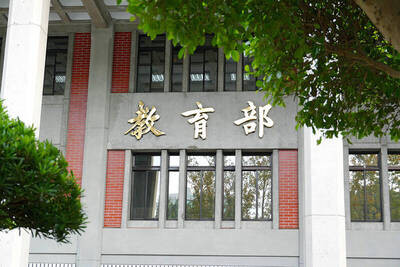
The Ministry of Education (MOE) is to launch a new program to encourage international students to stay in Taiwan and explore job opportunities here after graduation, Deputy Minister of Education Yeh Ping-cheng (葉丙成) said on Friday. The government would provide full scholarships for international students to further their studies for two years in Taiwan, so those who want to pursue a master’s degree can consider applying for the program, he said. The fields included are science, technology, engineering, mathematics, semiconductors and finance, Yeh added. The program, called “Intense 2+2,” would also assist international students who completed the two years of further studies in

Former president Tsai Ing-wen (蔡英文) departed for Europe on Friday night, with planned stops in Lithuania and Denmark. Tsai arrived at Taiwan Taoyuan International Airport on Friday night, but did not speak to reporters before departing. Tsai wrote on social media later that the purpose of the trip was to reaffirm the commitment of Taiwanese to working with democratic allies to promote regional security and stability, upholding freedom and democracy, and defending their homeland. She also expressed hope that through joint efforts, Taiwan and Europe would continue to be partners building up economic resilience on the global stage. The former president was to first
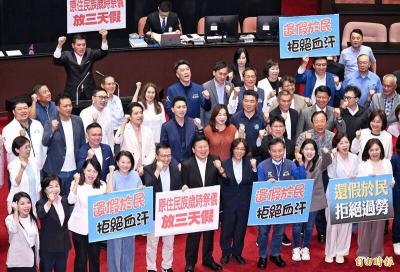
Taiwan will now have four additional national holidays after the Legislative Yuan passed an amendment today, which also made Labor Day a national holiday for all sectors. The Chinese Nationalist Party (KMT) and Taiwan People’s Party (TPP) used their majority in the Legislative Yuan to pass the amendment to the Act on Implementing Memorial Days and State Holidays (紀念日及節日實施辦法), which the parties jointly proposed, in its third and final reading today. The legislature passed the bill to amend the act, which is currently enforced administratively, raising it to the legal level. The new legislation recognizes Confucius’ birthday on Sept. 28, the

The Taipei District Court sentenced babysitters Liu Tsai-hsuan (劉彩萱) and Liu Jou-lin (劉若琳) to life and 18 years in prison respectively today for causing the death of a one-year-old boy in December 2023. The Taipei District Prosecutors’ Office said that Liu Tsai-hsuan was entrusted with the care of a one-year-old boy, nicknamed Kai Kai (剴剴), in August 2023 by the Child Welfare League Foundation. From Sept. 1 to Dec. 23 that year, she and her sister Liu Jou-lin allegedly committed acts of abuse against the boy, who was rushed to the hospital with severe injuries on Dec. 24, 2023, but did not


 RSS
RSS