


The pan-blue camp's lack of a clear discourse on cross-strait issues was highlighted during the recent uproar over the National Unification Council (NUC), local political observers said.
President Chen Shui-bian (
In reaction, the Chinese Nationalist Party (KMT) proposed a motion in the legislature to recall Chen, and the People First Party (PFP) proposed a motion to impeach the president.
Under current regulations, both motions need the approval of two-thirds of the legislature.
As the Democratic Progressive Party (DPP) holds more than one-third of the seats in the legislature, it is practically impossible for either motion to be passed.
Ku Chung-hwa (
"Both motions are merely symbolic, and the pan-blue camp knows it. There isn't much they can do with regard to this issue," Ku told the Taipei Times.
KMT Chairman Ma Ying-jeou (
Kao Yuang-kuang (
But the opposition should also take the opportunity to update its cross-strait discourse and to reflect the will of its "middle-course" stance, he said.
"Cross-strait relations are constantly changing and new interpretations are necessary. The so-called `1992 consensus,' for example, drew great controversy, and so it would be good for the pan-blues to come up with a new discourse," he said.
According to the KMT, the `1992 consensus' means that there is "one China, with each side having its own interpretation," but the government refuses to recognize the existence of such a "consensus," claiming that it never appeared in any official letters exchanged between China and Taiwan.
Ku said the issue of the NUC provided an opportunity for the pan-blue camp to redefine its cross-strait stance and policy.
"The pan-blue camp needs to answer a question: What does its unification discourse mean? Does it mean that Taiwan should unify China? Or that Taiwan is to be unified by China?" Ku said.
As the opposition leader, Ma's recent contradictory rhetoric -- from "unification with China is the ultimate goal of the KMT" to "independence is an option for Taiwan's future" to "Taiwan should maintain the status quo" -- probably best illustrates the party's need for a distinct cross-strait discourse to make clear what the KMT really stands for, Ku said.
"Ma stumbled over the NUC issue and made his party and other pan-blue allies look bad. He must develop clearer opinions on the party's stance on cross-strait relations if he is to continue as the opposition leader," Ku said.
Emile Sheng (
De jure independence would require amending the Statute Governing the Relations Between the People of the Taiwan Area and the Mainland Area (
With the opposition parties holding a majority in the legislature, Kao said it is unnecessary for them to enter into a debate over the issue of de facto independence with the president.
As to speculation that Chen's decision on the NUC was prompted by his desire to boost his own reputation and the strength of the DPP ahead of the year-end elections, critics said the public's disappointment with both parties made it hard to tell if either had benefited.

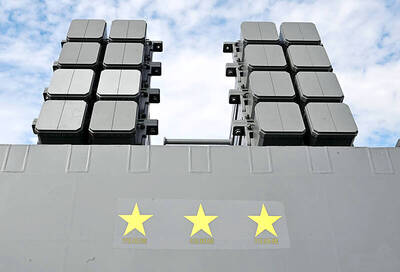
UPGRADE: The Kang Ding-class frigate is replacing its Chaparall missiles with Tien Chien II and Hua Yang VLS, which would provide it with long-range, 360° air defense Taiwan plans to produce 1,200 to 1,376 Hai Chien II missiles (海劍二, Sea Sword II) — also known as TC-2N — to serve as the standard air defense system of the navy’s surface combatant fleet, a source said yesterday. Last week, the Hai Chien II, the naval version of the Tien Kung II missile (天劍二, Sky Sword II), completed a live-fire test in waters off the National Chungshan Institute of Science and Technology’s Jiupeng facility (九鵬) in Pingtung County’s Manjhou Township (滿州). The MIM72 Chaparral and other dated air defense missiles that currently arm Taiwanese ships have inadequate range to combat Chinese

REASONS FOR TRAVEL: An assistant professor said that proposed amendments to penalize drivers if they used drugs overseas would not deter people from traveling People who operate a motor vehicle under the influence of marijuana would have their driver’s license revoked, even if they used the substance while overseas, the Ministry of Transportation and Communications said yesterday, citing proposed amendments to the Road Traffic Management and Penalty Act (道路交通管理處罰條例). The amendments would also authorize the government to revoke the licenses of people determined to have used Category 1 or Category 2 narcotics, even if they were not operating a vehicle while under the influence of drugs, as well as ban them from taking the license test for three years, the ministry said. People aged 18 or
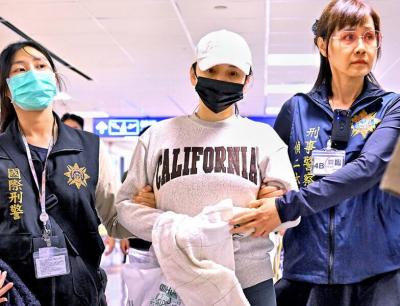
Johanne Liou (劉喬安), a Taiwanese woman who shot to unwanted fame during the Sunflower movement protests in 2014, returned to Taiwan last night after being deported from the US. She is to stand trial in Taiwan for charges involving embezzlement, fraud and drug crimes. The Criminal Investigation Bureau (CIB) said it took her into custody at Taiwan Taoyuan International Airport and would first question her before transferring her to the New Taipei District Prosecutors’ Office. She was arrested upon disembarking a flight from San Francisco that landed shortly before 7pm. Liou absconded to the US in 2019 after jumping bail
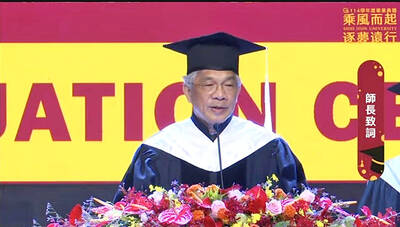
Shih Hsin University President Chen Ching-he (陳清河) yesterday issued a public apology for comments made in his commencement speech last week, stating that he has asked the school to suspend his duties and halt his wages for two months as a show of contrition. At the commencement ceremony on May 30, Chen said, “If you don’t manage your time well, or your own emotions, or your health, then I am telling every one of you — put a quick end to ‘you,’ because the world has no need for ‘you.’” The comments have sparked significant controversy online, and Chen through an open


 RSS
RSS