


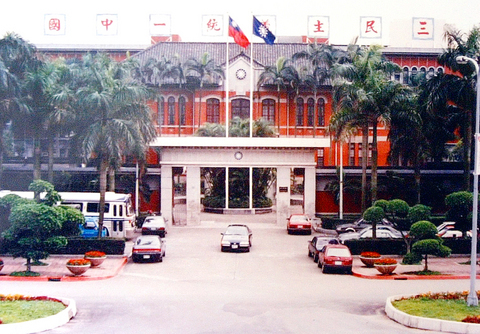
Chinese Nationalist Party (KMT) headquarters in Taipei has long faced the Presidential Office down Ketagelan Boulevard, as the party's spiritual fort.
But after more than five decades at its present site, the party is due to sell its ostentatious 12-story headquarters, valued at about NT$2 billion (US$62.4 million). In April, whether that building is sold or not, the party will move to a smaller headquarters on Bade Road. The downsizing comes as part of KMT Chairman Ma Ying-jeou's (
The current site, located in Taipei at the intersection of the Zhongshan S Road and Renai Road, belonged to a Japanese organization during Japan's 50-year colonization of Taiwan. In 1949, after Japan had ceded Taiwan at the end of World War II and the KMT government had arrived to take its place, the site became the party's headquarters. The KMT hasn't moved since.
TAIPEI TIMES FILE PHOTO
"The KMT bought the land from the National Property Bureau of the Finance Ministry with more than NT$300 million, and the first KMT central standing committee was held there in 1950," said the KMT's Organization and Development Committee head Liao Feng-teh (
The current 12-story building was built in 1995 with an exhibition room on the first floor, offices on the second to tenth floors, the chairman and vice chairmen's office on the 11th floor, and meeting and banquet rooms on the 12th floor.
The design of the building, Liao told the Taipei Times, was based on the concept of "democracy," incorporating modernity and a down-to-earth and expansive style.
Built with granite and shielded by a four-story tall arc wall, the headquarters look from above like the Chinese character da "
Rumor has it that the arc wall was designed in accordance with feng shui principles, but Lee denied that.
"We did discuss the use of feng shui in the design, but at the end feng shui did not determine the look of the building," he said.
The KMT finished the construction of the current headquarters under former president Lee Teng-hui (李登輝), who then also served as the party chairman.
During the 51 years when the party governed Taiwan, the headquarters once housed as many as 600 full-time party workers. After the KMT lost power to the Democratic Progressive Party (DPP) in 2000, the party began to downsize. There will only be 120 party workers left when the KMT moves to its new building on Bade Road.
In the 2004 presidential election, when former KMT chairman Lien Chan (連戰) and the People First Party Chairman James Soong (宋楚瑜) lost again to the DPP, pan-blue supporters held a protest along Ketagelan Boulevard, and the KMT headquarters turned into a place for protesters' to take shelter to sleep or bathe.
After Lien visited China last April, the KMT headquarters became a new attraction for Chinese tourists. According to the party, the exhibition room on the first floor and the party history room on the seventh floor are the two most visited spots in the building.
A NT$40 million maintenance fee per year for the headquarters, however, has become a heavy burden for the cash-strapped KMT. Furthermore, the luxurious building is not consistent with the clean, modest image that Ma is trying to create for the party.
Given those financial and symbolic concerns, the KMT decided to sell the building and move to a new location, despite opposition from many older party officials.
KMT Deputy Secretary-General Chang Che-chen (張哲琛) said that the new headquarters on Bade Road, whose maintenance fees are NT$8 million per year -- a fifth of the cost of the current site -- will ease the party's financial burdens. The party will use only the basement, first floor and third floor of the building.
"[The move] is our declaration to continue our reform efforts and fight against corruption," Chang said.
The KMT plans to sell its current headquarters to financial institutions, but it has also considered giving the building to a civic group. Whatever the building's fate, the KMT, yearning for a rebirth under Ma's leadership, is determined to leave the symbol of its corrupt past behind and "take the spirit with the KMT wherever the party moves," the chairman said.

UPGRADE: The Kang Ding-class frigate is replacing its Chaparall missiles with Tien Chien II and Hua Yang VLS, which would provide it with long-range, 360° air defense Taiwan plans to produce 1,200 to 1,376 Hai Chien II missiles (海劍二, Sea Sword II) — also known as TC-2N — to serve as the standard air defense system of the navy’s surface combatant fleet, a source said yesterday. Last week, the Hai Chien II, the naval version of the Tien Kung II missile (天劍二, Sky Sword II), completed a live-fire test in waters off the National Chungshan Institute of Science and Technology’s Jiupeng facility (九鵬) in Pingtung County’s Manjhou Township (滿州). The MIM72 Chaparral and other dated air defense missiles that currently arm Taiwanese ships have inadequate range to combat Chinese

REASONS FOR TRAVEL: An assistant professor said that proposed amendments to penalize drivers if they used drugs overseas would not deter people from traveling People who operate a motor vehicle under the influence of marijuana would have their driver’s license revoked, even if they used the substance while overseas, the Ministry of Transportation and Communications said yesterday, citing proposed amendments to the Road Traffic Management and Penalty Act (道路交通管理處罰條例). The amendments would also authorize the government to revoke the licenses of people determined to have used Category 1 or Category 2 narcotics, even if they were not operating a vehicle while under the influence of drugs, as well as ban them from taking the license test for three years, the ministry said. People aged 18 or
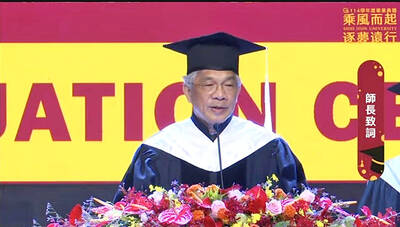
Shih Hsin University President Chen Ching-he (陳清河) yesterday issued a public apology for comments made in his commencement speech last week, stating that he has asked the school to suspend his duties and halt his wages for two months as a show of contrition. At the commencement ceremony on May 30, Chen said, “If you don’t manage your time well, or your own emotions, or your health, then I am telling every one of you — put a quick end to ‘you,’ because the world has no need for ‘you.’” The comments have sparked significant controversy online, and Chen through an open
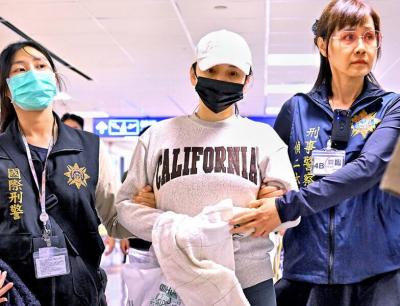
Johanne Liou (劉喬安), a Taiwanese woman who shot to unwanted fame during the Sunflower movement protests in 2014, returned to Taiwan last night after being deported from the US. She is to stand trial in Taiwan for charges involving embezzlement, fraud and drug crimes. The Criminal Investigation Bureau (CIB) said it took her into custody at Taiwan Taoyuan International Airport and would first question her before transferring her to the New Taipei District Prosecutors’ Office. She was arrested upon disembarking a flight from San Francisco that landed shortly before 7pm. Liou absconded to the US in 2019 after jumping bail


 RSS
RSS