


The stability of cross-strait relations is vital to Australia's strategic interests in Northeast Asia, where five of Australia's top 10 export markets are located in this region, Australia's top representative in Taiwan said.
In a recent interview with the Taipei Times, Steve Waters, director of the Australian Commerce and Industry Office (ACIO) in Taipei said last Monday that five of Australia's top 10 export markets, including Japan, China, Taiwan and Hong Kong, are located in close proximity to the Taiwan Strait, and therefore if anything goes wrong in the region, the Australian economy will be affected.
Along with the Korean Peninsula and the Middle East, Waters said the Taiwan Strait is also a recognized possible flashpoint in the world and therefore it affects the stability across the region.
"That's why we always tell the government here, as well as the government in Beijing, that we want to see continued stability in this region and we have total opposition to the use of any force in any way," Waters said.
Although Australia has built a reasonably sound relationship with China over the years in terms of growing economic relations and people-to-people contacts, there are still limitations in how close the bilateral relationship can be on the basis that there are differences in values, Waters said.
"Of course we have differences of views on a number of issues with China, in particular with questions of democracy and human rights ? and that have always affected the actual standing of our relationship," he said.
One such example Waters cited was Australia's resistance to China's pressure on allowing the performance by Taiwan's renowned Cloud Gate Dance Theater in the Sydney's Olympic Festival in 2000.
"We had to fight very hard for it to be in the Sydney Olympic Festival because Beijing disagreed. It was clear they [China] decided there was some sort of significance having the Taiwan culture as part of the Sydney festival. But we resisted that pressure," he said.
Currently Australia is Taiwan's seventh largest export market and Taiwan is Australia's 18th largest source of investment.
Discussing ways to improve Taiwan's investment environment, Waters said one necessary change is reducing bureaucratic red tape and loosening over-regulated financial restrictions.
He also urged greater Taiwanese investment in Australia, particularly in the energy sectors, amid the growing energy shortage in Taiwan in recent years and China's soaring energy demand.
He suggested the Taiwanese government to reconsider its energy procurement priorities by securing long-term supplies first, instead of focusing on prices.
"Traditionally, Taiwan has used the spot market to buy energy resources more than most other countries and the energy-purchase strategy has always been focused more on price rather than the supply," he said.
"Now with Taiwan running out of energy and the prices going very high, I think there is a need for its own resource security to perhaps reconsider the mix in this [price versus supply]," Waters said.
"It's particularly an important time when Beijing is expanding its economy and sucking up all the energy resources," he said.
Waters, 54, began his post as the Australian representative last July. He was the deputy head of the ACIO in Taiwan from 1993 to 1996 and has also served in Vanuatu and Hong Kong.
Now well into his second stint at the ACIO, Waters' relations with Taiwan date back to when he was a university student and came here in 1972 to study Mandarin Chinese at the National Normal Taiwan University.
Over the years of living in Taiwan, Waters said his favorite experiences have been the food and amiable people that have made Taiwan his favorite destinations among all his diplomatic postings.
"This is my third time here. The first time I came as a student in 1972. I wouldn't have come back three times unless I like the place," he said.
"Taipei is a great eating city, one of the best in the world. The quality of the ingredients and the varieties of regional Chinese cuisines make Taipei a great eating city, even better than China's," he said.
"The second reason [I like Taiwan] is I like the people here. I've made good friends here. Very loyal, reliable friends. As a diplomat, I meet many people. But you don't stay in touch with them all the time. But I found the quality of staying in touch with the Taiwanese people very reliable," he said.
Waters lives in Taipei with his Taiwanese partner and two black Labrador dogs he acquired here 10 years ago.
For the Lunar New Year holiday, Waters said he will celebrate at the family gathering of his partner's family in Hualien.
"For all the Chinese festivals, including Lunar New Year, Dragon Boast festival, or Mid-Autumn festival, we all go to Hualien. It's a nice drive down there. And the city has very good fresh seafood," he said.
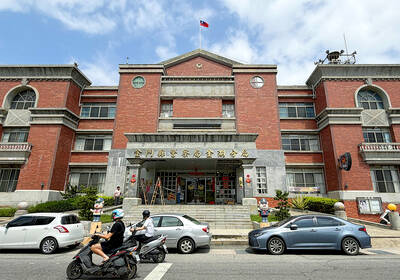
NATIONAL SECURITY: Authorities are working to confirm the identities of the military personnel involved and investigating possible illegal conduct and regulatory violations Authorities are probing possible national security implications after Kinmen police and immigration officers on Sunday found a Chinese woman allegedly posing as a tourist while engaging in prostitution involving more than 10 military personnel. The woman, surnamed Chen (陳), has since been deported, authorities said, adding that investigators are still working to confirm the identities of those implicated, as the records only listed code names and aliases. The case stemmed from a report received by the Kinmen District Prosecutors’ Office on Friday last week from the Jinhu Precinct of the Kinmen County Police Bureau. On Sunday, police, along with the National Immigration
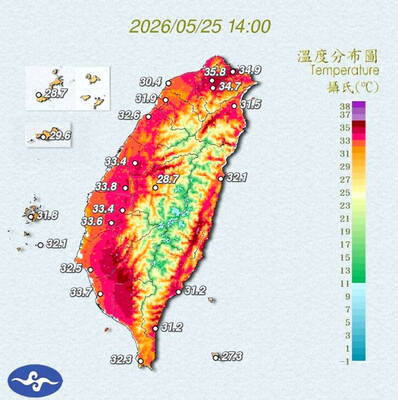
STAY COOL: The HPA recommended that people stay hydrated, use air-conditioning or fans while indoors, wear loose-fitting clothes and walk in the shade while outdoors Employers must implement measures such as installing cooling equipment, and providing drinking water and rest breaks for outdoor workers starting from Monday next week, the Taipei Department of Labor said on Sunday. Employers who fail to comply could face fines of NT$30,000 to NT$300,000 under the Occupational Safety and Health Act (職業安全衛生法), the department said. Businesses in Taipei employing fewer than 100 workers, as well as registered self-employed workers with labor insurance coverage, could receive on-site assessments and guidance from occupational safety consultants to help them apply for central government subsidies to implement or improve heat-protection measures, it said. Under the Ministry of

GLOBALGIVING: ‘ Caving to external pressure is not acceptable for an organization that has cultivated justice reform and human rights for 30 years,’ one NGO said A slew of non-government organizations (NGOs) have withdrawn from the GlobalGiving fundraising platform after it announced it would use “Chinese Taipei” instead of “Taiwan” from next month. The Taiwan Good Rice Association wrote on Facebook on Friday that it was informed on April 28 via a teleconference call of the change, which was made because the platform wanted to operate in China. Taiwan Good Rice is to terminate all cooperative relationships with GlobalGiving in response to the platform’s “unilateral and non-negotiable” decision to remove references to Taiwan, the NGO said. “Taiwan is in the official name of Taiwan Good Rice Association and the

Chinese Nationalist Party (KMT) Chairwoman Cheng Li-wun (鄭麗文) yesterday briefed her party’s Central Standing Committee regarding her scheduled visit to the US between Monday next week and June 16, saying that her purpose would be to persuade the US that the Republic of China (ROC) Constitution was a “one China” constitution that would foster stable and peaceful cross-strait relations. The ROC Constitution is the most important defense for all Taiwanese citizens, as it upholds our democracy and has contributed to our robust economy, which aligns with international and US interests, she said. “We would not be troublemakers and drag the US under,”


 RSS
RSS