


A top Mainland Affairs Council (MAC) official said yesterday that there will be no major change in cross-strait policies, clarifying President Chen Shui-bian's (
Council Vice Chairman You Ying-lung (游盈隆) made the remarks during a forum while responding to opposition politicians' interpretation that the elections showed that most people want the government to review its cross-strait policies.
"The municipal elections were not a referendum on cross-strait policies but just local elections. These two things should be clearly separated, not lumped together," the council official said.
You said the government will continue to pursue negotiations with China on improving cross-strait exchanges such as passengers and cargo charter flights and the opening of Taiwan to tourists from China.
Before the election Chen said that as a KMT victory would spur passage of the "cross-strait peace advancement bill" -- a bill to legalize the "one China" principle -- he would have to tighten cross-strait policies to defend Taiwan's sovereignty.
"The government will not take the initiative to tighten cross-strait policies unless the Chinese government makes a move which is against the interests of the Taiwanese people," You said.
"What the president meant was that China should not enact another `Anti-Secession' Law as it did following the opposition's victory in last year's legislative election," he said.
The passage of China's Anti-Secession Law, which authorizes Beijing authorities to use force to stop any attempt by Taiwan to formally secede from China, prompted the government to slow down reviewing the restrictions on cross-strait exchanges.
Several politicians at the forum, however, said that the government should review its cross-strait policies after the election.
Lee Shang-ren (
"The current issues the government is focused on, mainly economic and social exchanges, are not enough. As the country's sovereignty might be weakened with the broadening of the scope of cross-strait exchanges, political issues should be dealt with at the same time," Lee said.
"The government also needs to make efforts to seek a consensus with opposition parties about the political issues. Despite the difficulty, the most important thing is for all parties to reach a common position on the country's sovereignty," he said.
Cheng An-kuo (鄭安國), now a senior staffer of KMT Chairman Ma Ying-jiou (馬英九), echoed Lee's suggestion.
"The KMT's victory showed that most people have lost their interest in and belief in the DPP's old campaign strategy -- to libel the opposition as China's fellow travelers," Cheng said.
The KMT staffer suggested that the government should listen to the people and reach a compromise with the opposition to seriously review outdated cross-strait policies.


An essay competition jointly organized by a local writing society and a publisher affiliated with the Chinese Communist Party (CCP) might have contravened the Act Governing Relations Between the People of the Taiwan Area and the Mainland Area (臺灣地區與大陸地區人民關係條例), the Mainland Affairs Council (MAC) said on Thursday. “In this case, the partner organization is clearly an agency under the CCP’s Fujian Provincial Committee,” MAC Deputy Minister and spokesperson Liang Wen-chieh (梁文傑) said at a news briefing in Taipei. “It also involves bringing Taiwanese students to China with all-expenses-paid arrangements to attend award ceremonies and camps,” Liang said. Those two “characteristics” are typically sufficient
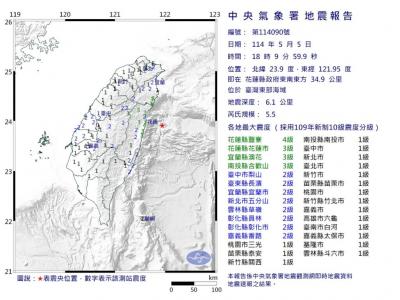
A magnitude 5.9 earthquake that struck about 33km off the coast of Hualien City was the "main shock" in a series of quakes in the area, with aftershocks expected over the next three days, the Central Weather Administration (CWA) said yesterday. Prior to the magnitude 5.9 quake shaking most of Taiwan at 6:53pm yesterday, six other earthquakes stronger than a magnitude of 4, starting with a magnitude 5.5 quake at 6:09pm, occurred in the area. CWA Seismological Center Director Wu Chien-fu (吳健富) confirmed that the quakes were all part of the same series and that the magnitude 5.5 temblor was
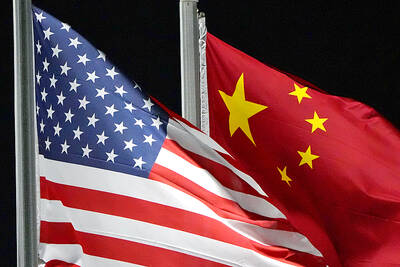
The brilliant blue waters, thick foliage and bucolic atmosphere on this seemingly idyllic archipelago deep in the Pacific Ocean belie the key role it now plays in a titanic geopolitical struggle. Palau is again on the front line as China, and the US and its allies prepare their forces in an intensifying contest for control over the Asia-Pacific region. The democratic nation of just 17,000 people hosts US-controlled airstrips and soon-to-be-completed radar installations that the US military describes as “critical” to monitoring vast swathes of water and airspace. It is also a key piece of the second island chain, a string of
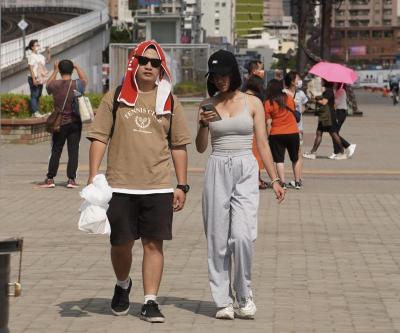
The Central Weather Administration has issued a heat alert for southeastern Taiwan, warning of temperatures as high as 36°C today, while alerting some coastal areas of strong winds later in the day. Kaohsiung’s Neimen District (內門) and Pingtung County’s Neipu Township (內埔) are under an orange heat alert, which warns of temperatures as high as 36°C for three consecutive days, the CWA said, citing southwest winds. The heat would also extend to Tainan’s Nansi (楠西) and Yujing (玉井) districts, as well as Pingtung’s Gaoshu (高樹), Yanpu (鹽埔) and Majia (瑪家) townships, it said, forecasting highs of up to 36°C in those areas


 RSS
RSS